Key Highlights
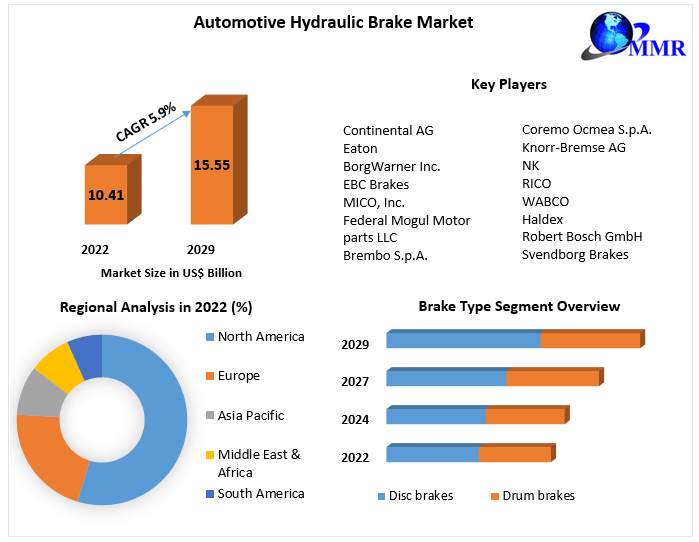
- The Automotive Hydraulic Brake Market is expected to reach USD 15.55 billion by 2029 from USD 10.41 billion in 2022.
- The market is forecast to grow at a CAGR of 5.9% during 2023–2029.
- Disc brakes remain the leading brake type due to superior stopping performance and enhanced safety.
- Passenger cars account for the largest share of hydraulic brake installations.
- OEM sales channels dominate the market with approximately 75% market share.
- Asia Pacific leads global demand through expanding vehicle manufacturing and rising automotive investments.
Why This Matters Now
Vehicle safety has become one of the automotive industry’s highest priorities. Governments continue to strengthen braking regulations while consumers increasingly expect higher levels of safety, reliability, and driving comfort. Hydraulic braking systems remain essential across conventional vehicles, supporting stable braking performance while enabling manufacturers to meet evolving safety standards in both developed and emerging automotive markets.
Market Overview
The Automotive Hydraulic Brake Market covers braking systems that use hydraulic pressure to transfer force from the brake pedal to the wheel brakes. The technology remains one of the most reliable braking solutions across passenger cars, commercial vehicles, and two-wheelers due to its consistent braking force, durability, and safety performance.
Growing vehicle production worldwide continues to support demand for hydraulic brake systems. Increasing sales of passenger vehicles, commercial fleets, and utility vehicles directly increase installation volumes for brake calipers, master cylinders, brake pads, brake fluids, and associated components.
Government regulations requiring enhanced vehicle safety features, including independent parking brake systems, continue to encourage manufacturers to invest in advanced hydraulic braking technologies. At the same time, automotive manufacturers are expanding investments in braking innovations that improve driver comfort, vehicle stability, and braking precision.
While rising raw material prices increase production costs, manufacturers continue to prioritize hydraulic braking technologies because of their proven reliability and broad compatibility across multiple vehicle platforms.
Key Trends Driving Growth
Vehicle safety regulations remain the strongest driver of hydraulic brake adoption. Governments continue to mandate advanced braking systems that improve vehicle control and reduce accident risks across passenger and commercial transportation.
Disc brake adoption continues to accelerate as automakers replace conventional drum brakes with higher-performance braking systems capable of delivering greater stopping power and improved heat dissipation.
Manufacturers are introducing hydraulic braking systems featuring extended pipe configurations that improve installation flexibility and overall braking performance.
Strategic investments and acquisitions are reshaping the competitive landscape. Automotive suppliers continue expanding engineering capabilities to strengthen their positions in high-growth vehicle markets.
Although electric braking technologies are gradually entering the market, hydraulic braking systems continue to dominate current vehicle production because of their mature technology, cost efficiency, and established manufacturing infrastructure.
Explore detailed analysis, insights, and growth opportunities
Segment Insights
Dominant Segment – Disc Brakes
Disc brakes account for the largest share of the Automotive Hydraulic Brake Market.
Their superior braking efficiency, improved heat dissipation, and enhanced stopping performance make them the preferred choice across passenger cars, sports vehicles, and premium automotive platforms.
Unlike conventional drum brakes, disc brakes minimize brake fade under demanding operating conditions while delivering consistent braking performance. Growing regulatory emphasis on vehicle safety continues to strengthen demand for disc brake installations worldwide.
The widespread adoption of disc braking systems directly benefits component manufacturers specializing in brake calipers, brake pads, and advanced braking assemblies.
Fastest-Growing Segment – Passenger Cars
Passenger cars remain the fastest-growing vehicle segment due to increasing disposable income, expanding urbanization, and rising global vehicle ownership.
Automotive manufacturers continue to increase production capacity to satisfy growing consumer demand while integrating advanced safety technologies into new vehicle models.
The continued recovery of passenger vehicle production following pandemic-related disruptions further supports long-term hydraulic brake demand across original equipment manufacturers.
Additional Segment Insights
The OEM segment dominates the market, accounting for approximately 75% of total demand. Vehicle manufacturers increasingly integrate advanced hydraulic braking systems during production to comply with safety regulations and improve vehicle performance.
Commercial vehicles continue generating stable demand as freight transportation, logistics, and construction activities expand globally.
Brake calipers, master cylinders, brake fluids, brake lines, and brake pads remain essential components supporting ongoing replacement demand and aftermarket servicing activities.
Regional Growth Story
Asia Pacific leads the Automotive Hydraulic Brake Market through its large-scale automotive manufacturing base, expanding domestic vehicle demand, and growing investments from global automotive suppliers. China remains the region’s largest manufacturing hub, while India and Japan continue expanding production and export capabilities.
Europe remains a major center for braking technology innovation. Germany dominates regional manufacturing due to its advanced automotive industry, while the United Kingdom continues strengthening production through investments by established brake manufacturers.
North America maintains strong market demand driven by high passenger vehicle ownership, premium vehicle sales, and growing awareness of advanced vehicle safety systems. Continued investments by leading automakers support long-term demand for hydraulic braking technologies.
South America and the Middle East & Africa continue experiencing gradual market expansion as vehicle production, infrastructure development, and commercial transportation activities increase.
Competitive Landscape
The Automotive Hydraulic Brake Market is highly competitive, with established global manufacturers focusing on product quality, engineering innovation, and strategic collaborations to strengthen their market positions.
Industry participants continue expanding manufacturing capacity while investing in advanced braking technologies that improve vehicle safety and operational performance. Mergers and acquisitions remain important growth strategies as companies seek access to new regional markets and engineering capabilities.
Continental’s acquisition of a 50% stake in RICO reflects increasing investment in hydraulic braking technologies, particularly to strengthen its presence in the rapidly growing Asia Pacific automotive market. Companies capable of integrating advanced braking technologies with cost-efficient manufacturing are expected to strengthen their competitive position as vehicle production continues to expand.
Major market participants include Continental AG, Eaton, BorgWarner Inc., EBC Brakes, MICO Inc., Federal Mogul Motorparts LLC, Brembo S.p.A., Coremo Ocmea S.p.A., Knorr-Bremse AG, NK, RICO, WABCO, Haldex, Robert Bosch GmbH, and Svendborg Brakes.
Recent Developments
- Continental acquired a 50% stake in RICO to strengthen its hydraulic braking business and expand its presence in the Indian automotive market.
- Manufacturers continue investing in advanced hydraulic brake technologies with extended pipe system designs.
- OEMs are increasing adoption of high-performance disc braking systems across passenger and commercial vehicle platforms.
- Leading suppliers are strengthening production capabilities through strategic investments and regional expansion initiatives.
- Companies continue optimizing supply chains and manufacturing operations following pandemic-related disruptions.
Future Outlook
Manufacturers that combine advanced hydraulic braking technology with cost-efficient production and strong OEM partnerships will be best positioned to capture growing demand despite the gradual emergence of alternative braking technologies.
Analyst Perspective-Dharti Raut
The Automotive Hydraulic Brake Market remains a core segment of the global automotive industry, supported by the continued dominance of hydraulic braking systems across passenger and commercial vehicles. While new braking technologies are emerging, hydraulic brakes continue to offer a proven combination of reliability, cost efficiency, and consistent performance, making them the preferred choice for high-volume vehicle production. Demand will remain closely linked to global vehicle manufacturing trends and increasingly stringent safety regulations.
About Maximize Market Research
Maximize Market Research Pvt. Ltd. (MMR) is a global market research and consulting company that provides reliable, data-focused, and practical business insights. The firm serves a wide range of industries, including healthcare, pharmaceuticals, technology, automotive, electronics, chemicals, personal carec, and consumer goods. Through market forecasts, competitive analysis, strategic consulting, and industry impact assessments, MMR helps organizations understand changing market conditions, identify growth opportunities, and make informed business decisions for long-term success.
Contact Us :
2nd Floor, Navale IT Park Phase 3
Pune Banglore Highway, Narhe
Pune, Maharashtra 411041, India
+91 9607365656
sales@maximizemarketresearch.com
