Key Highlights
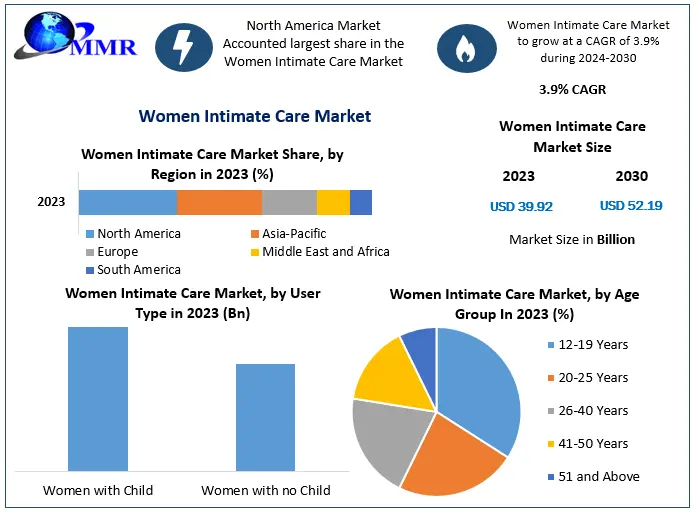
- The Women Intimate Care Market is expected to reach USD 52.19 Bn by 2030 at a 3.9% CAGR, keeping feminine hygiene products on the strategic agenda for FMCG and personal-care brands.
- Market size stood at USD 39.92 Bn in 2023, creating a sizable base for product expansion across hygiene, personal care and retail channels.
- Intimate wash is the dominant product segment disclosed by the report, driven by high demand and convenience.
- Offline distribution is expected to register the highest market growth because of purchase convenience, discounts and offers.
- North America held the highest share in 2023, while Asia Pacific is expected to register noteworthy growth through affordable products in developing economies.
Why This Matters Now
The Women Intimate Care Market care is moving from a private-use category to a mainstream retail and health-awareness market. Brands that fail to build trust, access and education will lose to competitors that normalize the category across pharmacies, supermarkets and digital platforms.
The category’s growth is not only a sales story. It shows how hygiene campaigns, workplace awareness, e-commerce availability and product penetration in developing economies are reshaping personal-care consumption.
Market Overview
Women’s intimate care products are used regularly to maintain and sanitize intimate areas. The category includes moisturizers and creams, intimate wash, hair removal products, oils, liners, powder and mousse, mists and sprays, and other products.
The market is segmented by product, age group, user type, distribution channel and region. Age groups include 12–19 years, 20–25 years, 26–40 years, 41–50 years, and 51 and above, giving brands a lifecycle-based product-development route.
The report does not disclose clean-label demand, sustainability initiatives, pricing trends or detailed e-commerce penetration figures. It does confirm that products are available on e-commerce platforms and in local markets, which makes distribution breadth a core growth lever.
Key Trends Driving Growth
Health and hygiene awareness is the main demand driver. MMR identifies increasing hygiene and health concerns among young females as a key factor supporting market growth, which makes education-led brand building important.
Workplace and school campaigns are expanding category visibility. Awareness programs around women’s hygiene and health are increasing demand, especially among working females, shifting intimate care from low-discussion usage to planned personal-care purchasing.
E-commerce is improving access. The report links rising product availability on online platforms and online shopping inclination to demand growth, helped by offers that attract consumers. This benefits brands that can combine privacy, product information and discounts in digital retail.
R&D and marketing campaigns are also lifting demand. Major producers are investing in product development and awareness, while government initiatives are spreading consciousness about hygiene and intimate care products.
The main restraint is low awareness in underdeveloped and developing countries. That creates a market-access gap: demand potential exists, but category education and affordability must improve before usage broadens.
Request a Market Research Sample Before Making Decisions
Segment Insights
- Dominant Segment Intimate Wash: Intimate wash is expected to hold market share because of high global demand and convenience. The page does not disclose the numeric share, so no figure should be stated.
- Fastest-Growing Segment Offline Distribution Channel: Offline distribution is expected to register the highest market growth, supported by purchase convenience and discounts or offers that influence consumers.
- Product Scope: The report covers intimate wash, liners, oils, masks, moisturizers and creams, hair removal products, powder, wipes, gels, foams, exfoliants, mousse, mists, sprays and e-products.
- User Scope: Women with child and women with no child are included. The public page does not disclose user-type market shares.
- Distribution Scope: Online retailers, company-owned platforms, hypermarkets and supermarkets, pharmacies, beauty salons, departmental stores and specialty stores are covered.
Regional Growth Story
North America held the highest share in 2023. The region benefits from easy product availability and high popularity of liners, hair removal products, moisturizers and creams, and intimate wash.
Europe also accounts for a large share and is expected to continue its dominance with North America during the forecast period. For global brands, this means mature regions remain important for portfolio depth and premium positioning.
Asia Pacific is expected to register noteworthy growth because of reasonable intimate care products in developing economies. That points to a value-access opportunity, especially where affordability and awareness can unlock first-time users.
The report covers the United States, Canada, Mexico, the UK, France, Germany, Italy, Spain, Sweden, Austria, China, South Korea, Japan, India and other countries. Country-level market values are not disclosed on the public page.
Competitive Landscape
The market includes Glenmark Pharmaceuticals, Procter & Gamble, Inlife Pharma, Kao, Johnson & Johnson, Zeta Farmaceutici, Edgewell Personal Care, Nölken Hygiene Products, Unilever, Boots, Himalaya, Unicharm, Kimberly-Clark, Elif Cosmetics, Ciaga, Emilia Personal Care, Nua Woman, TZMO SA and Bodywiseuk.
The public page does not disclose dated mergers, acquisitions, partnerships or divestitures. It states that the report evaluates key players by type, price, financial position, product portfolio, growth strategies and regional presence, but transaction-level facts are not visible.
The visible competitive signal is education-led expansion. Companies that invest in R&D, marketing campaigns, local availability and channel trust will be better placed over the next 12–24 months than brands relying only on shelf presence.
Recent Developments
- Awareness Campaigns: Campaigns in workplaces, schools and other locations are increasing demand for women’s hygiene and intimate care products, especially among working females.
- Digital Availability: Product availability on e-commerce platforms and online offers are supporting demand, making privacy-led digital discovery important.
- Producer Activity: R&D activities and marketing campaigns by major producers are helping spread category awareness and support product penetration.
Strategic Implications
For FMCG leaders, intimate care requires trust-first marketing. The category sits close to health and personal confidence, so unclear claims or weak education can slow adoption.
For retailers, offline remains powerful. The expected high growth in offline distribution shows that pharmacies, supermarkets and beauty salons still influence purchase decisions, even as e-commerce improves privacy and access.
For investors, developing economies offer upside but also execution risk. Low awareness can slow adoption, so brands need patient category-building rather than only aggressive product launches.
Future Outlook
The Women Intimate Care Market is forecast to reach USD 52.19 Bn by 2030 at a 3.9% CAGR. Growth will come from hygiene awareness, product penetration, workplace and school campaigns, e-commerce availability, offline retail offers, R&D and marketing investment.
Winners will educate consumers and build trusted access across offline and online channels; losers will remain exposed to low awareness, weak privacy positioning and poor regional affordability.
Analyst Perspective
“Women’s intimate care is becoming a mainstream personal-care category as health awareness, product access and consumer education improve,” said Siddhi Dole, Analyst at Maximize Market Research. “The strongest brands will combine trusted formulations, discreet distribution, offline reach and clear hygiene communication.”
About Maximize Market Research
Maximize Market Research Pvt. Ltd. (MMR) is a global market research and consulting company that provides reliable, data-focused, and practical business insights. The firm serves a wide range of industries, including healthcare, pharmaceuticals, technology, automotive, electronics, chemicals, personal care, and consumer goods. Through market forecasts, competitive analysis, strategic consulting, and industry impact assessments, MMR helps organizations understand changing market conditions, identify growth opportunities, and make informed business decisions for long-term success.
Contact Us
2nd Floor, Navale IT Park Phase 3
Pune Banglore Highway, Narhe
Pune, Maharashtra 411041, India
+91 9607365656
sales@maximizemarketresearch.com
