Key Highlights
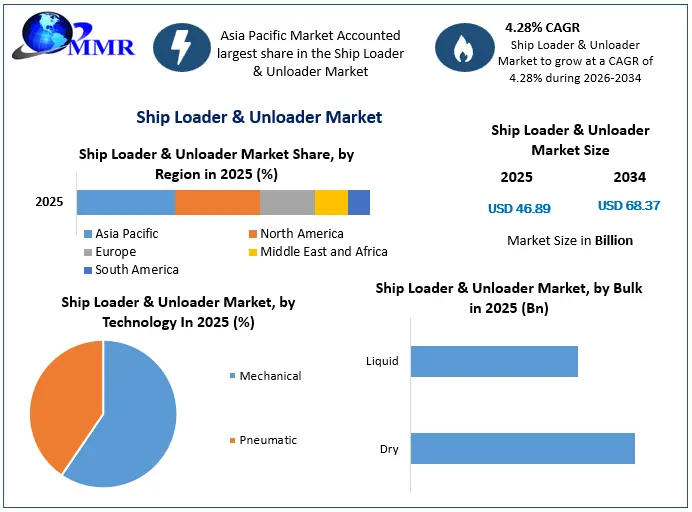
- Ship Loader & Unloader Market valued at USD 46.89 billion in 2025.
- Market projected to reach USD 68.37 billion by 2034.
- CAGR estimated at 4.28% during 2026–2034.
- Asia Pacific remains the largest regional market.
- Stationary systems account for more than 70% of market revenue.
- Mining is the leading application segment.
- Automation, sustainability, and higher cargo throughput are reshaping equipment investments.
- Manufacturers are focusing on energy-efficient, high-capacity, and low-maintenance systems.
Why This Matters Now
Global ports are under pressure to move higher cargo volumes while reducing vessel turnaround time and operating costs. Governments continue investing in maritime infrastructure to support international trade and supply chain resilience. At the same time, mining exports and bulk commodity shipments are increasing demand for faster, cleaner, and automated loading systems. These factors are shifting purchasing decisions toward technologically advanced ship loaders and unloaders capable of improving operational efficiency and environmental performance.
Market Overview
Ship loaders and unloaders Market are specialized material handling systems designed to transfer bulk commodities between vessels, storage facilities, railways, and trucks. They are widely deployed across ports, mining operations, manufacturing plants, and cargo terminals handling coal, iron ore, fertilizers, grains, cement, and other bulk materials.
Demand is primarily driven by expanding global trade, modernization of port infrastructure, and rising investment in cargo handling efficiency. Ports increasingly require equipment capable of handling larger vessel capacities while minimizing loading delays and maintenance downtime.
Supply-side competition is centered on technological innovation. Equipment manufacturers are integrating automation, digital monitoring, predictive maintenance, and energy-efficient designs to improve productivity and reduce operating costs.
Macroeconomic factors including industrial expansion, mining output, infrastructure spending, and international commodity trade continue to influence equipment procurement across developed and emerging markets.
Key Trends Driving Growth
Automation is becoming a standard feature in modern cargo handling systems. Intelligent control systems, remote operation, and real-time monitoring reduce labor dependency while improving safety and equipment utilization. Port operators benefit from lower operational costs and greater cargo throughput.
Environmental compliance is increasingly influencing equipment design. Manufacturers are introducing enclosed handling systems, dust suppression technologies, and energy-efficient mechanical solutions to help ports meet stricter environmental regulations while reducing emissions.
Sustainability initiatives are encouraging greater adoption of renewable energy within manufacturing operations and environmentally responsible production processes. These improvements strengthen supplier competitiveness, particularly in government-funded infrastructure projects.
Global trade expansion continues to support demand for larger and more efficient cargo handling equipment. Growth in containerized and bulk commodity transportation is creating long-term investment opportunities across port modernization projects worldwide.
Mining remains a major contributor to equipment demand as producers expand export capacity for minerals and energy commodities. High-capacity unloading systems capable of handling continuous operations provide measurable productivity improvements across mining supply chains.
Explore detailed analysis, insights, and growth opportunities
Segment Insights
Dominant Segment: Stationary
Stationary ship loaders and unloaders accounted for over 70% of market revenue in 2025. Their fixed installation delivers superior structural stability, allowing continuous handling of heavy bulk materials under demanding operating conditions.
The segment remains preferred for high-volume ports where consistent cargo movement justifies long-term infrastructure investment. Greater durability, lower maintenance requirements, and higher operational reliability improve lifecycle economics for terminal operators.
Business impact extends beyond equipment sales. Fixed systems enable ports to increase annual cargo throughput while lowering operational interruptions, strengthening competitiveness in global shipping networks.
Fastest-Growing Segment: Mining Application
Mining represents the largest and fastest-growing application segment as producers expand export infrastructure for coal, iron ore, limestone, and other bulk commodities.
Mining companies increasingly invest in pneumatic unloading systems and automated handling equipment to reduce dust emissions, improve worker safety, and accelerate loading cycles. These operational improvements reduce logistics costs while supporting environmental compliance.
The combination of expanding mineral exports and automation investment positions mining as a major revenue generator for equipment manufacturers.
Additional Key Sub-Segments
Mechanical technology continues to dominate due to proven reliability, high throughput, and suitability for continuous bulk handling applications.
Pneumatic systems are gaining importance where dust control and environmental performance are priorities. These systems improve workplace safety while supporting stricter emission standards adopted by modern ports.
Sea ports and cargo terminals remain important demand centers as governments upgrade maritime infrastructure to accommodate larger vessels and increasing international trade volumes.
Mobile ship loaders provide operational flexibility for smaller terminals and temporary cargo handling requirements. Although their market share remains lower than stationary systems, mobility creates value for facilities requiring adaptable logistics operations.
Regional Growth Story
Asia Pacific leads the global Ship Loader & Unloader Market through extensive port expansion, growing manufacturing activity, and rising international trade. China, India, Japan, and South Korea continue investing in larger terminals, automated logistics systems, and bulk commodity export capacity. Rapid industrialization and infrastructure development strengthen the region’s long-term competitive position.
Europe maintains strong demand through modernization of established ports and adoption of environmentally efficient cargo handling technologies. Regional manufacturers continue supplying advanced equipment for both domestic and export markets, reinforcing Europe’s position as a technology leader.
North America benefits from replacement demand, mining activity, and modernization of existing marine terminals. Investments focus on improving operational efficiency, digital integration, and reducing maintenance costs rather than large-scale capacity expansion.
Middle East, Africa, and South America present emerging growth opportunities driven by commodity exports, mining investments, and government-backed port development projects. As these regions expand maritime infrastructure, demand for reliable high-capacity loading systems is expected to increase.
Competitive Landscape
The market remains moderately consolidated, with established engineering companies competing through technological innovation, customized solutions, and long-term service capabilities.
European manufacturers continue to hold strong competitive positions through advanced engineering expertise and integrated automation technologies. Companies such as Thyssenkrupp AG, BRUKS Siwertell Group, Tenova TAKRAF GmbH, Telestack Ltd., FLSmidth & Co. A/S, Siemens AG, Liebherr-International AG, and Sandvik AB maintain competitive advantage by delivering specialized solutions for mining and port operators.
Asian manufacturers strengthen their presence by supporting large-scale regional infrastructure projects and leveraging domestic manufacturing capabilities. ZPMC and Sumitomo Heavy Industries Material Handling Systems continue expanding their influence across rapidly growing Asian port developments.
North American participants including Superior Industries, Astec Industries, EMS-Tech, and Terex Corporation remain competitive through engineering expertise, customized bulk handling solutions, and established customer relationships across industrial sectors.
Recent product innovation, sustainability initiatives, and regional expansion strategies indicate competition is shifting from equipment pricing toward lifecycle performance, digital capabilities, and environmental compliance.
Recent Developments
- May 2026: BRUKS Siwertell received the JCE Sustainability & Innovation Award for its Siwertell Edge ship unloader.
- May 2026: The company reported that renewable energy accounted for 59% of its global operations in its 2025 Sustainability Report.
- April 2026: BRUKS Siwertell was recognized as Bulk Handling Equipment Provider of the Year 2026 in Sweden.
- March 2026: The company secured its first Malaysian rail-travelling high-capacity ship unloader contract with Westports Malaysia.
- March 2026: BRUKS Siwertell signed an agreement to deliver a road-mobile Siwertell 10 000 S NGv2 ship unloader to Albania.
- February 2026: The company launched the NGV2 next-generation road-mobile ship unloader featuring an upgraded control system and improved operational performance.
Future Outlook
Companies that combine automation, sustainability, and high-capacity cargo handling solutions with expanding presence in Asia-Pacific and mining-driven export markets will capture the greatest competitive advantage as global port modernization accelerates.
Analyst View – Dharti Raut
The Ship Loader & Unloader Market is entering a phase of operational modernization rather than rapid expansion. A projected CAGR of 4.28% through 2034 reflects steady capital investment by ports, mining companies, and bulk cargo operators seeking higher throughput, lower operating costs, and improved environmental performance.
About Maximize Market Research
Maximize Market Research Pvt. Ltd. (MMR) is a global market research and consulting company that provides reliable, data-focused, and practical business insights. The firm serves a wide range of industries, including healthcare, pharmaceuticals, technology, automotive, electronics, chemicals, personal carec, and consumer goods. Through market forecasts, competitive analysis, strategic consulting, and industry impact assessments, MMR helps organizations understand changing market conditions, identify growth opportunities, and make informed business decisions for long-term success.
Contact Us :
2nd Floor, Navale IT Park Phase 3
Pune Banglore Highway, Narhe
Pune, Maharashtra 411041, India
+91 9607365656
sales@maximizemarketresearch.com
