Key Highlights
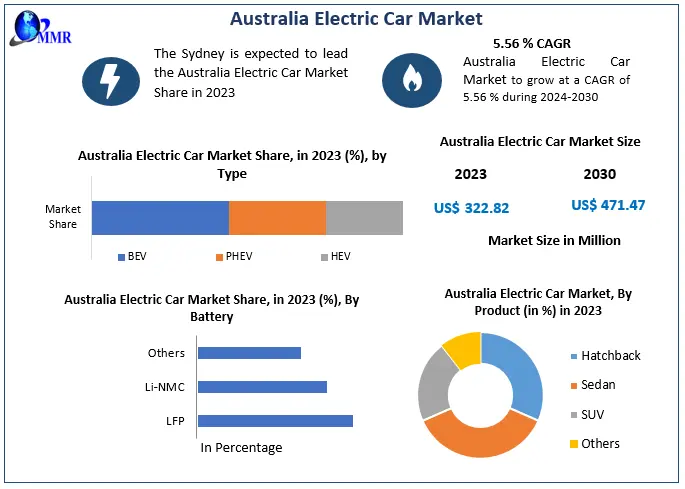
- Market valued at USD 322.82 million in 2023.
- Expected to reach USD 471.47 million by 2030.
- Forecast CAGR of 5.56%.
- Battery Electric Vehicles (BEVs) dominate the market.
- Plug-in Hybrid Electric Vehicles (PHEVs) represent the fastest-growing segment.
- Sydney remains Australia’s leading EV market.
- Government incentives continue supporting adoption.
- Charging infrastructure expansion improves consumer confidence.
Why This Matters Now
Australia’s transition toward low-emission mobility is gaining momentum as governments expand financial incentives, charging infrastructure improves, and fuel prices remain elevated. Automakers are introducing broader EV portfolios while consumers increasingly prioritize lower operating costs and environmental performance. These developments are reshaping investment priorities across automotive retail, charging infrastructure, battery supply chains, and clean transportation services.
Market Overview
The Australia Electric Car Market comprises battery electric vehicles (BEVs), plug-in hybrid electric vehicles (PHEVs), and hybrid electric vehicles (HEVs) designed to reduce dependence on fossil fuels and lower greenhouse gas emissions.
Market growth is supported by rising environmental awareness, improving battery technology, declining battery costs, and expanding availability of electric vehicle models from global manufacturers. Increasing fuel prices further strengthen the economic case for electric mobility by reducing long-term operating expenses.
Supply continues to improve as leading automakers expand EV offerings tailored to Australian consumers. Simultaneously, investments in public charging infrastructure reduce one of the market’s largest adoption barriers by improving charging accessibility across metropolitan areas and highway corridors.
Macroeconomic factors including decarbonization policies, energy transition strategies, urbanization, and infrastructure investment continue to influence long-term market development. However, high purchase prices and uneven charging infrastructure remain key constraints to faster adoption.
Key Trends Driving Growth
Government policy is becoming a major catalyst for EV adoption. State-level incentive programs, purchase rebates, stamp duty exemptions, and infrastructure investments are lowering ownership costs while encouraging consumers to transition from internal combustion vehicles.
Charging infrastructure expansion is reducing range anxiety. Public and private operators continue installing fast-charging stations across urban centers and major transport corridors, improving convenience for both private and commercial EV users.
Battery technology continues advancing through higher energy density, improved charging performance, and declining production costs. These improvements increase vehicle range while making electric vehicles more competitive with conventional alternatives.
Consumers are increasingly selecting zero-emission vehicles as sustainability becomes a larger purchasing consideration. Growing public awareness of climate change and stricter emissions targets are supporting long-term EV demand.
Global automotive manufacturers continue expanding Australian EV model availability. Increased product diversity across hatchbacks, sedans, SUVs, and premium vehicles broadens consumer choice and supports wider market penetration.
Explore detailed analysis, insights, and growth opportunities
Segment Insights
Dominant Segment: Battery Electric Vehicles (BEVs)
Battery Electric Vehicles accounted for the largest share of the Australian market in 2023 due to their zero-emission operation and increasing consumer acceptance.
Government incentives, improving charging infrastructure, and advances in battery technology continue strengthening BEV demand. Lower maintenance costs and reduced fuel expenditure enhance total cost of ownership, making BEVs increasingly attractive for urban consumers.
For manufacturers, expanding BEV sales creates opportunities to strengthen market share as Australia gradually shifts toward fully electrified transportation.
Fastest-Growing Segment: Plug-in Hybrid Electric Vehicles (PHEVs)
PHEVs represent the fastest-growing segment by combining electric driving capability with conventional internal combustion engines.
This dual-powertrain approach addresses consumer concerns regarding charging availability and long-distance travel while allowing drivers to benefit from electric operation during daily commuting.
The segment serves as an important transition technology, particularly in regions where charging infrastructure remains under development.
Additional Key Sub-Segments
Hybrid Electric Vehicles continue attracting consumers seeking improved fuel efficiency without relying on external charging infrastructure. They remain an attractive option for buyers entering the electrification journey.
SUVs continue gaining popularity as manufacturers introduce electric models that combine higher driving range, larger battery capacity, and practical family transportation.
Lithium Nickel Manganese Cobalt (Li-NMC) batteries remain widely used due to their balance of energy density and driving range, while Lithium Iron Phosphate (LFP) batteries gain market attention through lower production costs and improved safety characteristics.
Personal users remain the largest end-user segment as private vehicle ownership continues driving EV adoption across metropolitan regions.
Regional Growth Story
Sydney remains Australia’s largest electric vehicle market due to extensive charging infrastructure, higher consumer awareness, and supportive state government incentives. Strong urban density also supports faster deployment of charging stations and EV retail networks.
Melbourne continues expanding EV adoption through growing public charging infrastructure and increasing availability of electric vehicle models across multiple price segments.
Brisbane benefits from infrastructure investment and rising consumer interest in sustainable transportation, strengthening Queensland’s position within Australia’s evolving EV ecosystem.
Other Australian states are gradually increasing charging station deployment, although inconsistent policy support and infrastructure availability continue creating regional differences in adoption rates. Continued investment outside major metropolitan areas will be critical for achieving broader national EV penetration.
Competitive Landscape
The Australia Electric Car Market remains highly competitive, with global automotive manufacturers competing through product innovation, battery performance, charging capabilities, pricing strategies, and dealer network expansion.
Tesla continues to maintain a strong competitive position through its established brand, advanced battery technology, and integrated charging ecosystem. Nissan, Hyundai, Kia, BMW, Mercedes-Benz, Volkswagen, Audi, Porsche, Volvo, Mitsubishi, Ford, Chevrolet, Renault, Jaguar, Rivian, and Lucid Motors continue expanding their Australian EV portfolios across multiple vehicle categories.
Competition is increasingly shifting toward battery efficiency, driving range, charging speed, software capabilities, and after-sales support rather than vehicle performance alone. Manufacturers introducing affordable electric vehicles alongside expanding charging partnerships are expected to strengthen long-term market positioning.
Recent Developments
- Australian state governments expanded EV purchase incentives and stamp duty exemptions to encourage electric vehicle adoption.
- Charging network providers accelerated deployment of fast-charging stations across metropolitan areas and national highways.
- Global automakers increased the availability of new battery electric and plug-in hybrid models for Australian consumers.
- Industry stakeholders continued investing in charging infrastructure expansion to reduce range anxiety and improve nationwide EV accessibility.
Future Outlook
Manufacturers and infrastructure providers that combine affordable electric vehicle offerings with nationwide fast-charging networks and strong government partnerships will secure the greatest competitive advantage as Australia’s transition to electric mobility accelerates.
Analyst Perspective – Dharti Raut
The Australia Electric Car Market is transitioning from an early-adoption phase to a more structured growth cycle, supported by improving policy frameworks, expanding charging infrastructure, and increasing consumer acceptance of electric mobility. Although electric vehicles currently represent a relatively small share of Australia’s overall vehicle fleet, the market is steadily building the conditions required for broader adoption.
About Maximize Market Research
Maximize Market Research Pvt. Ltd. (MMR) is a global market research and consulting company that provides reliable, data-focused, and practical business insights. The firm serves a wide range of industries, including healthcare, pharmaceuticals, technology, automotive, electronics, chemicals, personal carec, and consumer goods. Through market forecasts, competitive analysis, strategic consulting, and industry impact assessments, MMR helps organizations understand changing market conditions, identify growth opportunities, and make informed business decisions for long-term success.
Contact Us :
2nd Floor, Navale IT Park Phase 3
Pune Banglore Highway, Narhe
Pune, Maharashtra 411041, India
+91 9607365656
sales@maximizemarketresearch.com
