Key Highlights
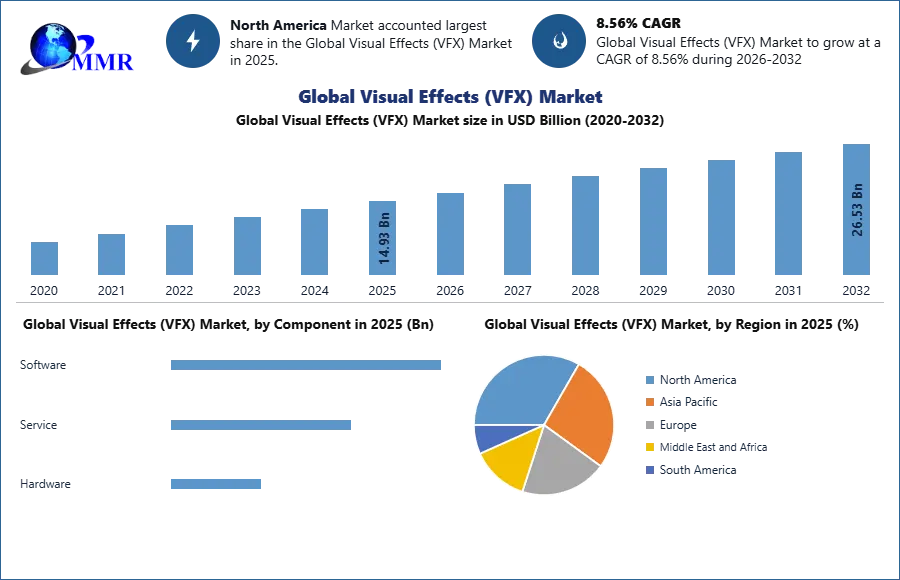
- The Visual Effects (VFX) Market was valued at USD 14.93 billion in 2025, showing that visual content has become a strategic production asset for film, television, streaming, gaming and advertising.
- The market is expected to reach nearly USD 26.53 billion by 2032, expanding opportunities for studios, cloud rendering providers, software vendors, gaming companies and virtual production specialists.
- The market is projected to grow at a CAGR of 8.56% from 2026 to 2032, indicating continued demand for high-quality digital content and more efficient production workflows.
- The simulation FX segment held the largest market share in 2025, supported by demand for realistic effects in film, television and gaming.
- The television segment is expected to grow rapidly as streaming platforms increase original content production.
- North America held the largest market share in 2025, supported by established film studios, streaming companies, gaming developers and VFX technology providers.
- Asia Pacific is expected to grow rapidly as animation, gaming, streaming and digital media production expand.
Why This Matters Now
The content industry is moving from linear production to software-defined production. Studios, streaming platforms and game publishers are using AI, cloud rendering and virtual production to create more visual content while managing cost, speed and creative complexity.
The Visual Effects (VFX) Market Size was valued at USD 14.93 billion in 2025. That value shows that VFX has become a core part of modern content economics rather than a specialized post-production function. The market is expected to reach nearly USD 26.53 billion by 2032, creating wider demand for VFX studios, real-time graphics platforms, cloud infrastructure providers and digital content software companies.
The market is expected to grow at a CAGR of 8.56% from 2026 to 2032. This growth rate points to sustained investment in high-quality visual storytelling across streaming, cinema, television, gaming, advertising and immersive media. The business question is no longer whether companies need VFX. It is how they can deliver it faster, securely and at scale.
Market Overview
Visual effects combine digital tools, computer-generated imagery, animation, simulation and compositing to create scenes that cannot be captured through conventional filming. VFX is used in movies, television shows, advertisements, video games, music videos and other digital media formats.
The market includes simulation FX, animation, modeling, compositing and other VFX services. These services support content producers that need realistic environments, characters, explosions, weather effects, digital doubles and complex visual scenes. The expanding use of digital storytelling is increasing the importance of VFX across entertainment and commercial media.
The report identifies rising demand for high-quality visual content as a key market driver. Streaming platforms, film studios and gaming companies need distinctive content to attract and retain audiences. This makes visual production quality a competitive tool in crowded media markets.
The growth of online video platforms is also changing demand patterns. Content is now produced for global audiences across multiple screens, languages and formats. This increases the need for scalable VFX workflows that can support fast release cycles and large content libraries.
Key Trends Driving Growth
Artificial intelligence is changing VFX workflows. AI-assisted tools can support rotoscoping, motion tracking, image enhancement, character animation and scene generation. These tools can reduce repetitive production work and allow artists to focus more on creative direction and complex visual tasks.
Machine learning is also improving production efficiency. VFX teams can use automated systems to manage large volumes of footage, detect visual inconsistencies and improve rendering workflows. The business impact is faster turnaround time and better resource allocation across complex projects.
Virtual production is becoming a major technology trend. It combines real-time graphics, LED screens, game engines and digital environments to create visual scenes during filming. This can reduce the need for location shoots and post-production revisions while giving directors more control over visual outcomes.
Cloud rendering is expanding the capacity of VFX studios. Rendering requires significant computing power, especially for high-resolution content and complex simulations. Cloud infrastructure allows studios to access computing resources when needed rather than maintaining large fixed hardware environments. This supports flexible production capacity but also increases demand for secure data management.
Real-time rendering is gaining importance in gaming, virtual production and immersive content. Game engines allow creators to preview scenes, lighting and environments quickly. This reduces production delays and can improve collaboration between directors, artists, editors and technical teams.
Digital transformation is also changing how VFX teams collaborate. Global production pipelines now connect artists, studios and clients across regions. Cloud-based collaboration platforms allow teams to share assets, review scenes and manage production schedules. However, these systems require strong cybersecurity because unreleased content and intellectual property are valuable targets.
Cybersecurity is becoming a strategic requirement for VFX studios. Content leaks, ransomware attacks and unauthorized access can disrupt production and damage commercial value. Studios need secure cloud environments, access controls, encryption and backup systems to protect creative assets and production data.
Segment Insights
- Dominant Segment: Simulation FX — The simulation FX segment held the largest market share in 2025. Its leadership shows continued demand for realistic visual effects such as fire, water, smoke, destruction and environmental scenes in film, television and gaming.
- Fastest-Growing Segment: Television — The television segment is expected to grow rapidly during the forecast period. Streaming services and broadcasters are increasing demand for premium series, episodic content and visual storytelling.
- Technology Opportunity: AI-Assisted VFX — AI tools can improve production speed by automating repetitive tasks such as tracking, masking, cleanup and image enhancement.
- Infrastructure Opportunity: Cloud Rendering — Cloud rendering gives studios access to scalable computing power for large projects and high-resolution content.
- Production Opportunity: Virtual Production — Virtual production can improve creative control and reduce the cost and complexity of physical location shoots.
Regional Growth Story
North America held the largest share of the Visual Effects Market in 2025. The region benefits from major film studios, streaming companies, gaming developers, advertising agencies and technology providers. The United States remains central to the market because of its strong entertainment ecosystem and large demand for premium digital content.
Hollywood continues to influence global VFX demand, but the market is expanding beyond traditional film production. Streaming platforms are increasing investment in original series, documentaries, animation and franchise content. This creates demand for VFX services across a wider range of budgets and production formats.
Canada also plays an important role in North American VFX production because of its established studio ecosystem and talent base. The report includes North America in its regional coverage but does not provide country-level market values or rankings.
Europe remains a major VFX market due to film production, television content, gaming and advertising. The United Kingdom, Germany and France are important production centers with strong creative industries and technical talent. European studios are also adopting cloud workflows and real-time production tools to compete for global projects.
Asia Pacific is expected to grow rapidly during the forecast period. China, India, Japan and South Korea are expanding their roles in animation, gaming, streaming and digital entertainment. Rising internet access, mobile video consumption and investment in local content are increasing demand for visual effects services.
India is an important opportunity because of its large film industry, growing streaming market and expanding digital production talent. Japan and South Korea are also key markets due to gaming, animation, visual storytelling and technology adoption. China’s large digital media ecosystem supports demand for high-volume content production and visual effects services.
The regional opportunity will depend on talent availability, cloud infrastructure, production incentives and access to advanced software tools. Markets that combine creative talent with scalable digital infrastructure will be better positioned to attract international VFX projects.
Competitive Landscape
The market includes VFX studios, animation companies, software vendors, cloud providers, game engine developers and post-production specialists. Competition depends on creative quality, technical capability, production capacity, project delivery speed and access to skilled artists.
The competitive landscape is shifting toward technology-enabled production platforms. Studios that combine creative talent with AI tools, cloud rendering and real-time production capabilities can improve efficiency and manage larger project volumes. This can strengthen their ability to win contracts from streaming platforms, film studios and gaming companies.
Software vendors are becoming more influential because VFX workflows increasingly depend on integrated production tools. Companies that provide modeling, compositing, simulation, rendering and collaboration software can become central to studio operations. This creates platform economics where workflow integration and ecosystem compatibility matter as much as individual software features.
Cloud providers also have a growing role. VFX production requires significant computing capacity, storage and data transfer. Providers that can offer secure, scalable and cost-effective infrastructure can become strategic partners for studios moving toward cloud-based production.
The market is also seeing pressure on pricing and delivery timelines. Streaming platforms need more content, but production budgets remain closely managed. VFX studios must balance quality with efficiency. AI and automation can improve margins, but companies still need skilled artists to manage creative direction and complex visual work.
Recent Developments
- The report identifies rising demand for high-quality visual content across film, television, gaming and advertising as a key market driver.
- AI and machine learning tools are improving VFX workflows through automation, image enhancement and production efficiency.
- Virtual production and real-time rendering are changing how studios create digital environments and manage filming.
- Cloud rendering is expanding access to scalable computing resources for high-resolution content and complex visual effects.
- Cybersecurity is becoming more important as VFX studios use cloud collaboration platforms and manage valuable intellectual property.
Strategic Implications
For CIOs and CTOs in media companies, VFX technology is becoming part of the broader digital production strategy. Cloud infrastructure, AI tools, asset management systems and secure collaboration platforms must work together to support creative teams without slowing production.
For studios, the opportunity lies in building flexible production pipelines. Companies that can move work between artists, locations and cloud systems can respond faster to project demand. This flexibility can become a competitive advantage in a market where streaming platforms expect rapid delivery.
For cloud providers and software vendors, the market creates opportunities in rendering infrastructure, workflow automation, storage, security and real-time production tools. VFX studios need technology that reduces technical complexity while protecting content assets.
For investors, the market offers exposure to streaming growth, gaming, digital media, AI software and cloud computing. Companies with recurring software revenue, scalable infrastructure and strong production ecosystems may be better positioned to benefit from the next phase of content creation.
Future Outlook
The Visual Effects Market is moving toward AI-assisted, cloud-based and real-time production ecosystems. VFX will increasingly connect creative talent with scalable computing, virtual production tools and secure global collaboration networks.
Future content leaders will use AI and real-time production to turn creative ideas into global digital experiences at speed, while laggards will be constrained by fragmented workflows, limited compute capacity and slow production cycles.
Analyst Perspective
“Visual effects are becoming more technology-intensive as AI, cloud rendering and virtual production reshape how content is created. Studios that combine creative talent with scalable digital workflows will be better positioned to serve the growing demand for premium entertainment and immersive media,” said Yash Ghosalkar, Analyst.
About Maximize Market Research
Maximize Market Research Pvt. Ltd. (MMR) is a global market research and consulting company that provides reliable, data-focused, and practical business insights. The firm serves a wide range of industries, including healthcare, pharmaceuticals, technology, automotive, electronics, chemicals, personal care, and consumer goods. Through market forecasts, competitive analysis, strategic consulting, and industry impact assessments, MMR helps organizations understand changing market conditions, identify growth opportunities, and make informed business decisions for long-term success.
2nd Floor, Navale IT Park Phase 3
Pune Banglore Highway, Narhe
Pune, Maharashtra 411041, India
+91 9607365656
sales@maximizemarketresearch.com
