Key Highlights
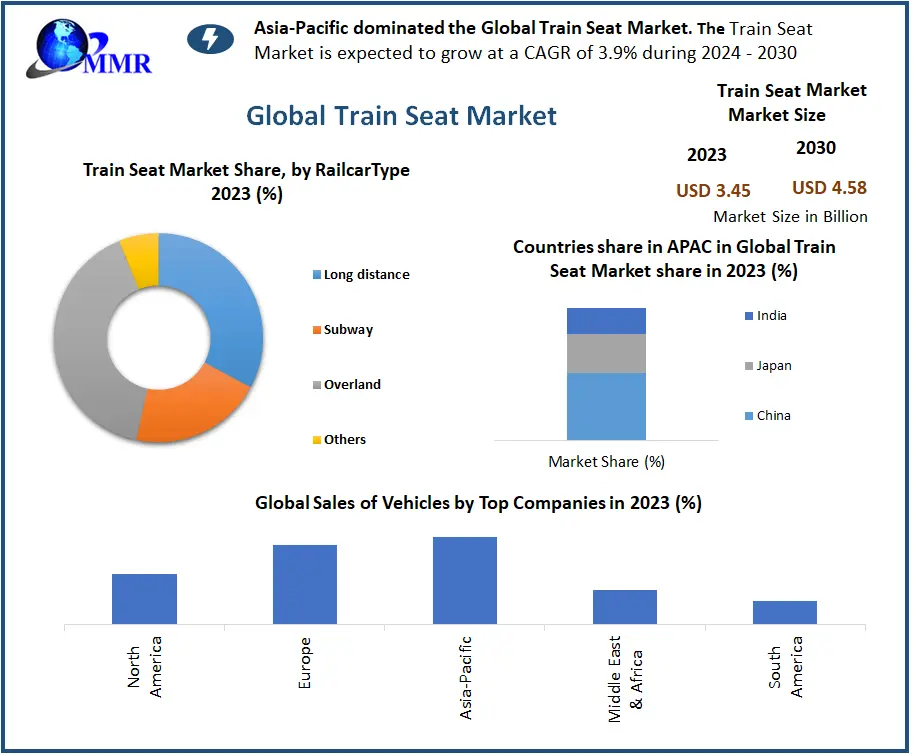
- The global Train Seat Market was valued at USD 3.45 Billion in 2023.
- Market revenue is projected to reach USD 4.58 Billion by 2030, expanding at a CAGR of 3.9%.
- Asia Pacific accounted for the largest market share in 2023 due to railway infrastructure investments in China and India.
- Regular seats dominated the market with a 51.03% share in 2023 due to cost efficiency and high passenger capacity advantages.
- High-speed trains remained the leading train type segment as governments prioritize faster and sustainable transportation networks.
- Manufacturers are investing in lightweight materials, recyclable fabrics, and advanced passenger comfort technologies.
Why This Matters Now
Rail transportation is undergoing a major transformation as governments focus on reducing road congestion, lowering carbon emissions, and improving urban mobility. Rising urban populations are increasing pressure on existing transport systems, creating demand for high-capacity railway networks.
The expansion of high-speed rail projects is directly influencing demand for advanced train seating solutions. Rail operators are prioritizing passenger comfort, safety, durability, and energy efficiency, encouraging manufacturers to develop upgraded seating systems with improved ergonomics and sustainable materials.
Market Overview
The Train Seat Market includes passenger seating systems installed across high-speed trains, passenger trains, light trains, trams, subways, and monorails. These seats are designed with features such as reclining mechanisms, armrests, tray tables, folding systems, and smart passenger features to enhance travel experience.
The market was valued at USD 3.45 Billion in 2023 and is expected to reach USD 4.58 Billion by 2030. Growth is supported by increasing railway investments, urbanization, and expansion of intercity transportation networks.
Governments across major economies are allocating significant budgets toward railway modernization. China’s continued expansion of its high-speed rail network under long-term railway development plans is creating strong demand for train components, including seating systems.
Supply-side growth is influenced by manufacturers focusing on lightweight designs, improved durability, and environmentally responsible materials. However, high production costs and capital-intensive railway projects remain challenges for market expansion.
Key Trends Driving Growth
Advanced Seating Technologies Improve Passenger Experience
Rail operators are increasingly adopting seats with improved ergonomic designs, adjustable reclining systems, and passenger-focused features. Smart seating technologies are gaining attention as operators seek to differentiate premium travel services.
Sustainability Shapes Railway Interior Design
Environmental regulations are encouraging manufacturers to use recyclable and low-impact materials. Companies are developing sustainable fabrics and lightweight components to reduce overall train weight and improve energy efficiency.
The adoption of eco-friendly materials is becoming a competitive factor among seating manufacturers as railway operators target lower environmental impact.
High-Speed Rail Investments Increase Demand
High-speed rail expansion remains a major market driver. These projects require specialized seating solutions designed for longer journeys, higher speeds, and enhanced passenger comfort.
Countries investing in new rail corridors are creating opportunities for global seating suppliers and component manufacturers.
Raw Material and Manufacturing Challenges
Fluctuations in material costs, including metals, textiles, and composite materials, influence production expenses. Manufacturers are focusing on efficient supply chains and material optimization to maintain profitability.
Explore detailed analysis, insights, and growth opportunities
Segment Insights
Regular Seat Segment Dominates Market Demand
Based on seat type, the Regular Seat segment held the largest market share of 51.03% in 2023. The segment is expected to maintain its position through 2030, growing at a CAGR of 3.9%.
Regular seats dominate because they provide a balance between affordability, passenger capacity, and operational efficiency. Local and regional trains prioritize maximizing passenger volume, making cost-effective seating systems essential.
Rail operators in developing economies continue to prefer regular seating configurations due to high passenger demand and budget limitations.
High-Speed Train Segment Leads Train Type Category
The High-Speed Train segment accounted for the largest market share in 2023 and is expected to maintain dominance through 2030.
Increasing demand for faster intercity transportation is supporting high-speed rail development worldwide. These trains require advanced seating systems that deliver comfort during longer journeys while meeting safety and durability standards.
Growth in high-speed rail projects creates opportunities for premium seat manufacturers offering advanced designs and customized solutions.
Recliner and Smart Seat Solutions Gain Importance
Premium seating categories, including recliner seats and smart seats, are gaining attention as railway operators focus on improving passenger experience.
Business-class and long-distance train services are increasingly adopting enhanced seating features to compete with alternative transportation modes such as air travel.
Regional Growth Story
Asia Pacific Leads Global Demand
Asia Pacific dominated the Train Seat Market in 2023 with a 42.03% market share and is expected to maintain its leadership position through 2030.
China and India are driving regional growth through large-scale railway infrastructure investments. China’s high-speed rail expansion continues to generate demand for railway components, while India’s metro and rail modernization projects are creating new opportunities for domestic and international suppliers.
The region benefits from high population density, increasing urban mobility requirements, and government-supported railway development programs.
Europe Focuses on Sustainable Rail Expansion
Europe is expected to grow at a CAGR of 3.8% during the forecast period. The region is emphasizing sustainable transportation systems and passenger-focused rail solutions.
Rail initiatives supported by European Union funding are encouraging railway development and increasing demand for environmentally friendly seating materials.
Manufacturers operating in Europe are focusing on recyclable fabrics, lightweight structures, and premium passenger comfort solutions.
North America Invests in Railway Modernization
North America is witnessing steady growth as governments invest in improving passenger rail networks. High-speed rail projects connecting major population centers are expected to support future seating demand.
Infrastructure modernization programs are creating opportunities for seating suppliers with advanced manufacturing capabilities.
Competitive Landscape
The Train Seat Market is characterized by established manufacturers competing through product innovation, sustainability initiatives, and strategic partnerships.
Companies such as Grammer AG, Seats Incorporated, Saira Seats, Harita Seating System Ltd., Kiel Group, Camira Fabrics, and Juyi Seating are strengthening their market positions through product development and sustainable solutions.
Leading players are investing in research and development to create lightweight, durable, and passenger-focused seating systems. Sustainability has become a major competitive factor, with manufacturers introducing recycled and environmentally friendly materials.
The market structure favors established suppliers with strong manufacturing capabilities and railway industry partnerships, creating barriers for new entrants.
Recent Developments
- China’s National Development and Reform Commission announced plans in November 2020 to invest approximately USD 12.6 Billion in high-speed rail projects, supporting demand for railway components.
- Camira Fabrics introduced sustainable fabric solutions using recycled plastic collected from oceans, supporting eco-friendly railway interiors.
- Chile’s railway modernization initiative, valued at USD 5 Billion, aims to expand railway infrastructure and increase passenger transportation capacity, creating future demand for rail components.
Future Outlook
The Train Seat Market will favor manufacturers that combine sustainable materials, advanced passenger comfort technologies, and scalable production capabilities as global rail networks accelerate modernization.
Analyst Opinion: Dharti Raut
The Train Seat Market is positioned for steady expansion as railway operators worldwide prioritize passenger experience, sustainability, and transportation efficiency. Analysts expect demand to remain strong due to increasing investments in high-speed rail networks, metro systems, and railway modernization projects, particularly across Asia Pacific and Europe.
About Maximize Market Research
Maximize Market Research Pvt. Ltd. (MMR) is a global market research and consulting company that provides reliable, data-focused, and practical business insights. The firm serves a wide range of industries, including healthcare, pharmaceuticals, technology, automotive, electronics, chemicals, personal carec, and consumer goods. Through market forecasts, competitive analysis, strategic consulting, and industry impact assessments, MMR helps organizations understand changing market conditions, identify growth opportunities, and make informed business decisions for long-term success.
Contact Us :
2nd Floor, Navale IT Park Phase 3
Pune Banglore Highway, Narhe
Pune, Maharashtra 411041, India
+91 9607365656
sales@maximizemarketresearch.com
