SKey Highlights
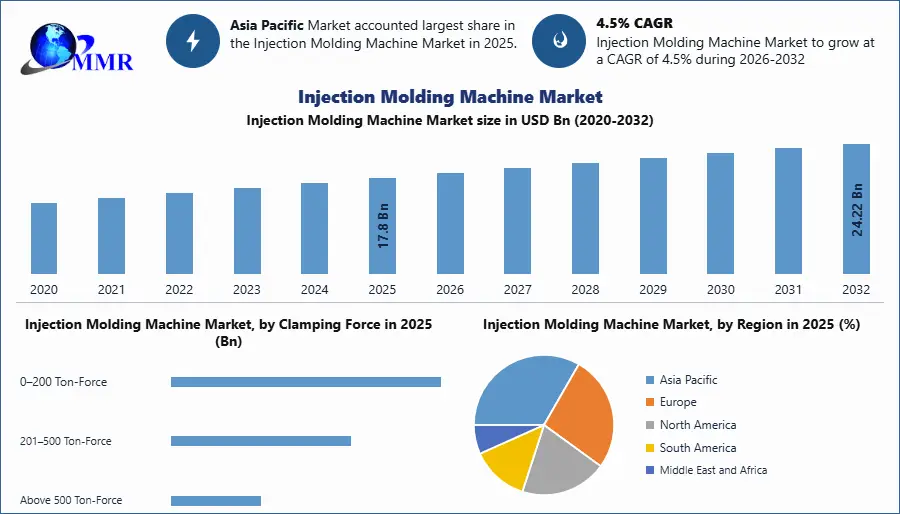
The global market reached USD 17.8 Billion in 2025 and is tracking toward USD 24.78 Billion by 2032 under a 4.5% CAGR.
High-strength automotive parts production remains the single largest application segment globally.
All-electric machinery represents the fastest-growing technology sector due to localized efficiency requirements.
Asia Pacific maintains geographic supremacy, accelerated by massive manufacturing clusters in India, China, and Southeast Asia.
Production demands are pivoting toward lightweight, highly complex geometries for electronics and vehicle architectures.
Why This Matters Now
Industrial procurement models face immediate disruption as volatile energy costs force a structural migration away from legacy hydraulic systems. Chemical processors and plastic molders cannot maintain margin baselines without addressing the energy consumption of floor machinery. Regulatory compliance deadlines regarding energy management have made the transition to advanced machinery a operational necessity rather than a capital expense preference.
Industrial buyers face high baseline machinery costs combined with rising demands for product structural integrity. Equipment deployed today must handle complex, lightweight components without multiplying cycle times or reject rates. This technological bottleneck separates highly agile, high-margin contract manufacturers from operations reliant on depreciating, inefficient infrastructure.
Market Overview
The global Injection Molding Machine Market Size operates as a core foundational pillar for structural polymer conversion. The industry achieved a valuation of USD 17.8 Billion in 2025 and is projected to expand at a CAGR of 4.5% between 2026 and 2032. This trajectory will push total sector revenue to nearly USD 24.78 Billion by the end of the forecast cycle.
The underlying engineering consists of an integrated injection unit paired with a dedicated clamping unit. These heavy assets convert plastic, rubber, metal, powder, liquid, and ceramic feedstocks into precise commercial components. Modern industrial capacity utilization depends heavily on optimizing these dual-stage mechanical processes to lower unit manufacturing costs.
Key Trends Driving Growth
Accelerating adoption of energy-efficient machinery stands as the primary structural catalyst across global factory floors. Rising utility rates and corporate emission mandates force processing facilities to evaluate the total power draw of active systems. This shift directly influences purchasing cycles, moving capital expenditure allocations toward technologies that minimize idle energy loss.
Simultaneously, downstream consumption profiles dictate rapid changes in machine capability requirements. The automotive and electronics sectors demand lightweight, geometrically complex components that traditional machinery cannot consistently produce. This dynamic forces manufacturers to integrate advanced hybrid systems and all-electric configurations to achieve necessary precision thresholds.
Segment Insights
Automotive (Dominant Segment): Emerges as the leading application channel, utilizing high-clamping-force machinery to produce complex structural assemblies. This segment drives capital deployment for manufacturing gearboxes, engines, turbochargers, steering systems, and interior or exterior trims requiring exceptional structural integrity.
All-Electric Injection Molding Machine (Fastest-Growing Segment): Secures the highest growth acceleration rate across the technology sector. Accelerated deployment across the electronics, high-volume packaging, and medical healthcare industries drives this segment as operations target reduced processing costs.
Feedstock Formats: Market segments track across distinct chemical and material typologies including thermoplastics, thermosets, rubber, metal, powder, liquid, and ceramics.
Clamping Force Classifications: Operational deployment splits into specific force bands including 0–200 Ton-Force, 201–500 Ton-Force, and high-capacity units tracking Above 500 Ton-Force.
Regional Growth Story
The Asia Pacific region commands the leading position within the global manufacturing footprint. Rapid infrastructure expansion combined with sustained industrialization across key developing economies maintains high demand for new machinery installations. Mass production ecosystems across India, Indonesia, Thailand, and Vietnam act as core regional volume drivers.
Western manufacturing hubs focus their capital cycles heavily on technology upgrades. Facilities within Germany and the United States prioritize automated, low-emission machinery to counter high localized labor and energy inputs. This regional differentiation creates a multi-tiered demand structure, balancing high-volume asset additions in Asia with high-value technical retrofits in Western Europe and North America.
Competitive Landscape
The global marketplace exhibits intense corporate competition among a highly diversified cadre of machinery producers. Established multinational entities compete directly with agile regional players focusing on bespoke component customization and advanced software integration. Profitability within this space depends on sustaining heavy capital allocations toward research and development.
Corporate strategies focus on improving machine efficiency, reducing baseline power requirements, and embedding factory automation protocols. Market participants utilize targeted joint ventures and collaborative technical partnerships to pool engineering resources. These structural alliances allow firms to distribute the high costs of developing next-generation high-tonnage machinery platforms.
Recent Developments
Strategic mergers and acquisitions are being executed by top-tier suppliers to consolidate technical intellectual property and expand regional distribution networks.
Machinery builders are increasing capital allocations toward R&D facilities to improve real-time clamping control systems and reduce total hydraulic oil dependencies.
Manufacturers are expanding regional field engineering offices within fast-growing Southeast Asian industrial corridors to secure long-term maintenance and service revenues.
Product lines are expanding to incorporate specialized multi-material injection capabilities, allowing operators to mold complex composite structures within a single machine cycle.
Strategic Implications
Every consolidation and technology investment signals a clear industry transition toward closed-loop, highly automated production cells. Companies acquiring specialized control-software providers are positioning themselves to lock in industrial buyers through proprietary ecosystem architectures. This strategy enhances vendor pricing power and raises long-term switching costs for plastic component molders.
Furthermore, the expansion of localized manufacturing and service hubs across developing territories indicates a push to insulate supply lines from trade disruptions. Machine builders that establish local assembly plants reduce cross-border tariff exposures and shipping lag times for massive structural components. This structural realignment forces smaller machinery providers to compete on localized service response times rather than asset pricing alone.
Future Outlook
Operational survival across the plastics processing sector will depend entirely on the rapid retirement of legacy, energy-inefficient hydraulic machinery. Industrial operations that fail to upgrade their production floors to precision hybrid or all-electric units face structural margin compression as energy costs scale. The market will reward highly capitalized manufacturing entities that integrate automated, high-precision equipment capable of processing advanced engineering polymers at low cycle times.
Analyst Perspective
“The global manufacturing landscape is undergoing an irreversible pivot toward processing efficiency and extreme component precision,” states Ankita Kagawade, Lead Analyst at Maximize Market Research. “Automotive lightweighting initiatives and strict energy consumption limits mean that traditional, unmonitored injection molding infrastructure is becoming an operational liability for tier-one component suppliers.”
About Maximize Market Research
Maximize Market Research Pvt. Ltd. (MMR) is a global market research and consulting company that provides reliable, data-focused, and practical business insights. The firm serves a wide range of industries, including healthcare, pharmaceuticals, technology, automotive, electronics, chemicals, personal care, and consumer goods. Through market forecasts, competitive analysis, strategic consulting, and industry impact assessments, MMR helps organizations understand changing market conditions, identify growth opportunities, and make informed business decisions for long-term success.
2nd Floor, Navale IT Park Phase 3
Pune Banglore Highway, Narhe
Pune, Maharashtra 411041, India
+91 9607365656
sales@maximizemarketresearch.com
