Smokeless Cigarettes Market: Innovation, Regulation, and Consumer Preferences Reshape the Industry
The Smokeless Cigarettes Market is experiencing significant growth as consumers increasingly seek alternatives to traditional tobacco products. Growing awareness of the health risks associated with combustible cigarettes, coupled with advancements in nicotine delivery technologies, has accelerated the adoption of smokeless products across both developed and emerging markets. These products, which include electronic cigarettes, heat-not-burn devices, and other smoke-free nicotine alternatives, are transforming the tobacco industry by offering consumers a different experience while addressing changing lifestyle preferences.
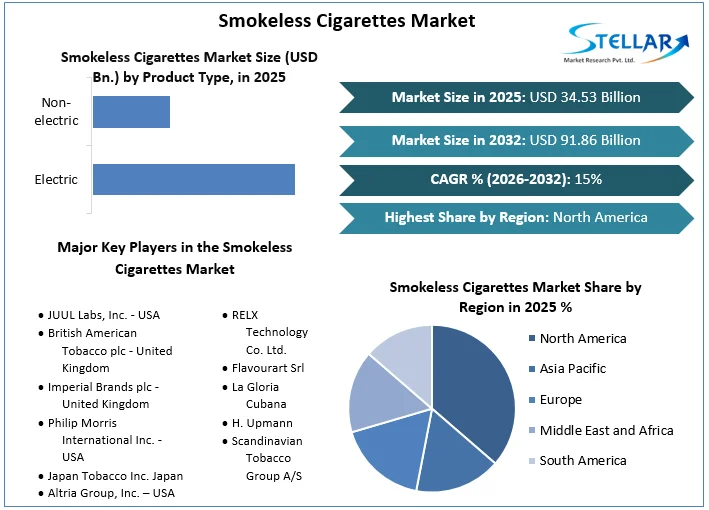
According to industry estimates, the Smokeless Cigarettes Market was valued at USD 34.53 billion in 2025 and is projected to reach nearly USD 91.86 billion by 2032, expanding at a robust CAGR of 15% during the forecast period. The market’s rapid growth reflects increasing consumer demand for innovative nicotine products, expanding distribution channels, and continuous investments in product development by leading manufacturers.
Download Free PDF Brochure: https://www.stellarmr.com/report/req_sample/Smokeless-Cigarettes-Market/1782
Rising Consumer Shift Toward Smoke-Free Alternatives
One of the most significant factors driving the Smokeless Cigarettes Market is the global transition toward smoke-free nicotine products. Health-conscious consumers are increasingly moving away from conventional cigarettes due to growing awareness of smoking-related diseases and stricter public smoking regulations.
Smokeless cigarette products offer users greater convenience, reduced odor, and improved portability compared to traditional tobacco products. Many consumers perceive these products as modern alternatives that better fit contemporary lifestyles, particularly in urban environments where smoking restrictions are becoming more widespread.
The growing popularity of flavored nicotine products, customizable devices, and rechargeable systems has further expanded consumer interest, especially among adult users seeking personalized experiences.
Technological Innovation Driving Product Development
Technology has become a major competitive differentiator within the smokeless cigarette industry. Manufacturers continue investing heavily in research and development to improve battery efficiency, heating systems, vapor generation, and nicotine delivery mechanisms.
Modern electronic cigarettes incorporate advanced temperature control systems, leak-resistant cartridge designs, fast-charging batteries, and smart device connectivity that enhance user experience and product reliability. Heat-not-burn technologies have also gained traction by heating processed tobacco instead of burning it, producing aerosol with significantly reduced combustion by-products.
Artificial intelligence, digital sensors, and connected mobile applications are gradually being integrated into premium devices to monitor usage patterns, battery performance, and personalized nicotine consumption, reflecting the industry’s move toward digital innovation.
Expanding Retail and E-Commerce Distribution Channels
Distribution networks have evolved considerably over the past decade. While specialty vape stores and convenience retailers remain important sales channels, online platforms have become increasingly influential in product distribution.
E-commerce enables manufacturers to reach wider customer bases through product customization, subscription services, and direct-to-consumer marketing strategies. Consumers benefit from broader product selections, competitive pricing, educational resources, and convenient purchasing experiences.
However, online sales are increasingly subject to age verification systems and regulatory compliance measures designed to prevent youth access while supporting responsible retail practices.
Regulatory Landscape Continues to Shape Market Dynamics
Government regulations remain one of the most influential factors affecting the Smokeless Cigarettes Market. Regulatory authorities across North America, Europe, Asia-Pacific, and other regions continue introducing policies related to product approval, nicotine concentration limits, packaging requirements, advertising restrictions, taxation, and flavor regulations.
Manufacturers must continuously adapt product portfolios to comply with evolving legal frameworks while maintaining innovation and competitiveness. Regulatory approvals for new products often require extensive scientific evidence regarding product quality, manufacturing standards, and consumer safety.
Although regulatory uncertainty creates challenges, it also encourages higher manufacturing standards and greater investment in product research and quality assurance.
Growing Demand Across Emerging Markets
Emerging economies are becoming increasingly important contributors to market expansion. Rising disposable incomes, rapid urbanization, growing internet penetration, and changing consumer preferences have accelerated adoption in several developing countries.
Asia-Pacific represents one of the fastest-growing regional markets due to its large adult population, expanding retail infrastructure, and increasing awareness of alternative nicotine products. Countries such as Japan and South Korea have demonstrated strong demand for heat-not-burn products, while several Southeast Asian markets continue witnessing growing interest in electronic cigarettes.
Latin America and parts of the Middle East are also emerging as attractive markets, supported by expanding consumer spending and evolving retail ecosystems.
Sustainability Becoming a Strategic Priority
Environmental sustainability has become an important focus area for manufacturers operating in the smokeless cigarette industry. Companies are increasingly developing recyclable packaging materials, refillable pod systems, and rechargeable devices designed to reduce electronic waste.
Manufacturers are also exploring environmentally responsible battery technologies and sustainable sourcing practices to minimize environmental impact throughout product lifecycles. Several companies have introduced recycling initiatives encouraging consumers to return used devices and cartridges for responsible disposal and material recovery.
As environmental regulations become more stringent, sustainability initiatives are expected to play an increasingly important role in product differentiation and corporate reputation.
Competitive Landscape
The Smokeless Cigarettes Market is characterized by intense competition among global tobacco companies, specialized vaping manufacturers, and emerging technology firms. Leading companies continuously invest in product innovation, scientific research, regulatory compliance, and global market expansion.
Major participants include:
- JUUL Labs, Inc. – USA
- British American Tobacco plc – United Kingdom
- Imperial Brands plc – United Kingdom
- Philip Morris International Inc. – USA
- Japan Tobacco Inc. Japan
- Altria Group, Inc. – USA
- RELX Technology Co. Ltd.
- Flavourart Srl
- La Gloria Cubana
- H. Upmann
Download Free PDF Brochure: https://www.stellarmr.com/report/req_sample/Smokeless-Cigarettes-Market/1782
Challenges Facing the Market
Despite strong growth prospects, the industry faces several challenges. Regulatory uncertainty remains a major concern as governments continue evaluating the long-term health impacts of smokeless nicotine products. Frequent changes in legislation can affect product availability, marketing strategies, and international expansion plans.
Public health organizations continue advocating stricter regulations, particularly regarding youth access and flavored products. Additionally, misinformation surrounding product safety can influence consumer perception and market adoption.
Manufacturers must therefore balance innovation with regulatory compliance while investing in transparent scientific research and consumer education.
Future Outlook
The future of the Smokeless Cigarettes Market remains promising as technological innovation, consumer preferences, and product diversification continue reshaping the industry. Increasing investments in research and development will likely produce more advanced nicotine delivery systems featuring improved efficiency, safety, and customization.
Digital technologies, smart device integration, and sustainable product development are expected to become key competitive advantages over the coming years. Furthermore, expanding adult consumer acceptance, broader retail accessibility, and continued investment in reduced-risk product categories will support long-term market growth.
Although regulatory developments will continue influencing market dynamics, manufacturers that prioritize product quality, scientific validation, environmental sustainability, and responsible marketing will be well-positioned for future success.
In conclusion, the Smokeless Cigarettes Market is entering a new phase of transformation driven by innovation, changing consumer lifestyles, and evolving regulatory frameworks. As companies continue advancing technology while responding to public health expectations and sustainability goals, the market is expected to witness substantial expansion through 2032, creating significant opportunities for manufacturers, investors, and stakeholders across the global nicotine products industry.
Media Contact
Stellar Market Research
Website: Stellar Market Research – Global Research Reports & Consulting
Email: sales@stellarmr.com
