Spinal Fusion Bone Graft Substitutes Market: Advancing Spine Care Through Innovative Biomaterials
The Spinal Fusion Bone Graft Substitutes Market is witnessing significant growth as healthcare providers increasingly adopt advanced biomaterials to improve patient outcomes in spinal fusion procedures. Bone graft substitutes have become an essential component of modern spinal surgery by promoting bone regeneration, enhancing fusion success rates, and reducing the need for harvesting bone from the patient’s own body. As the prevalence of spinal disorders continues to rise worldwide, coupled with technological advancements in orthopedic surgery, the demand for innovative bone graft substitutes is expected to grow steadily over the coming years.
Spinal fusion is a widely performed surgical procedure used to treat conditions such as degenerative disc disease, spinal deformities, fractures, spinal stenosis, and spondylolisthesis. Traditionally, autografts harvested from the patient’s pelvis were considered the gold standard for spinal fusion. However, concerns regarding donor site pain, limited bone availability, and longer recovery times have accelerated the adoption of synthetic and biologically engineered bone graft substitutes.
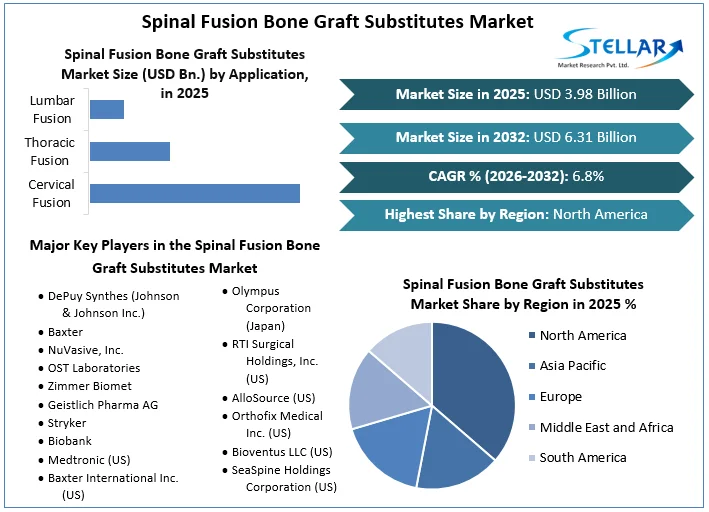
The Spinal Fusion Bone Graft Substitutes Market size was valued at USD 3.98 Bn. in 2025 and the total Global Spinal Fusion Bone Graft Substitutes revenue is expected to grow at a CAGR of 6.8% from 2026 to 2032, reaching nearly USD 6.31 Bn. by 2032.
Increasing Incidence of Spinal Disorders Driving Market Growth
One of the primary factors fueling the Spinal Fusion Bone Graft Substitutes Market is the growing incidence of spinal disorders across all age groups. Sedentary lifestyles, obesity, workplace injuries, and the aging global population have contributed to a substantial increase in chronic back pain and degenerative spinal conditions.
Older adults are particularly vulnerable to osteoporosis and degenerative disc diseases that often require spinal fusion surgery. As life expectancy continues to improve worldwide, healthcare systems are witnessing an increasing number of spinal procedures, creating sustained demand for high-performance bone graft materials.
In addition, sports injuries, traumatic accidents, and congenital spinal deformities continue to contribute to the expanding patient pool requiring surgical intervention.
Technological Innovations Transforming Bone Graft Materials
Continuous research and innovation have significantly improved the effectiveness of spinal fusion bone graft substitutes. Modern products incorporate advanced biomaterials that closely mimic the biological characteristics of natural bone while stimulating new bone formation.
Manufacturers are developing synthetic ceramics, calcium phosphate compounds, bioactive glass, collagen-based matrices, and demineralized bone matrices that provide excellent osteoconductive properties. These materials support bone growth while minimizing complications associated with traditional autografts.
Biological growth factors, stem cell technologies, and tissue engineering are further revolutionizing spinal fusion procedures by enhancing healing rates and improving long-term fusion outcomes. Three-dimensional printing technologies are also enabling the development of patient-specific implants and customized bone scaffolds for complex spinal surgeries.
Growing Preference for Minimally Invasive Spine Surgery
Minimally invasive spine surgery has become an important trend influencing the Spinal Fusion Bone Graft Substitutes Market. Surgeons increasingly prefer techniques that reduce tissue damage, shorten hospital stays, minimize blood loss, and accelerate patient recovery.
Advanced bone graft substitutes are specifically designed to support these minimally invasive procedures by offering easy handling, improved biological performance, and reliable fusion capabilities through smaller surgical incisions.
The increasing availability of robotic-assisted spinal surgery and computer-guided navigation systems has further improved surgical precision, allowing physicians to achieve better clinical outcomes while reducing postoperative complications.
Expanding Applications Across Healthcare Facilities
Hospitals remain the largest end users of spinal fusion bone graft substitutes due to the high volume of complex spinal surgeries performed annually. However, ambulatory surgical centers and specialty orthopedic clinics are rapidly adopting these advanced materials as minimally invasive procedures become more common.
Improved reimbursement policies in several countries, along with increased healthcare investments, are supporting broader patient access to advanced spinal treatment options. Furthermore, healthcare providers are increasingly selecting bone graft substitutes that offer consistent quality, lower infection risks, and predictable clinical performance.
As personalized medicine continues to evolve, customized treatment approaches are expected to further increase the adoption of specialized bone graft materials.
Regulatory Advances Supporting Market Development
Regulatory agencies worldwide continue strengthening quality standards for orthopedic biomaterials to ensure patient safety and product effectiveness. Manufacturers are investing heavily in clinical research, product validation, and regulatory approvals to demonstrate the long-term safety and efficacy of their bone graft substitutes.
Stringent manufacturing standards have encouraged companies to improve production quality, enhance traceability, and adopt advanced sterilization technologies. Although regulatory requirements may lengthen product approval timelines, they also increase physician confidence and support broader market acceptance.
Growing collaboration between regulatory bodies, healthcare institutions, and medical device manufacturers continues to encourage innovation while maintaining high patient safety standards.
Regional Market Outlook
North America dominates the Spinal Fusion Bone Graft Substitutes Market due to its advanced healthcare infrastructure, high adoption of innovative medical technologies, favorable reimbursement systems, and increasing number of spinal surgeries. The United States remains the largest contributor owing to continuous investments in orthopedic research and strong demand for minimally invasive procedures.
Europe represents another significant market supported by an aging population, expanding orthopedic healthcare services, and increasing awareness regarding advanced spinal treatment options. Germany, France, Italy, and the United Kingdom continue investing in healthcare modernization and innovative surgical technologies.
Asia-Pacific is expected to register the fastest growth during the forecast period. Rapid improvements in healthcare infrastructure, rising healthcare expenditure, increasing medical tourism, and expanding access to specialized orthopedic care are driving market demand across China, India, Japan, and South Korea.
Emerging economies in Latin America and the Middle East are also witnessing growing investments in healthcare facilities and orthopedic services, creating additional opportunities for market expansion.
Competitive Landscape
- DePuy Synthes (Johnson & Johnson Inc.)
- Baxter
- NuVasive, Inc.
- OST Laboratories
- Zimmer Biomet
- Geistlich Pharma AG
- Stryker
- Biobank
- Medtronic (US)
- Baxter International Inc. (US)
Download Free PDF Brochure: https://www.stellarmr.com/report/req_sample/Spinal-Fusion-Bone-Graft-Substitutes-Market/1783
Future Outlook
The future of the Spinal Fusion Bone Graft Substitutes Market appears highly promising as demand for effective, minimally invasive, and biologically advanced spinal treatments continues to rise. Ongoing innovations in biomaterials, tissue engineering, regenerative medicine, and surgical technologies will continue improving patient outcomes while reducing recovery times and healthcare costs.
Artificial intelligence-assisted surgical planning, robotic spine surgery, and personalized bone graft solutions are expected to become increasingly integrated into clinical practice over the coming decade. Simultaneously, growing healthcare investments and aging populations will continue driving the number of spinal fusion procedures performed globally.
As manufacturers focus on developing safer, more effective, and clinically validated bone graft substitutes, the market is well-positioned for sustained long-term growth. With continuous advancements in regenerative technologies and increasing adoption of minimally invasive spine surgery, spinal fusion bone graft substitutes will remain a critical component of modern orthopedic care, supporting improved quality of life for millions of patients worldwide.
Media Contact
Stellar Market Research
Website: Stellar Market Research – Global Research Reports & Consulting
Email: sales@stellarmr.com
