Key Highlights
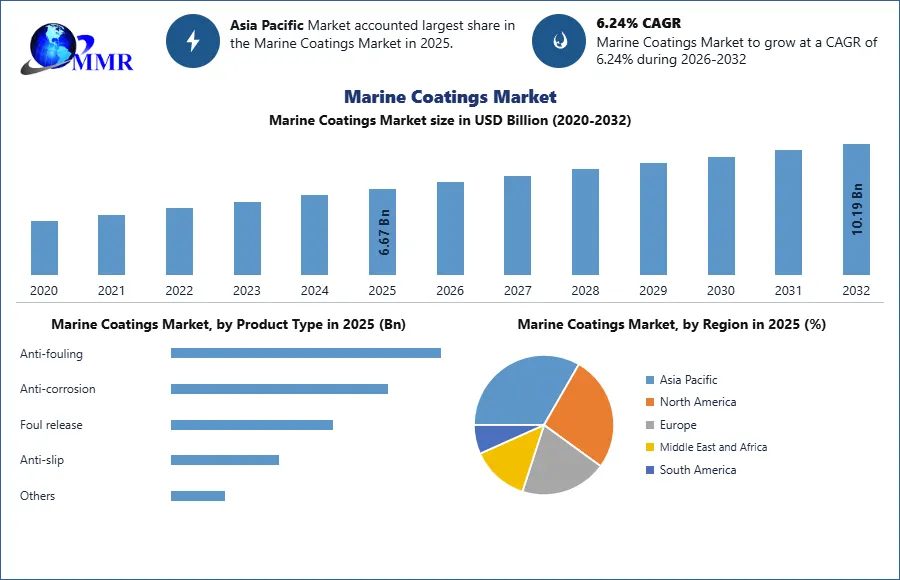
- The Marine Coatings Market was valued at USD 6.67 billion in 2025 and is forecast to reach nearly USD 10.19 billion by 2032 at a CAGR of 6.24%.
- Asia Pacific remains the largest demand center, led by China’s shipbuilding, maintenance and dry-docking activity.
- Epoxy resins held the dominant resin position in 2025 due to corrosion resistance, adhesion and durability.
- Repair work drives recurring revenue because vessels require regular recoating, dry-docking and corrosion-control maintenance.
- Anti-corrosion coatings account for about 40% of marine coatings sales, making protection performance a central procurement issue.
- Coating suppliers are moving toward low-VOC, biocide-free, silicone-based, hybrid and fuel-efficiency technologies.
Why This Matters Now
Marine coating suppliers face a sharper divide between volume demand and value creation. New shipbuilding remains exposed to cyclical order flows, while repair, dry-docking and fleet-life extension are creating more predictable demand for premium coating systems.
The Marine Coatings Market Size was valued at USD 6.67 billion in 2025 and is expected to reach nearly USD 10.19 billion by 2032, growing at a CAGR of 6.24% from 2026 to 2032. The forecast signals a larger addressable market, but it also raises the stakes for manufacturers that must protect margins against raw material volatility, regulatory scrutiny and intense competition in Asian shipyards.
For procurement leaders, coating selection is no longer limited to upfront paint cost. It now affects docking frequency, fuel consumption, corrosion risk, vessel availability and lifecycle economics. That shifts buying power toward suppliers that can demonstrate measurable operational savings.
Market Overview
Marine coatings protect vessels and offshore structures from corrosion, fouling, UV exposure, moisture, salt spray, oils and chemical solvents. Their role spans ship hulls, ballast tanks, decks, cargo areas and offshore steel structures. The product category combines specialty chemical performance with heavy industrial demand.
The market is being shaped by two distinct demand cycles. New shipbuilding creates large project-based coating requirements, while repair work produces recurring consumption through maintenance and dry-docking. This balance matters because repair demand can stabilize supplier revenue when shipyard orders weaken.
The report identifies challenging conditions in the marine sector, including sluggish new-build demand and rising competition. Marine new-build markets in China and South Korea faced pressure, and the industry remained difficult in 2024. That environment increases the importance of aftermarket sales, differentiated formulations and long-term fleet relationships.
Key Trends Driving Growth
Shipbuilding remains a primary demand engine. Rising seaborne trade, foreign direct investment and multinational operating activity have supported shipbuilding expansion since 2010. More vessels entering service increase coating demand at construction, while aging fleets create future repair requirements.
Anti-corrosion protection is moving from a technical requirement to a commercial differentiator. The anti-corrosion segment accounts for about 40% of total marine coatings sales. This concentration gives suppliers with proven corrosion resistance an advantage in high-value applications such as hulls, ballast tanks and offshore assets.
Fuel efficiency is also changing product development priorities. Fouling increases drag, raises fuel use and can shorten dry-docking intervals. Self-polishing, foul-release and silicone-based systems are gaining attention because shipowners are seeking lower operating costs alongside compliance with environmental requirements.
Sustainability is reshaping the chemistry mix. The report highlights low-VOC, waterborne, hybrid, nanotechnology and biocide-free coating technologies. These systems create opportunities for specialty suppliers, but they also require manufacturers to manage formulation performance, application reliability and regulatory approval.
Raw material exposure remains a strategic issue. The report covers the pricing impact of inputs such as zinc, copper oxide, pigments, solvents and titanium dioxide. Suppliers with stronger sourcing discipline, inventory buffers and localized production can better protect delivery reliability and pricing discipline.
Segment Insights
- Dominant Segment — Epoxy Resins: Epoxy resins dominated the market in 2025 because they offer strong adhesion, corrosion resistance and durability. Their use in ship hulls, ballast tanks and offshore structures makes them central to high-performance protective coating demand.
- Fastest-Growing Segment — Not specified in the supplied report: The report identifies several growth areas, including environmentally compliant low-VOC coatings, offshore vessels and shipbuilding activity, but does not provide a named fastest-growing segment.
- End-User Demand — Repair Work: Repair work supports recurring coating demand because dry-docking cycles, inspection requirements and life-extension strategies require frequent recoating. This segment offers suppliers a more stable revenue base than one-time new-build contracts.
- New Ships: New ships account for a significant share, supported by fleet expansion and replacement of aging vessels, particularly at Asia Pacific shipyards. This benefits suppliers that can qualify coatings with OEM shipbuilders.
- Product Opportunity — Anti-Corrosion: Anti-corrosion coatings are a major revenue contributor. Their importance rises where vessel owners prioritize asset life, safety and reduced maintenance disruption.
Regional Growth Story
Asia Pacific is expected to retain the highest share of the Marine Coatings Market. China leads regional and global consumption, supported by shipbuilding, maintenance and dry-docking operations. This gives coating producers access to large-volume demand, but also places pressure on pricing and local service capability.
South Korea remains an important marine coatings market, although it trails China in market share. Japan ranks third in the Asia Pacific region. These markets remain strategically important because they combine advanced shipbuilding capacity with demand for high-performance coatings.
India is expected to become a stronger competitor in the marine coatings industry. Lower-cost labor in China, India and Vietnam is supporting shipbuilding and repair activity. For coating suppliers, this creates a case for regional manufacturing, technical service teams and local inventory rather than export-led supply models.
Europe benefits from established boat manufacturers and large freight and passenger fleets. The region held a market share of more than 10% in 2025. Germany remains relevant through its industrial and maritime manufacturing base, while European environmental compliance requirements raise demand for low-VOC and environmentally compliant formulations.
North America is expected to grow during the forecast period, although the report describes growth as slower due to the region’s limited marine industry scale. The United States remains important for marine maintenance, offshore activity and specialty protective coatings, where technical performance can support premium pricing.
Competitive Landscape
Competition is shifting from broad product portfolios toward measurable vessel performance. AkzoNobel, Hempel, Jotun, Nippon Paint Holdings, PPG Industries and other suppliers are investing in anti-fouling, corrosion protection and lower-emission technologies.
The competitive advantage increasingly lies in technical service, application consistency and lifecycle evidence. Suppliers that can link coatings to fuel savings, longer dry-dock intervals or improved cargo flexibility can move procurement discussions away from price per liter toward total cost of ownership.
Market structure may favor companies with global supply networks and shipyard relationships. Smaller players can still compete in regional repair markets, cost-sensitive maintenance coatings and specialized applications, but they face higher pressure from compliance costs and customer qualification requirements.
Recent Developments
- On March 31, 2026, AkzoNobel secured a contract to supply International marine coatings for three new-generation ferries. The agreement strengthens its passenger-vessel position and supports demand for durable protective systems.
- On February 3, 2026, Hempel completed the first Hempaguard NB applications on Maersk newbuilding vessels. The move signals deeper adoption of silicone-based coatings designed to improve fuel efficiency from vessel delivery.
- On January 7, 2026, Jotun joined the EOLMED Floating Wind Project in France and supplied more than 60,000 liters of specialized coatings. The project expands marine coatings demand beyond vessels into offshore renewable-energy infrastructure.
- On December 11, 2025, Advanced Polymer Coatings signed an agreement with Fratelli Cosulich for MarineLINE tank coatings on two new-build methanol tankers. The development points to rising demand for chemical-resistant linings as alternative-fuel fleets expand.
- On June 9, 2025, Jotun and BW LPG agreed to apply Hull Performance Solutions across 38 vessels, targeting a 3% to 5% reduction in fuel consumption and emissions. The agreement shows how performance data is becoming a commercial tool in coating selection.
Strategic Implications
Marine coating manufacturers need to balance volume exposure with specialty value. Epoxy systems remain essential, but the strongest pricing opportunities are likely to come from anti-fouling, foul-release, silicone-based, hybrid and low-VOC technologies that solve operational problems for shipowners.
Supply chain resilience will also influence competitive outcomes. Dependence on imported pigments, solvents and specialty additives can expose manufacturers to trade disruption, tariffs and freight delays. Local production hubs, inventory planning and supplier diversification can reduce delivery risk at shipyards and repair docks.
For buyers, the decision framework is moving toward lifecycle economics. A coating system that reduces fuel use, extends dry-docking intervals or improves corrosion protection can justify higher upfront cost. That creates a stronger role for performance guarantees, data-backed service contracts and technical partnerships.
Future Outlook
The market’s next phase will be defined by fleet modernization, offshore energy activity, repair demand and environmental compliance. Suppliers that pair high-performance chemistry with reliable shipyard execution will gain share as owners seek lower fuel use and longer asset life.
The winners will be coating companies that convert sustainability and fuel-efficiency claims into verified operating savings while protecting supply reliability in Asia Pacific’s competitive shipbuilding ecosystem.
Analyst Perspective
“Marine coatings are becoming a vessel-performance decision rather than a maintenance purchase. Suppliers that combine corrosion protection, fuel-efficiency gains and regulatory-ready formulations will be best positioned as shipowners focus on lifecycle cost and fleet availability,” said Ankita Kagawade, Analyst at Maximize Market Research.
About Maximize Market Research
Maximize Market Research Pvt. Ltd. (MMR) is a global market research and consulting company that provides reliable, data-focused, and practical business insights. The firm serves a wide range of industries, including healthcare, pharmaceuticals, technology, automotive, electronics, chemicals, personal care, and consumer goods. Through market forecasts, competitive analysis, strategic consulting, and industry impact assessments, MMR helps organizations understand changing market conditions, identify growth opportunities, and make informed business decisions for long-term success.
2nd Floor, Navale IT Park Phase 3
Pune Banglore Highway, Narhe
Pune, Maharashtra 411041, India
+91 9607365656
sales@maximizemarketresearch.com
