Key Highlights
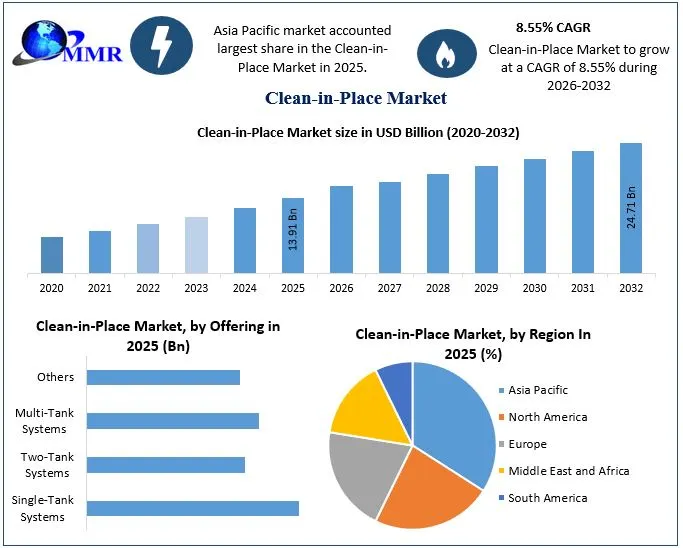
The global Clean-in-Place market size is projected to escalate from USD 13.91 Billion in 2025 to USD 24.71 Billion by 2032.
Automated systems generate a compound annual growth rate of 8.55% between 2026 and 2032, optimizing industrial resource allocation.
Reuse CIP systems dominate global market operations, mitigating chemical consumption and reducing raw water intake requirements.
Strict statutory frameworks across American and European jurisdictions mandate heightened validation protocols for processing lines.
Asia Pacific maintains the highest expansion rate, fueled by shifting industrial investments and domestic capacity additions.
Why This Matters Now
Volatile utility tracking and escalating wastewater remediation expenses are forcing global chemical manufacturers and sanitary processors to immediately re-engineer their production footprint. Unplanned downtime and manual disassembly protocols introduce unacceptable operational vulnerabilities, driving rapid capital deployment toward inline sanitation frameworks. Corporate engineering budgets are shifting toward closed-loop automated hardware to insulate production lines against regulatory penalties and soaring chemical procurement costs. Capital allocators require immediate visibility into these infrastructural transitions to protect downstream margin generation.
Market Overview
Industrial manufacturing demands continuous asset availability alongside strict biological risk mitigation across all processing pipelines. The Clean-in-Place Market serves this requirement by automating the cleaning of internal surfaces of pipes, vessels, process equipment, filters, and related fittings without hardware disassembly. This process minimizes manual labor liabilities, sanitizes complex structural geometries, and reduces production downtime between distinct product runs. The base valuation of this market stands at USD 13.91 Billion in 2025. Projections indicate a valuation of USD 24.71 Billion by 2032, yielding a steady CAGR of 8.55% during the forecast horizon. This steady revenue trajectory demonstrates that manufacturing plants are actively prioritizing continuous automated maintenance architectures over manual processing techniques.
Key Trends Driving Growth
Accelerated plant automation acts as the primary mechanism elevating market revenues as operators eliminate human variables from sanitation workflows. Automated CIP configurations deliver repeatable, documented data sets that fulfill corporate quality assurance mandates and public health inspection criteria. By generating verifiable cleaning records, these installations insulate manufacturers from product contamination liabilities and subsequent brand erosion. Furthermore, the rising volume of processed convenience food, expanding dairy operations, and scaling pharmaceutical batches expand the total surface area requiring sanitation.
Operational cost management provides an additional commercial justification for capital investments in automated cleaning infrastructure. Integrating advanced CIP setups optimizes detergent concentrations, thermal energy delivery, and rinse volumes, lowering total expenditure per sanitization cycle. This reduction directly offsets the high initial capital requirements that historically restricted systemic factory adoption. Industrial facilities face a shortage of qualified and experienced system operators, prompting corporate engineering divisions to implement closed-loop systems that run independently.
Segment Insights
System Type: Reuse CIP Systems (Dominant Segment & Fastest-Growing Segment). This system type holds the majority of market share due to its capability to recirculate cleaning solutions and water, reducing wastewater fees. The technical configuration collects used chemical detergents and rinse water from an active cycle, storing the solutions for subsequent pre-rinse routines. This continuous recycling process curbs fresh chemical procurement needs and lowers raw water intake volume, defending plant operating margins against rising commodity costs.
Offering: Single-Tank Systems, Two-Tank Systems, Multi-Tank Systems, and alternative customized multi-chamber variations. Multi-tank iterations provide the structural separation necessary to store distinct cleaning chemical streams, acid rinses, and recovered water volumes independently.
End-User Industry: Food Industry, Dairy Industry, Pharmaceuticals Industry, Brewery and Beverages Industry, and alternative sanitary processing sectors. The food and beverage sector requires constant pipe and vessel sanitation to remove residual product fragments, directly driving high-volume equipment consumption.
Regional Growth Story
The Asia Pacific region occupies the leading position within the global industrial framework, expanding at the fastest regional rate through 2032. Rapid modernization of regional processing plants alongside a growing presence of international manufacturing corporations accelerates regional sales volumes. Rising domestic investments within China and India expand production capacities across local pharmaceutical, dairy, and consumer product sectors. Concurrently, regional regulators are strengthening statutory oversight concerning food hygiene and pharmaceutical batch purity, forcing processing facilities to abandon manual cleaning protocols.
Conversely, mature industrial zones across American and European territories experience sustained equipment demand driven by severe regulatory mandates. Regulatory agencies across these jurisdictions enforce strict validation rules on multi-product processing lines, making repeatable CIP data extraction mandatory for market compliance. This continuous oversight forces manufacturing operations to upgrade legacy single-use setups to high-efficiency multi-tank reuse systems. These technical upgrades insulate domestic processors from product recall risks while lowering corporate exposure to local wastewater disposal surcharges.
Competitive Landscape
The global clean-in-place sector exhibits a consolidated structural arrangement where major engineering conglomerates command substantial pricing leverage. Industry leaders utilize specialized product development, capacity expansions, and targeted corporate partnerships to secure long-term capital expenditure contracts. These global entities focus engineering resources on improving automated telemetry, flow control mechanics, and inline analytical instrumentation. This technical concentration allows top-tier suppliers to command premium margins while setting industry benchmarks for fluid processing efficiency.
Mid-tier manufacturers and localized providers compete by targeting regional market niches or offering custom structural integrations for legacy processing facilities. These participants encounter barriers related to the lack of specialized field operators and the structural constraints of existing plant layouts. To bypass these limitations, equipment providers are developing modular, skid-mounted CIP units that assemble rapidly with existing plant infrastructure. This engineering shift lowers installation downtime, helping smaller operators capture market share in developing manufacturing hubs.
Recent Developments
Market participants including Alfa Laval, SPX FLOW, Tetra Pak, and Kärcher are expanding production facilities to capture rising global demand for inline cleaning installations.
Engineering firms are integrating automated control software into multi-tank architectures to provide real-time validation data directly to corporate enterprise resource planning software.
Manufacturing organizations are establishing strategic technical partnerships with regional chemical distributors to optimize the concentration profiles of recirculated detergent solutions.
System designers are rolling out modular hardware skids intended to minimize the initial engineering and footprint requirements for legacy factory retrofits.
Strategic Implications
Every major capital expansion or technology partnership within the clean-in-place domain directly alters regional market structures and supplier concentration. As tier-one engineering firms expand their automated product lines, they increase their pricing control over complex, multi-tank system installations. This concentration pressures procurement officers to sign extended service and chemical supply agreements to offset volatile initial capital costs. Operating facilities that invest early in closed-loop reuse systems secure durable advantages by insulation against volatile local water and chemical prices.
Furthermore, these technological advancements redefine capacity utilization metrics across downstream consumer and chemical manufacturing lines. Implementing high-efficiency CIP equipment compresses cleaning cycle durations, converting previous sanitation downtime directly into revenue-generating production hours. This structural shift allows operators to increase plant throughput without adding new production vessels or building out additional real estate. Consequently, selecting an efficient cleaning architecture directly influences a facility’s long-term unit economics and return on invested capital.
Future Outlook
Corporate capital allocation will continuously favor manufacturing configurations that integrate automated sanitation telemetry directly into active production frameworks. Facilities operating legacy, labor-intensive cleaning processes face increasing risks of compliance failures, product recalls, and margin compression from rising utility costs. Long-term commercial success belongs to engineering divisions that build closed-loop recycling systems capable of verifying clean lines while reducing raw material inputs.
Analyst Perspective
“Stricter statutory compliance requirements and rising chemical procurement costs are compelling global processing plants to immediately eliminate manual maintenance protocols. Corporate engineering budgets are shifting away from legacy single-use setups toward automated reuse CIP networks to protect operating margins from rising wastewater surcharges. Companies that integrate verifiable closed-loop cleaning telemetry into their operations will protect their supply chain continuity and gain a clear edge over competitors stuck with manual processes.” — Ankita Kagawade, Analyst, Maximize Market Research
About Maximize Market Research
Maximize Market Research Pvt. Ltd. (MMR) is a global market research and consulting company that provides reliable, data-focused, and practical business insights. The firm serves a wide range of industries, including healthcare, pharmaceuticals, technology, automotive, electronics, chemicals, personal care, and consumer goods. Through market forecasts, competitive analysis, strategic consulting, and industry impact assessments, MMR helps organizations understand changing market conditions, identify growth opportunities, and make informed business decisions for long-term success.
2nd Floor, Navale IT Park Phase 3
Pune Banglore Highway, Narhe
Pune, Maharashtra 411041, India
+91 9607365656
sales@maximizemarketresearch.com
