Key Highlights
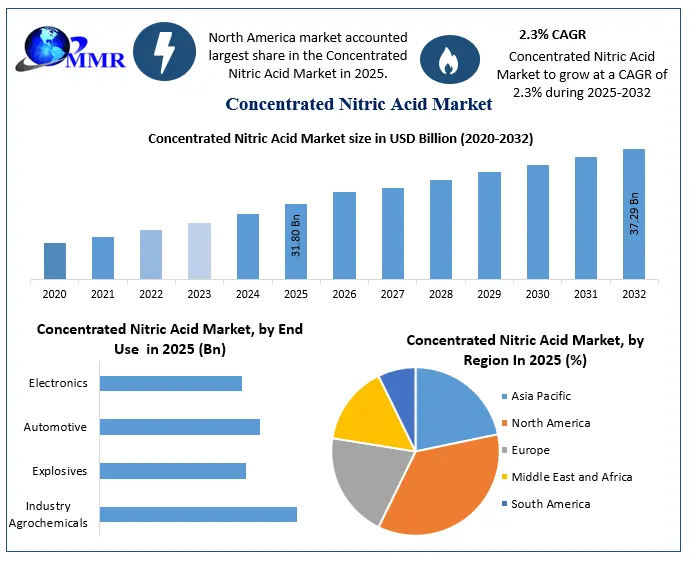
- The Concentrated Nitric Acid Market was valued at USD 31.80 billion in 2025 and is expected to reach nearly USD 37.29 billion by 2032, growing at a CAGR of 2.3%.
- Asia Pacific held the leading market share in 2025, supported by fertilizer consumption, industrial manufacturing and chemical processing capacity.
- Fertilizer production remains the central downstream demand driver because nitric acid is used in ammonium nitrate and other nitrogen-based products.
- Ammonia availability is a key feedstock issue because nitric acid production depends on ammonia oxidation.
- Industrial buyers are placing greater emphasis on secure regional supply, handling safety and emission-control performance.
- Nitrogen oxide emissions and hazardous-material rules are increasing pressure for cleaner production technologies and tighter operating controls.
Why This Matters Now
Nitric acid producers are operating in a market where volume growth is modest but execution risk is rising. Fertilizer demand remains essential, yet ammonia availability, energy exposure, emissions compliance and transport constraints are making supply reliability more valuable than simple capacity.
The Concentrated Nitric Acid Market Size was valued at USD 31.80 billion in 2025 and is expected to reach nearly USD 37.29 billion by 2032, growing at a CAGR of 2.3% from 2026 to 2032. The forecast indicates a stable expansion path, but the pace means producers will need disciplined cost control, efficient plant utilization and differentiated service to protect returns.
For fertilizer manufacturers, explosives producers and specialty chemical buyers, nitric acid is a critical input with limited tolerance for disruption. Procurement decisions increasingly depend on local availability, safe logistics, purity consistency and a supplier’s ability to manage environmental compliance.
Market Overview
Concentrated nitric acid is a highly corrosive mineral acid used in fertilizer production, chemical synthesis, explosives, metal processing and specialty manufacturing. It is produced through the oxidation of ammonia, making ammonia supply and energy economics central to the industry’s cost structure.
The product serves both large-volume and specialty applications. Fertilizer production drives broad demand through ammonium nitrate and related nitrogen products. Other uses include adipic acid, nitrobenzene, dyes, pharmaceuticals, metal etching and chemical intermediates.
This mix creates two different commercial markets. Fertilizer demand is volume-led and exposed to agricultural cycles, while specialty applications can require higher purity, controlled specifications and stronger technical support. Producers with flexible plants can serve both segments and reduce dependence on one downstream market.
The report identifies expanding agriculture, industrialization and rising demand for nitrogen-based fertilizers as market drivers. The implication is that food production and industrial investment will continue to support baseline nitric acid consumption, even where regional demand cycles differ.
Key Trends Driving Growth
Fertilizer demand remains the most important market force. Nitric acid is used to produce ammonium nitrate, a major nitrogen fertilizer. Population growth, pressure on agricultural yields and the need to improve crop productivity support continued demand for nitrogen inputs.
Ammonia is the central feedstock variable. Nitric acid production relies on ammonia oxidation, so producers are exposed to ammonia availability, natural gas-linked economics and regional supply conditions. Integrated fertilizer complexes can reduce this exposure by linking ammonia, nitric acid and downstream fertilizer production.
Emission control is becoming more important. Nitric acid plants can generate nitrogen oxide emissions, creating regulatory and operating pressure for abatement systems. Producers that invest in emission-control technology can improve compliance and protect access to regulated markets.
Industrial applications are supporting demand beyond agriculture. Nitric acid is used in metal processing, electronics-related manufacturing, chemical synthesis and explosives production. These end uses create opportunities for suppliers that can provide reliable purity grades and secure delivery.
Safety and logistics remain decisive. Concentrated nitric acid is hazardous and corrosive, requiring specialized storage, transport and handling. Regional production capacity and dependable distribution networks can become a competitive advantage where customers need uninterrupted supply.
Technology investment is focused on process efficiency, energy management and emission reduction. Improved catalyst systems, absorption technologies and process controls can help producers reduce operating costs and strengthen environmental performance. In a low-growth market, these gains can be more important than adding capacity.
Segment Insights
- Dominant Segment — Fertilizer Applications: Fertilizer production is expected to dominate concentrated nitric acid demand because the chemical is a key input for ammonium nitrate and other nitrogen-based products. This gives agricultural cycles and fertilizer manufacturing capacity major influence over market volumes.
- Fastest-Growing Segment — Not specified in the supplied report: The supplied report information does not identify a named fastest-growing segment. It highlights fertilizer, industrial and specialty chemical demand but provides no segment growth ranking.
- Major Feedstock — Ammonia: Ammonia is the essential feedstock for nitric acid production. Its availability and cost affect plant economics, operating rates and the reliability of downstream supply.
- Industrial Applications: Metal treatment, chemical synthesis, dyes, pharmaceuticals and explosives contribute to demand. These applications can support premium pricing where customers require consistent purity and tailored logistics.
- Specialty Chemical Demand: Nitric acid is used in the production of intermediates such as adipic acid and nitrobenzene. This gives producers exposure to broader chemical manufacturing activity beyond fertilizer markets.
Regional Growth Story
Asia Pacific held the largest share of the Concentrated Nitric Acid Market in 2025. The region benefits from large agricultural economies, fertilizer demand, chemical manufacturing capacity and industrial development. This supports high-volume consumption and makes regional supply chains strategically important.
China is a major market because of its fertilizer production, industrial base and chemical processing capacity. Demand from agriculture and manufacturing supports nitric acid consumption, while local production capacity can influence trade flows and regional pricing.
India is also a key demand center due to agricultural activity and growing industrial production. Nitrogen fertilizer consumption remains important for crop productivity, while expanding manufacturing can increase demand for nitric acid in chemical and metal-processing applications.
Japan and South Korea remain relevant through advanced manufacturing and specialty chemical demand. The supplied report does not provide separate market values, capacity figures or country-level growth rates for either country. Their role is therefore best viewed through industrial demand rather than quantified market size.
Europe remains important for specialty chemicals, industrial processing and regulated fertilizer markets. Germany is included in the report’s regional coverage, but no country-specific market figure is available. Strict environmental rules in Europe can increase demand for low-emission production systems and reliable handling practices.
North America remains a significant market due to agriculture, industrial production and chemical manufacturing. The United States benefits from fertilizer demand and a developed chemical sector, although the supplied report does not provide a separate national value or capacity outlook.
Competitive Landscape
The market is competitive because nitric acid is both a bulk chemical and a critical industrial input. Producers compete on cost, ammonia integration, plant reliability, purity, logistics and compliance performance.
Integrated fertilizer and chemical companies have an advantage because they can control ammonia supply and capture value across the nitrogen chain. This can improve capacity utilization and reduce exposure to external feedstock volatility. Independent producers may face greater margin pressure when ammonia costs rise.
The competitive balance also depends on local distribution. Transporting concentrated nitric acid requires specialized infrastructure and safety procedures. Producers close to fertilizer plants, chemical clusters and industrial buyers can offer shorter lead times and lower logistics risk.
Technology is becoming a source of differentiation. Suppliers that reduce nitrogen oxide emissions, improve energy efficiency and maintain stable product quality can strengthen customer retention. These capabilities matter especially in regions with strict environmental oversight and high safety standards.
Recent Developments
- The report identifies continued demand from fertilizer manufacturing, particularly for ammonium nitrate production. This supports integrated nitrogen producers that can secure ammonia and convert it into downstream products.
- Producers are focusing on process efficiency and emission-control technologies. This signals that future competitiveness will depend on operating performance and regulatory readiness, not only on nameplate capacity.
- Industrial demand from chemical synthesis, metal treatment and explosives is broadening the customer base. The trend supports producers able to supply multiple purity grades and specialized delivery requirements.
- Environmental rules related to nitrogen oxide emissions are increasing pressure on nitric acid plants. This can favor producers with modern abatement systems and may raise compliance costs for older facilities.
- Supply-chain resilience is becoming more important because concentrated nitric acid requires specialized handling and transport. Regional production and local storage can improve customer reliability.
- The report does not provide verified acquisition, partnership, investment, trade-flow, pricing or capacity-expansion announcements. Those data points are omitted to avoid unsupported claims.
Strategic Implications
For producers, ammonia integration is a central strategic lever. A secure ammonia position can protect operating rates, improve cost visibility and support long-term contracts with fertilizer and industrial customers.
For buyers, supply continuity should rank alongside price. Nitric acid shortages can interrupt fertilizer output, chemical production and industrial processing. Procurement teams should assess supplier location, storage capability, transport readiness and safety performance.
Environmental compliance will shape capital allocation. Nitrogen oxide abatement and energy-efficiency improvements can increase upfront spending, but they can also reduce regulatory risk and strengthen access to customers with strict sustainability requirements.
The market’s moderate growth rate favors disciplined investment. New capacity must be aligned with local demand, ammonia supply and logistics infrastructure. Plants without strong downstream connections may face lower utilization and weaker pricing power.
Future Outlook
The Concentrated Nitric Acid Market will remain anchored in fertilizer demand while specialty chemicals and industrial processing provide diversification. The most important operational issues will be ammonia economics, emissions compliance, plant efficiency and regional supply security.
The strongest producers will be those that combine feedstock integration, low-emission operations and reliable delivery into a defensible position across fertilizer and specialty chemical markets.
Analyst Perspective
“Concentrated nitric acid remains a critical link in the nitrogen value chain. Producers that secure ammonia supply, improve emission performance and build reliable regional delivery networks will be better positioned to serve fertilizer and industrial customers,” said Ankita Kagawade, Analyst at Maximize Market Research.
About Maximize Market Research
Maximize Market Research Pvt. Ltd. (MMR) is a global market research and consulting company that provides reliable, data-focused, and practical business insights. The firm serves a wide range of industries, including healthcare, pharmaceuticals, technology, automotive, electronics, chemicals, personal care, and consumer goods. Through market forecasts, competitive analysis, strategic consulting, and industry impact assessments, MMR helps organizations understand changing market conditions, identify growth opportunities, and make informed business decisions for long-term success.
2nd Floor, Navale IT Park Phase 3
Pune Banglore Highway, Narhe
Pune, Maharashtra 411041, India
+91 9607365656
sales@maximizemarketresearch.com
