Key Highlights
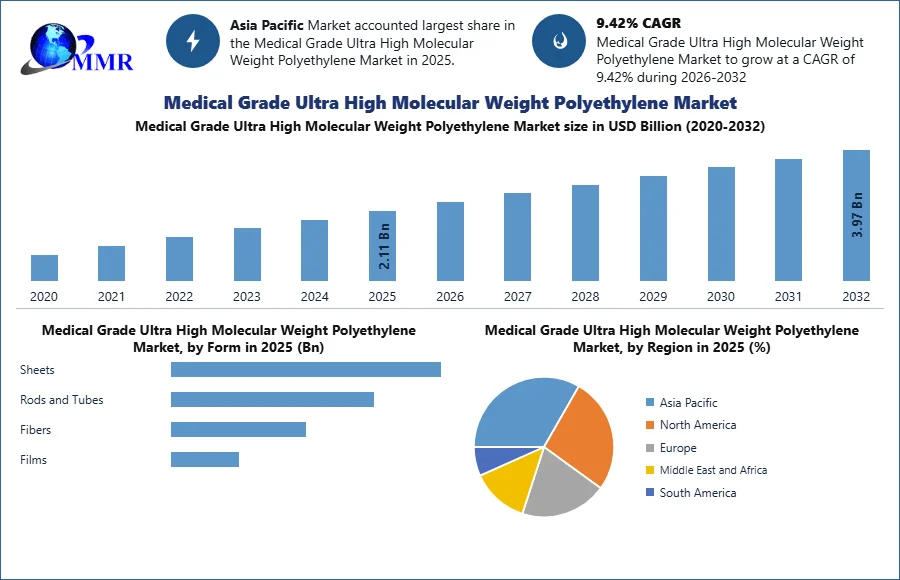
- The Medical Grade Ultra High Molecular Weight Polyethylene Market was valued at USD 2.11 billion in 2025 and is projected to reach nearly USD 3.97 billion by 2032, growing at a CAGR of 9.42%.
- North America held the leading market share in 2025, supported by advanced healthcare infrastructure and high orthopedic procedure volumes.
- Orthopedic implants are expected to remain the dominant application because UHMWPE offers wear resistance, durability and biocompatibility.
- Rising joint-replacement procedures are increasing demand for high-performance implant materials.
- Cross-linked and highly cross-linked UHMWPE grades are gaining attention for improved wear performance in hip and knee implants.
- Regulatory compliance, material traceability and supply reliability are becoming central procurement requirements for medical polymer buyers.
Why This Matters Now
Medical polymer suppliers are facing a higher bar for performance and proof. Orthopedic device makers need materials that can withstand years of motion inside the body while meeting strict requirements for biocompatibility, traceability and manufacturing consistency.
The Medical Grade Ultra High Molecular Weight Polyethylene Market Size was valued at USD 2.11 billion in 2025 and is expected to reach nearly USD 3.97 billion by 2032, growing at a CAGR of 9.42% from 2026 to 2032. The market’s expansion signals a strong demand outlook for implant-grade polymers, but it also increases pressure on suppliers to maintain validated quality systems and dependable medical-grade capacity.
For chemical producers, the opportunity is not in commodity polyethylene. It is in highly controlled specialty grades used in joint implants, trauma devices and other medical applications. The value lies in material purity, molecular-weight consistency, processing expertise and long-term customer qualification.
Market Overview
Medical grade ultra high molecular weight polyethylene, or UHMWPE, is a high-performance polymer used in medical devices because of its wear resistance, toughness, low friction and biocompatibility. Its best-known use is in orthopedic implants, particularly components used in hip and knee replacement systems.
UHMWPE differs from standard polyethylene because of its very high molecular weight. This gives the material mechanical strength and abrasion resistance that are valuable where implants experience repeated movement and load. In medical applications, the material must also meet strict purity, sterilization and documentation requirements.
The market is driven by demand for orthopedic procedures, an aging population and rising access to healthcare. Joint replacements are increasing as more patients seek mobility restoration and treatment for degenerative joint conditions. Each procedure creates demand for precisely manufactured implant components.
The report identifies growing demand for medical devices and advances in healthcare infrastructure as major market drivers. The commercial implication is that material suppliers can benefit from long product qualification cycles and recurring demand, provided they meet medical-device quality expectations.
Key Trends Driving Growth
Orthopedic implants remain the central demand driver. Hip and knee replacement systems require materials that can resist wear while allowing smooth movement. UHMWPE is used because it can reduce friction and support implant durability, making it a critical component in long-term joint replacement performance.
Highly cross-linked UHMWPE is gaining importance. Cross-linking can improve wear resistance, which is a major concern in joint implants. The technology supports demand for advanced grades that can help device makers improve implant longevity and reduce revision surgery risk.
Healthcare access is expanding in several regions. More hospitals, specialty clinics and orthopedic centers are increasing procedure capacity. This creates demand not only for implants but also for reliable material supply, technical support and processing consistency.
Aging populations are increasing the need for joint-replacement procedures. Older patients are more likely to require treatment for mobility-related conditions, while younger and more active patients are also raising expectations for implant durability. This pushes device manufacturers to seek higher-performance materials.
Material traceability is becoming more important. Medical-device companies need documentation covering resin origin, batch consistency, processing conditions and sterilization compatibility. Suppliers that can provide robust quality assurance can strengthen their position in high-value medical markets.
Innovation is focused on improving wear performance, oxidation resistance and implant life. Research into cross-linked grades, vitamin E-stabilized UHMWPE and advanced processing methods is creating opportunities for specialty polymer suppliers. These materials can command stronger value when supported by clinical and performance data.
Segment Insights
- Dominant Segment — Orthopedic Implants: Orthopedic implants are expected to dominate the market because UHMWPE is widely used in hip and knee replacement components. The segment benefits from rising joint-replacement procedures and demand for durable, low-friction implant materials.
- Fastest-Growing Segment — Not specified in the supplied report: The report highlights increasing use in medical devices and orthopedic applications but does not identify a named fastest-growing segment.
- Key Product Category — Cross-Linked UHMWPE: Cross-linked and highly cross-linked grades are gaining attention because they improve wear resistance. This supports premium demand from implant manufacturers focused on long-term performance.
- Medical Device Applications: Beyond joint replacement, UHMWPE can be used in trauma devices and other medical components where durability, toughness and biocompatibility are required.
- Material Performance: Wear resistance, low friction, impact strength and chemical resistance make UHMWPE valuable in demanding medical applications. These attributes differentiate medical-grade material from standard polyethylene products.
Regional Growth Story
North America held the largest share of the Medical Grade Ultra High Molecular Weight Polyethylene Market in 2025. The region benefits from advanced healthcare systems, high orthopedic procedure volumes and established medical-device manufacturing. These factors support demand for validated, high-performance implant materials.
The United States is a key market because it combines major orthopedic device companies, specialized hospitals and high demand for joint replacement procedures. Medical polymer suppliers serving the country must meet strict quality, regulatory and traceability requirements, which can create barriers to entry.
Europe remains an important market for orthopedic implants and medical technology. Germany is included in the report’s regional coverage and is relevant because of its medical-device manufacturing base and healthcare infrastructure. The supplied report does not provide separate market values, capacity data or country-specific growth figures.
Asia Pacific is expected to offer significant growth opportunities as healthcare access expands and medical-device manufacturing develops. China, India, Japan and South Korea are covered within the regional framework, although the report does not provide individual country market figures.
China and India are important because of their large patient populations and growing healthcare investment. Japan and South Korea are relevant through advanced medical technology, hospital infrastructure and demand for high-quality orthopedic solutions. Suppliers entering these markets need local regulatory knowledge and strong distribution partnerships.
Competitive Landscape
The market is specialized and quality-driven. Suppliers compete on medical-grade resin consistency, documentation, processing support and the ability to meet long qualification cycles with orthopedic device manufacturers.
Medical-grade UHMWPE suppliers benefit from high switching costs. Device makers must validate materials, manufacturing processes and implant performance before changing resin sources. This can strengthen supplier relationships and support stable pricing for qualified grades.
Competition is likely to intensify around advanced formulations. Cross-linked, highly cross-linked and antioxidant-stabilized UHMWPE grades can provide performance advantages, but suppliers must support claims with testing, regulatory documentation and manufacturing consistency.
The market also depends on supply reliability. Implant makers cannot easily substitute unqualified materials during a shortage. Producers with dedicated medical-grade production, controlled contamination risk and secure logistics can gain a strategic advantage.
Material suppliers are also competing through collaboration. Technical partnerships with implant manufacturers can help tailor resin properties, machining performance and sterilization compatibility. These relationships can deepen customer integration and reduce the risk of replacement by lower-cost suppliers.
Recent Developments
- The report identifies rising demand for orthopedic implants, especially hip and knee replacement components. This supports continued investment in medical-grade UHMWPE supply and application development.
- Cross-linked UHMWPE technology is gaining traction because of its potential to improve wear resistance. The trend increases demand for advanced specialty grades rather than standard polymer materials.
- Medical-device manufacturers are placing greater emphasis on traceability and quality documentation. This favors suppliers with validated production systems and consistent batch control.
- Healthcare infrastructure expansion is increasing access to orthopedic procedures in developing markets. The shift creates new demand for implant materials and regional supply partnerships.
- Research into oxidation resistance and longer implant life is supporting innovation in stabilized UHMWPE materials. Suppliers that can meet performance and regulatory requirements may capture higher-value opportunities.
- The supplied report does not provide verified acquisitions, partnerships, capacity expansions, pricing trends or trade-flow announcements. These items are omitted to avoid unsupported claims.
Strategic Implications
For chemical manufacturers, medical-grade UHMWPE offers a route into a higher-value specialty polymer market. Success depends on more than polymer production. It requires clean manufacturing, strict quality systems, technical documentation and long-term customer support.
For orthopedic device makers, material selection is a design and risk-management decision. Better wear resistance can support implant longevity, while reliable resin supply reduces production interruption risk. Procurement teams should evaluate material suppliers on validation history, traceability and capacity security.
Regulatory expectations will remain high. Medical-grade polymers must support device approval requirements and meet standards for biocompatibility, cleanliness and consistent performance. Suppliers that invest early in compliance infrastructure can create a durable barrier against lower-cost competitors.
Sustainability is an emerging issue, but the supplied report does not provide specific circular-economy, recycling or carbon-reduction data for medical-grade UHMWPE. The market’s immediate priority remains patient safety, implant performance and quality assurance.
Future Outlook
The Medical Grade Ultra High Molecular Weight Polyethylene Market will be driven by orthopedic demand, healthcare investment and material innovation. The shift toward advanced wear-resistant grades will strengthen the importance of specialty polymer expertise.
The strongest position will belong to suppliers that combine validated medical-grade quality, advanced UHMWPE performance and dependable global supply for implant manufacturers.
Analyst Perspective
“Medical-grade UHMWPE is becoming more important as orthopedic implant makers seek longer-lasting, lower-wear materials. Suppliers that provide consistent quality, traceability and advanced performance grades will be best placed to support the next phase of implant innovation,” said Ankita Kagawade, Analyst at Maximize Market Research.
About Maximize Market Research
Maximize Market Research Pvt. Ltd. (MMR) is a global market research and consulting company that provides reliable, data-focused, and practical business insights. The firm serves a wide range of industries, including healthcare, pharmaceuticals, technology, automotive, electronics, chemicals, personal care, and consumer goods. Through market forecasts, competitive analysis, strategic consulting, and industry impact assessments, MMR helps organizations understand changing market conditions, identify growth opportunities, and make informed business decisions for long-term success.
2nd Floor, Navale IT Park Phase 3
Pune Banglore Highway, Narhe
Pune, Maharashtra 411041, India
+91 9607365656
sales@maximizemarketresearch.com
