Key Highlights
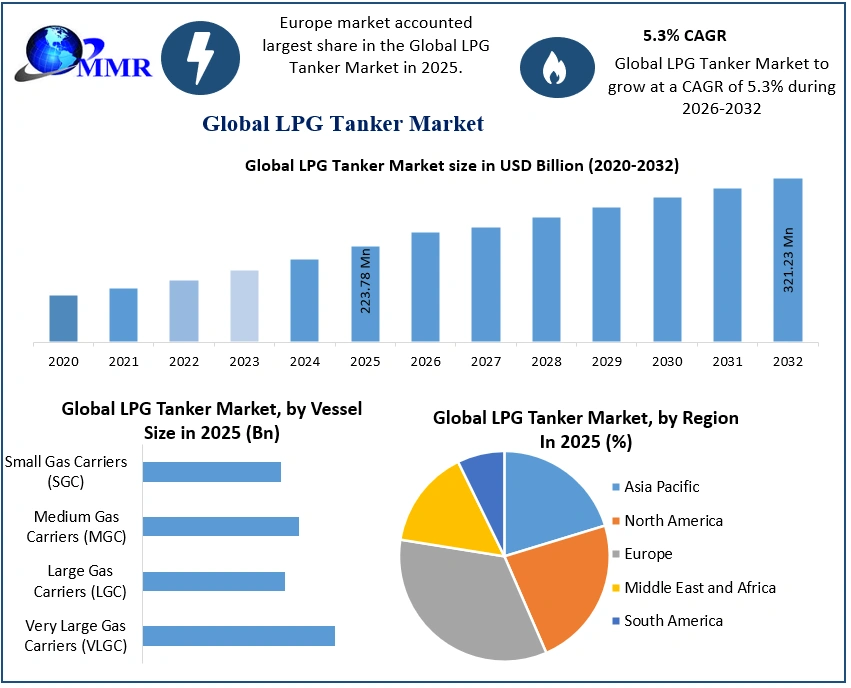
- LPG Tanker Market valued at USD 223.78 Million in 2025
- Forecast to reach USD 321.23 Million by 2032
- CAGR of 5.3% during 2025–2032
- Rising international LPG trade continues to support fleet demand
- Vessel size and refrigeration technology remain key competitive differentiators
- Asia Pacific remains a major regional demand center
- Fleet modernization and operational efficiency are reshaping investment priorities
Why This Matters Now
Energy trade is becoming more dependent on specialized shipping capacity. Every disruption in LPG transportation affects industrial buyers, residential fuel supply, and petrochemical feedstock availability.
The LPG Tanker Market was valued at USD 223.78 Million in 2025 and is projected to reach USD 321.23 Million by 2032, growing at a 5.3% CAGR. That expansion signals sustained investment in maritime infrastructure as global LPG trade continues to expand. For ship owners, energy companies, procurement leaders, and investors, vessel availability increasingly determines supply reliability and commercial competitiveness.
Market Overview
The LPG Tanker Market tankers remain a critical component of the global energy supply chain. These specialized vessels transport LPG under pressurized or refrigerated conditions, connecting producing regions with industrial and residential consumption markets.
The market’s outlook is increasingly linked to international LPG trade rather than domestic production alone. As cross-border shipments increase, fleet utilization becomes more important than simple vessel ownership. This creates opportunities for shipping companies capable of operating efficient fleets while maintaining strict safety standards.
Supply chain resilience has become another strategic priority. Lessons from recent logistics disruptions have encouraged energy companies to diversify shipping routes, improve fleet deployment, and strengthen transportation reliability. Those changes are influencing fleet investments across both established and emerging shipping operators.
Key Trends Driving Growth
Growing LPG consumption across industrial and residential sectors continues to support long-term shipping demand. Increased trade between major exporting countries and Asia Pacific markets remains one of the strongest structural demand drivers. Every increase in international cargo movement raises vessel utilization and supports new fleet investments.
Technology is becoming a competitive differentiator. Modern LPG tankers emphasize improved refrigeration systems, enhanced cargo handling, greater operational efficiency, and stronger safety performance. These investments reduce operating costs while helping operators comply with increasingly demanding international shipping standards.
The market is also responding to changing supply chain priorities. Fleet owners increasingly focus on operational flexibility by deploying different vessel classes across regional and international routes. That allows operators to optimize utilization while serving both large export terminals and smaller regional ports.
Pricing dynamics increasingly depend on freight availability, fleet deployment, logistics costs, and shipping efficiency rather than vessel acquisition alone. Companies capable of maintaining high utilization rates are better positioned to preserve margins during market fluctuations.
Segment Insights
- Dominant Segment: The report segments the market by Vessel Size, Refrigeration & Pressurization, and Region. The specific dominant segment is not disclosed in the available report extract.
- Fastest-Growing Segment: The available report extract does not identify the fastest-growing segment.
- Vessel size continues to influence route economics, cargo capacity, and operating efficiency.
- Refrigeration and pressurization technologies remain essential purchasing considerations because they determine cargo flexibility, operational safety, and transport efficiency.
Regional Growth Story
Asia Pacific continues to represent one of the most important demand centers for LPG transportation. Expanding industrial activity, urban energy consumption, and increasing LPG imports continue to support shipping activity across the region. Strong trade connections with major exporting countries further reinforce demand for specialized tanker capacity.
The United States remains significant because expanding LPG production supports export activity. Greater export volumes translate directly into increased demand for international shipping capacity, strengthening long-haul tanker utilization.
China continues investing in energy infrastructure while maintaining substantial LPG import requirements. That combination supports consistent shipping demand across regional trade routes.
India’s expanding LPG consumption also supports additional import requirements, increasing the importance of reliable maritime logistics and efficient fleet deployment.
Japan and South Korea continue to depend on stable LPG imports for industrial and residential consumption. Their established port infrastructure and long-term supply contracts help maintain consistent shipping activity.
Europe, including Germany, continues emphasizing energy diversification and supply chain security. Reliable LPG transportation remains an important component of broader regional energy resilience strategies.
Competitive Landscape
Competition increasingly centers on fleet capability rather than vessel ownership alone. Operators investing in modern refrigeration systems, higher operational efficiency, and enhanced safety performance improve both commercial competitiveness and long-term asset utilization.
The report evaluates the competitive landscape through benchmarking of fleet size, vessel capacity, market share, and company positioning. It also includes assessments of mergers, acquisitions, investment activity, and market structure. These developments signal continued industry consolidation as larger operators pursue economies of scale while strengthening pricing power through improved fleet efficiency. Capacity additions also indicate confidence in sustained international LPG trade rather than short-term demand cycles.
Recent Developments
- Growing international LPG trade continues supporting fleet expansion strategies.
- Companies continue evaluating investments in modern tanker technologies to improve operational performance.
- Competitive benchmarking increasingly focuses on fleet size, vessel capacity, and operational capability.
- Industry participants continue strengthening logistics resilience through improved transportation infrastructure and optimized vessel deployment.
Strategic Implications
Procurement leaders increasingly recognize shipping capacity as a strategic asset rather than a transportation expense. Reliable vessel availability directly influences inventory planning, supply security, and contract execution.
Ship owners benefit from maintaining technologically advanced fleets capable of serving multiple cargo routes efficiently. Investors should monitor fleet modernization and capacity utilization because these factors increasingly determine long-term profitability.
Industrial buyers gain greater resilience by diversifying transportation partnerships and securing reliable shipping access before supply constraints emerge. Companies with efficient fleets, flexible deployment strategies, and strong operational reliability are positioned to capture larger shares of future international LPG transportation demand.
Future Outlook
The LPG Tanker Market is expected to continue expanding alongside global LPG trade and evolving energy supply chains. Investment priorities will increasingly emphasize operational efficiency, advanced refrigeration technologies, logistics resilience, and optimized fleet deployment rather than simple capacity additions. Companies that align fleet modernization with changing trade routes will strengthen their competitive position while supporting more reliable global LPG distribution. The strongest competitive advantage will belong to operators that combine modern fleets with high utilization and resilient international logistics networks.
Analyst Perspective
“The LPG Tanker Market is entering a phase where fleet quality, operational efficiency, and reliable global logistics will matter as much as fleet size. Companies investing in modern vessels and resilient shipping networks are likely to strengthen their long-term competitive position as international LPG trade continues to expand.” — Ankita Kagawade
About Maximize Market Research
Maximize Market Research Pvt. Ltd. (MMR) is a global market research and consulting company that provides reliable, data-focused, and practical business insights. The firm serves a wide range of industries, including healthcare, pharmaceuticals, technology, automotive, electronics, chemicals, personal care, and consumer goods. Through market forecasts, competitive analysis, strategic consulting, and industry impact assessments, MMR helps organizations understand changing market conditions, identify growth opportunities, and make informed business decisions for long-term success.
2nd Floor, Navale IT Park Phase 3
Pune Banglore Highway, Narhe
Pune, Maharashtra 411041, India
+91 9607365656
sales@maximizemarketresearch.com
