Key Highlights
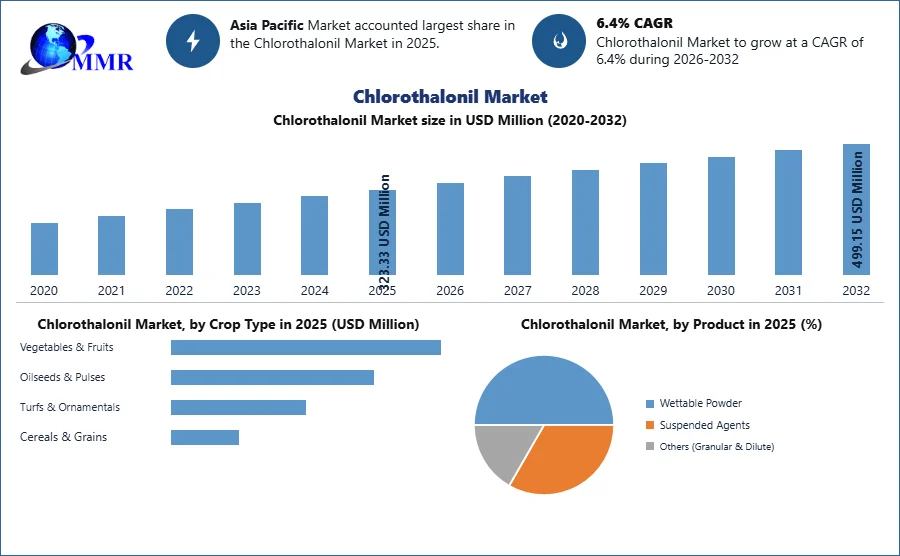
- Chlorothalonil Market was valued at USD 323.33 Million in 2025.
- Market revenue is projected to reach USD 499.15 Million by 2032.
- CAGR is forecast at 6.4% during 2026–2032.
- Asia Pacific leads global market demand.
- Rising crop disease pressure continues to support fungicide adoption.
- Product innovation and regulatory compliance are reshaping competition.
- Strategic collaborations and portfolio expansion remain major competitive priorities.
Why This Matters Now
Food security has become a strategic issue for governments, growers, and agricultural suppliers. Crop losses caused by fungal diseases directly threaten farm productivity, export competitiveness, and supply stability. That makes fungicides a procurement priority rather than a seasonal input.
The Chlorothalonil Market illustrates this shift. The market was valued at USD 323.33 Million in 2025 and is expected to reach USD 499.15 Million by 2032, expanding at a 6.4% CAGR. For manufacturers, the implication is clear: sustained investment in production efficiency, regulatory compliance, and differentiated product portfolios will determine long-term competitiveness.
Market Overview
The Chlorothalonil Market remains one of the widely used broad-spectrum fungicides across commercial agriculture because of its effectiveness against multiple fungal diseases affecting vegetables, fruits, cereals, ornamentals, and other crops. Demand is increasingly linked to the need for higher agricultural productivity while protecting crop quality.
Pressure on agricultural output continues to increase as food consumption rises. Growers are investing more heavily in disease management to reduce post-harvest losses and improve yields. This creates consistent downstream demand for fungicides throughout the crop production cycle.
The market also faces structural challenges. New fungal resistance patterns require continuous product innovation, while health and environmental concerns have intensified regulatory scrutiny across several regions. Companies that successfully balance efficacy with compliance are positioned to strengthen market share as regulatory standards become more demanding.
Key Trends Driving Growth
Growing food demand remains the strongest structural driver. Expanding production of cereals, vegetables, fruits, pulses, and other essential crops increases fungicide consumption throughout major agricultural economies. Every increase in crop protection spending supports stable demand for chlorothalonil products.
Technology is becoming an important competitive differentiator. Market participants are investing in research to improve product performance while developing formulations that align more closely with sustainability objectives and evolving regulatory expectations. These investments signal a transition from volume competition toward higher-value product differentiation.
Supply chains are also evolving. Asia continues to serve as an important manufacturing base for chlorothalonil production, supported by extensive agricultural chemical manufacturing capacity. This concentration strengthens regional supply while increasing the importance of resilient sourcing strategies for international buyers.
Regulation has become another defining market force. European authorities have introduced stricter restrictions on chlorothalonil use, encouraging suppliers to adapt portfolios and accelerate innovation. Rather than reducing competitive activity, tighter regulations are increasing investment in compliance and product development.
Segment Insights
- Dominant Segment: Vegetables & Fruits crop type, supported by extensive fungicide usage to protect high-value crops from fungal diseases.
- Fastest-Growing Segment: Asia Pacific regional demand continues to expand rapidly, supported by rising agricultural production in China and India.
- Type Trend: 98% Chlorothalonil represents a major product category within the market segmentation.
- Product Trend: Wettable Powder remains one of the primary commercial formulations serving agricultural applications.
Regional Growth Story
Asia Pacific remains the leading regional market, supported by extensive agricultural activity and strong crop protection requirements. China and India continue to produce significant volumes of staple crops including rice, corn, and cotton, creating sustained demand for fungicides. The region also benefits from an established manufacturing ecosystem with numerous chlorothalonil producers operating across China and India. In India, widespread adoption of synthetic pesticides has contributed to reduced crop losses, strengthening long-term consumption of crop protection products.
North America continues to represent an important consumption market. Chlorothalonil is extensively used across vegetables, fruits, orchards, grapes, corn, turf, berries, and ornamental crops. The region’s emphasis on maintaining crop quality while supporting sustainable farming practices continues to sustain demand.
Europe presents a more complex landscape. The region maintains significant agricultural demand, yet increasingly strict regulatory oversight requires manufacturers to invest heavily in compliance and portfolio management. Companies capable of meeting evolving regulatory standards are likely to retain pricing power and customer loyalty despite tighter market conditions.
Trade patterns also highlight shifting demand centers. India, the United States, and Belgium rank among the leading chlorothalonil importers, illustrating the importance of international supply networks in balancing regional production and agricultural demand.
Competitive Landscape
The Chlorothalonil Market remains highly concentrated, with leading producers accounting for a significant share of global supply. This concentration creates meaningful competitive advantages through manufacturing scale, distribution reach, and research capabilities.
Competition is increasingly centered on formulation improvements, strategic partnerships, and regulatory readiness rather than simple production expansion. Investment in research enhances product performance while helping companies satisfy increasingly demanding environmental standards.
Strategic acquisitions also indicate market consolidation. Portfolio expansion enables larger suppliers to strengthen distribution networks, improve capacity utilization, and increase bargaining power with agricultural distributors. Collaborative development agreements similarly reduce innovation costs while accelerating commercialization of next-generation fungicide technologies. These developments suggest future competition will increasingly favor diversified agrochemical companies with global manufacturing and regulatory expertise.
Recent Developments
- Adama Agricultural Solutions acquired the crop protection business of Jiangsu Yangnong Chemical Group, strengthening its chlorothalonil portfolio and expanding global competitive positioning.
- BASF and ADAMA announced collaboration to develop and commercialize new fungicide solutions, including chlorothalonil applications, indicating continued investment in innovation.
- The European Union introduced partial renewal with stricter restrictions and phased regulatory changes, increasing emphasis on compliance and sustainable product development.
Strategic Implications
Procurement leaders should prepare for a market increasingly shaped by regulation alongside agricultural demand. Supplier selection will depend not only on pricing but also on manufacturing reliability, regulatory compliance, and innovation capabilities.
Manufacturers should prioritize investments that improve operational resilience while expanding differentiated product portfolios. Companies with diversified production footprints and advanced formulation capabilities are better positioned to manage regulatory changes and evolving customer expectations.
Investors should monitor capacity expansion, collaborative research, and acquisition activity. These strategic moves increasingly signal future pricing power, market consolidation, and competitive leadership rather than short-term revenue growth alone.
Future Outlook
The Chlorothalonil Market is expected to remain closely linked to global food production, disease management requirements, and agricultural productivity. Demand fundamentals remain supported by the need to protect high-value crops, while regulatory developments will continue to reshape product strategies and competitive positioning.
Future success will depend less on production volume and more on innovation, compliance, and resilient supply chains. The companies that combine regulatory leadership with advanced fungicide innovation will capture the strongest competitive advantage as the market approaches 2032.
Analyst Perspective
“The Chlorothalonil Market is entering a phase where regulatory preparedness and innovation will become as important as manufacturing scale. Companies investing in sustainable product development, strategic partnerships, and resilient supply chains will be best positioned to capture long-term value across global agricultural markets.” — Ankita Kagawade, Analyst
About Maximize Market Research
Maximize Market Research Pvt. Ltd. (MMR) is a global market research and consulting company that provides reliable, data-focused, and practical business insights. The firm serves a wide range of industries, including healthcare, pharmaceuticals, technology, automotive, electronics, chemicals, personal care, and consumer goods. Through market forecasts, competitive analysis, strategic consulting, and industry impact assessments, MMR helps organizations understand changing market conditions, identify growth opportunities, and make informed business decisions for long-term success.
2nd Floor, Navale IT Park Phase 3
Pune Banglore Highway, Narhe
Pune, Maharashtra 411041, India
+91 9607365656
sales@maximizemarketresearch.com
