Key Highlights
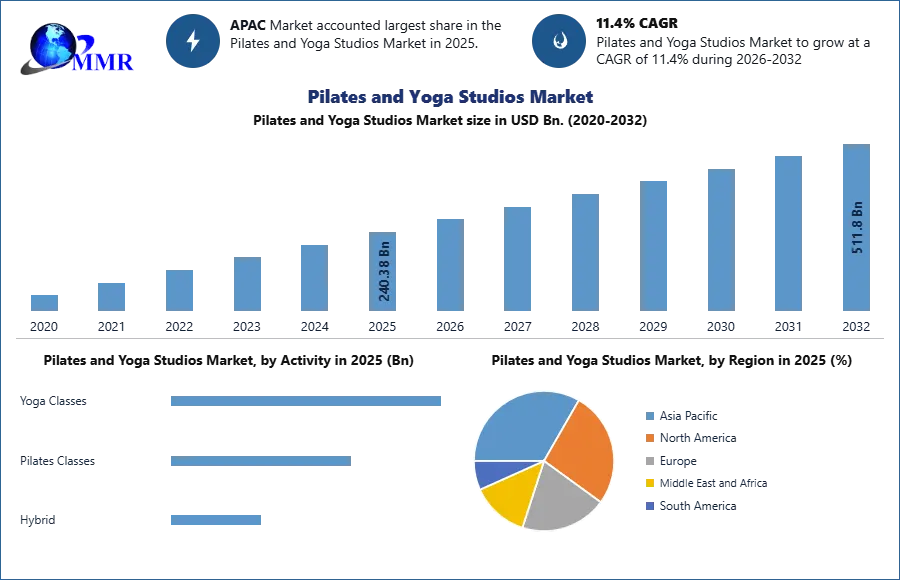
The global Pilates and yoga studios market achieved a valuation of USD 240.38 billion in 2025, establishing a robust baseline for wellness infrastructure investment.
Total revenue is expected to grow at an 11.4% CAGR from 2026 through 2032, reaching nearly USD 511.8 billion.
The internet fitness sub-sector is forecasted to exceed USD 59 billion by 2032, driving significant capital allocation toward virtual architectures.
The yoga sub-segment maintains dominant market share through 2032, capitalizing on widespread consumer adoption and therapeutic health trends.
Asia-Pacific represents the most established and rapidly expanding regional market, anchored by deep-rooted training infrastructure in India and China.
High threat of new entrants forces established operators to deploy aggressive promotional frameworks to defend market share.
Why This Matters Now
The rapid expansion of the alternative healthcare landscape has altered the risk-return profile for commercial real estate developers, corporate wellness allocators, and digital health investors. The escalation of this market to nearly USD 511.8 billion by 2032 demonstrates that low-impact health platforms are no longer discretionary lifestyle choices but core pillars of preventative medicine. As corporate insurance structures increasingly subsidize preventative alternative therapies, studio operators face an immediate imperative to scale operations.
Failure to capture consumer loyalty during this high-growth phase risks permanent displacement by agile, tech-enabled market entrants. Furthermore, the convergence of physical infrastructure with biometric tracking devices creates a high-stakes environment. Traditional standalone operations face rapid obsolescence if they do not integrate data-driven client management architectures immediately.
Market Overview
The global Pilates and yoga studios market stood at USD 240.38 billion in 2025, driven by an accelerating societal shift toward alternative healthcare and structured low-impact conditioning. Data from the Sporting Goods Manufacturers Association shows yoga participation increased fivefold over recent years, expanding dedicated facilities globally. This unprecedented surge in participation has triggered an expansion in the net number of dedicated commercial studio facilities globally.
However, the market faces strong headwinds from alternative physical fitness formats. Studio operators must compete directly against gyms, Zumba franchises, martial arts schools, kickboxing gyms, and dedicated meditation centers that utilize aggressive pricing and discount bundles to capture consumer discretionary spend. To counter these substitutes, the industry is relying heavily on specialized programming, such as High-Intensity Interval Training (HIIT) combination classes that blend traditional low-impact flexibility with metabolic conditioning.
Key Trends Driving Growth
Digital transformation represents the primary catalyst re-shaping industry infrastructure. Virtual training platforms complement traditional locations, with fitness brands deploying proprietary streaming architectures. Gym networks integrating virtual choices recorded a 12% increase in physical class participation, demonstrating that digital accessibility funnels physical studio utilization rather than cannibalizing it.
Concurrently, the proliferation of biometric wearable technology has expanded beyond basic tracking into comprehensive health metrics monitoring, including body temperature, stress levels, sleep cycles, and heart rates. This data integration allows personal trainers and studio franchises to offer highly tailored, hyper-personalized routines that align with macro corporate investments, as evidenced by biometric developer Whoop securing USD 200 million in funding rounds. Furthermore, consumer demand has shifted decisively toward low-impact, joint-friendly strengthening regimes that prioritize functional daily movement, allowing specialized boutique concepts like the Pure Barre franchise to achieve significant market scale through micro-movement training methodologies.
Segment Insights
Dominant Segment: Yoga Sub-Segment. The yoga category is projected to maintain its leading market share position through 2032, supported by consumer recognition of its structural advantages in flexibility, blood pressure regulation, weight management, and muscular endurance. This continuous demand guarantees stable recurring revenue streams for operators focusing on traditional asana methodologies.
Fastest-Growing Segment: Online and Virtual Facilities. Propelled by shifting workspace dynamics and convenience-driven consumer demands, the virtual training infrastructure is expanding rapidly to surpass USD 59 billion by 2032. This swift growth offers massive capital optimization opportunities, allowing trainers to provide services globally without geographical constraints.
End-User Dynamics: Women, Men, and Kids. While women’s historical adoption drives core studio utilization, operators are increasingly diversifying class formats to capture underserved male and youth demographics, optimizing off-peak facility capacity.
Regional Growth Story
Asia-Pacific is the most established and fastest-growing market, structurally supported by traditional lineage and institutional training frameworks. China and India serve as primary instructor supply hubs with numerous academies where students train under masters, lowering labor acquisition costs while maintaining instructional quality.
Concurrently, Pilates is experiencing accelerating mainstream adoption across major metropolitan hubs in India and China, heavily influenced by high-profile cultural figures and celebrity endorsements. For example, prominent facilities such as the Pilates and Altitude Training Studio in Santacruz West, Mumbai, have established premium brand equity by catering to elite Bollywood clienteles. This trend highlights a broader regional shift where rising middle-class disposable income is being actively reallocated toward premium, high-margin wellness services, prompting international franchises to accelerate their capital deployment across developing Asian economic zones.
Competitive Landscape
The market exhibits high competitive rivalry and heavy fragmentation. Because there is zero supplier engagement or raw material dependency in operating these studios, supplier bargaining power remains low, allowing operators to retain absolute pricing control over internal assets. Conversely, the threat of new entrants is exceptionally high, as low initial capital barriers allow independent trainers to open boutique facilities rapidly.
To protect their market share against new entrants and substitute fitness concepts, established industry leaders are deploying sophisticated commercial strategies. These include offering deep structural discounts on upfront membership fees and providing complimentary bonus months on annual subscription packages. Buyers currently hold a moderate level of bargaining power, which is further amplified by consumer collective bargaining, where small groups organize to negotiate lower tier group membership rates from competing studio chains.
Recent Developments
Multi-modality class architectures have expanded, with studios launching specialized hybrid formats that blend high-intensity interval training with traditional Pilates mat-work to capture broader consumer demographics.
Digital personal training models have decoupled from geographical constraints, enabling cross-border virtual training sessions that maximize trainer monetization rates via high-speed internet infrastructures.
Boutique fitness franchising has accelerated globally, with major brands leveraging standardized operational blueprints to rapidly scale geographic footprints without incurring direct corporate real estate debt.
Strategic Implications
For institutional investors and real estate planners, the transition into a half-trillion-dollar industry necessitates shifting asset allocation strategies. Landlords must view boutique wellness studios as critical anchor tenants driving consistent foot traffic, given that virtual offerings boost physical class attendance by 12%. Investment capital must prioritize omni-channel operational models that combine premium brick-and-mortar facilities with robust digital subscription platforms to maximize customer lifetime value.
Furthermore, because the threat of new entrants remains structurally high, operators must invest heavily in proprietary technology, such as specialized booking applications and integrated wearable metrics, to build high switching costs for consumers. Independent studios that fail to offer personalized data integration or multi-modality class options will likely face margin compression as larger, well-capitalized corporate franchises utilize economies of scale to underbid membership pricing.
Future Outlook
The global Pilates and yoga studios market will continue its structural formalization through 2032, driven by the irreversible integration of digital fitness ecosystems and rising consumer valuation of low-impact physical longevity. Market leaders will be determined by their capacity to execute an omni-channel strategy that leverages biometric data to drive hyper-personalized training outcomes, while pure-play physical studios failing to digitize risk complete market obsolescence.
Analyst Perspective
“The global shift toward preventative alternative healthcare has structurally solidified the economics of the studio market,” stated Ankita Kagawade, Lead Analyst at Maximize Market Research. “Operators who successfully merge physical boutique environments with advanced biometric wearable metrics will secure unprecedented consumer retention and pricing leverage over the next decade.”
About Maximize Market Research
Maximize Market Research Pvt. Ltd. (MMR) is a global market research and consulting company that provides reliable, data-focused, and practical business insights. The firm serves a wide range of industries, including healthcare, pharmaceuticals, technology, automotive, electronics, chemicals, personal care, and consumer goods. Through market forecasts, competitive analysis, strategic consulting, and industry impact assessments, MMR helps organizations understand changing market conditions, identify growth opportunities, and make informed business decisions for long-term success.
2nd Floor, Navale IT Park Phase 3
Pune Banglore Highway, Narhe
Pune, Maharashtra 411041, India
+91 9607365656
sales@maximizemarketresearch.com
