Key Highlights
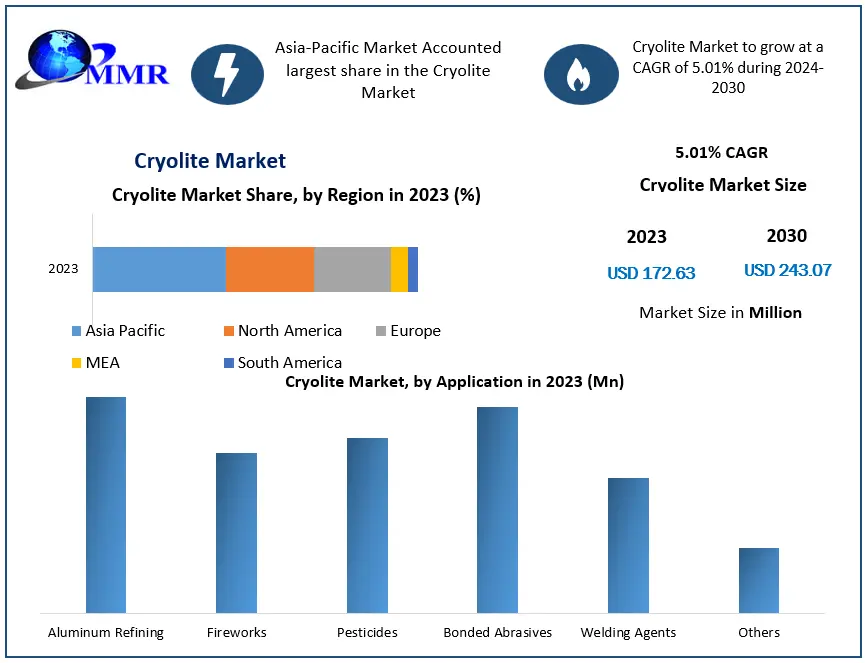
Market valuation will expand from US $ 172.63 Million in 2023 to US $ 243.07 Million by 2030, establishing a steady 5.01% compounding annual growth rate.
Aluminum refining stands as the foundational application pillar, relying on molten cryolite as a critical solvent to optimize the Hall-Héroult extraction process.
The automotive industry represents the dominant revenue-generating segment, driven by the pressing need for vehicular weight reduction to maximize electric vehicle range.
Asia-Pacific maintains structural leadership in production and consumption, backed by intensive investments in vehicle manufacturing across India and China.
Natural cryolite scarcity forces a total industrial reliance on synthetic sodium aluminum fluoride derived from fluorite minerals.
Regulatory interventions targeting the fireworks manufacturing industry act as the primary operational constraint on secondary demand segments.
Why This Matters Now
Volatile energy markets and aggressive carbon reduction mandates are forcing global aluminum smelters and chemical manufacturers to fundamentally overhaul their processing efficiencies. If industrial buyers and procurement heads fail to secure reliable, long-term contracts for synthetic cryolite fluxes, their refining operations risk facing severe cost inflation or complete production shutdowns.
The industrial shift toward electric vehicles requires massive volumes of lightweight aluminum, transforming cryolite from a standard metallurgical chemical into a highly strategic industrial asset. Because natural cryolite deposits are virtually exhausted, the entire metallurgical supply chain hinges completely on the processing stability of synthetic sodium aluminum fluoride manufacturers. This creates an immediate need for capital expenditure deployment in fluorochemical refining hubs to ensure upstream security.
Market Overview
The Cryolite Market operates as the absolute operational foundation of the modern primary aluminum extraction industry. Historically utilized as a direct aluminum ore, the extreme scarcity of natural mineral deposits shifted the entire commercial landscape toward synthetic sodium aluminum fluoride production, utilizing fluorite as the principal feedstock. In the standard Hall-Héroult refining method, molten cryolite functions as an indispensable solvent for aluminum oxide, or bauxite derivatives like gibbsite, boehmite, and diaspore.
Pure aluminum oxide features an incredibly high melting threshold ranging between 2000 and 2500 degrees Celsius, which requires cost-prohibitive levels of energy to process independently. Introducing synthetic cryolite as a chemical flux drastically depresses this operational melting environment down to a manageable 900 to 1000 degrees Celsius. Furthermore, this chemical combination significantly improves overall electrical conductivity during electrolysis, enabling cost-effective separation of aluminum from oxygen atoms.
This operational efficiency directly dictates the economic viability of global primary aluminum producers. The global market valuation reflected this critical dependence with an established baseline of US $ 172.63 Million in 2023. As industrial smelting capacities expand globally to feed downstream consumer, construction, and electronic manufacturing channels, the market size is set to reach US $ 243.07 Million by 2030, progressing at a stable 5.01% CAGR.
Key Trends Driving Growth
The overarching catalyst driving global demand is the rapid structural transformation of the transportation sector. Regulatory authorities in the United States, Europe, and Asia are enforcing strict carbon emission boundaries, which forces automotive engineering groups to prioritize aggressive vehicle weight reductions. Because a vehicle’s overall fuel consumption and electric battery range are directly proportional to its structural mass, aluminum consumption per vehicle is rising rapidly.
This growing demand for aluminum translates into an immediate, non-negotiable requirement for synthetic cryolite fluxes at primary smelting plants. Beyond standard passenger vehicles, the booming aerospace and defense manufacturing sectors are amplifying consumption requirements. Rising commercial air passenger volumes alongside heightened military defense procurement globally require extensive production of high-performance, lightweight structural alloys.
Concurrently, the expansion of high-tech manufacturing adds secondary momentum to the global market. The global rollout of autonomous vehicles, advanced telecommunications infrastructure, and next-generation home electronics requires substantial aluminum casing and internal component integration. These expanding high-volume assembly lines ensure a continuous, long-term consumption runway for cryolite producers worldwide.
Segment Insights
Dominant Application Segment: Aluminum Refining
The aluminum refining sector maintains absolute dominance over global market revenues, functioning as an essential process input rather than an optional additive. Because alternative chemical fluxes cannot match its specific capability to lower the melting point of aluminum oxide while preserving high electrical conductivity, smelters are completely dependent on synthetic cryolite. This structural lock-in guarantees that the segment’s growth trajectory will mirror broader global primary aluminum production volumes throughout the forecast period.
Fastest-Growing Segment: Automotive Applications
The automotive manufacturing application segment represents the fastest-growing revenue stream inside the global marketplace. The rapid transition from internal combustion engines to large-scale battery electric vehicle platforms is driving unprecedented demand for lightweight aluminum structural castings, battery enclosures, and body panels. This sharp consumption spike forces chemical suppliers to realign their distribution networks directly toward major automotive production clusters.
Regional Growth Story
The Asia-Pacific region held the largest global market share in 2023, anchored by massive chemical refining assets and manufacturing hubs across China and India. India’s domestic market is experiencing high growth as the nation works toward its stated goal of complete electric vehicle transition by 2030 to mitigate urban carbon footprints. This government policy framework has catalyzed major domestic infrastructure investments from top-tier aerospace and defense companies, including Boeing, Honeywell International Inc., and BAE Systems, driving localized consumption of advanced aluminum parts.
North America is positioned to sustain rapid growth through 2030, driven by the broad integration of high-performance electronics within the regional healthcare, transit, and telecommunications sectors. The regional supply chain is highly sensitive to input energy costs, making cryolite’s energy-saving properties critical for local smelters looking to remain globally competitive.
Across Europe, industrial demand is tightly linked to state-supported aerospace and military modernization programs. The European Union’s dedicated 2023 policy frameworks, including the Preparatory Action on Defense Research and the European Defense Research Programme, have funneled significant capital into regional defense manufacturing, driving steady demand for high-grade chemical fluxes across the continent’s industrial bases.
Competitive Landscape
The global cryolite marketplace is highly consolidated, with a select group of specialized fluorochemical companies controlling the majority of synthetic sodium aluminum fluoride production capacity. These top-tier market participants possess sophisticated supply chains designed to source high-grade fluorite feedstock, manage hazardous chemical syntheses, and maintain strict quality control standards for international smelting clients.
Prominent market participants driving global supply include:
Do-Fluoride Chemicals
Fluorsid
Fluoro Chemicals
Purex Global
S B Chemicals
Solvay
Dupre Minerals Limited
Sanyo Corporation of America
Henan Buckton industry & commerce co., ltd
Jay Intermediates & Chemicals
Derivados del Fluor
Xinhai Chemicals Co.
Yuzhou FlwordChemical Co.
Skyline Chemical Corporation
Recent Developments
Upstream fluorite mining restrictions and environmental audits in major producing nations have triggered a shift toward synthetic manufacturing methods that optimize raw material consumption.
Strategic cross-border distribution partnerships are expanding between synthetic cryolite producers and international logistics firms to mitigate post-pandemic maritime freight interruptions.
Strict environmental regulations targeting safety and emission controls in the global fireworks sector have reduced demand for cryolite as a yellow colorant, forcing suppliers to reallocate excess capacity toward the aluminum sector.
Strategic Implications
The total lack of viable natural cryolite reserves introduces a critical supply chain vulnerability for the entire primary metals sector. Smelters and procurement managers must accept that their operational continuity rests entirely on the manufacturing capacities and feedstock access of synthetic fluorochemical producers. Any supply disruption in upstream fluorite mining or synthetic processing facilities will quickly cause supply shortages and price spikes at primary smelting locations.
To hedge against this systemic risk, forward-looking aluminum refiners are forming deeper, multi-year supply partnerships with key chemical producers like Fluorsid, Solvay, and Do-Fluoride Chemicals. At the same time, chemical manufacturers are investing heavily in advanced synthesis technologies to improve production yields and reduce energy consumption during the fluorite-to-cryolite conversion process.
Future Outlook
The global cryolite market will continue its steady expansion through 2030, anchored entirely by the critical role it plays in cost-efficient aluminum production. While secondary applications face structural headwinds from strict environmental laws—particularly the tightening regulations on global fireworks manufacturing—the massive consumption runway provided by the global electric vehicle and aerospace sectors will more than offset these losses. Chemical companies that successfully secure stable fluorite feedstocks and optimize their refining efficiencies are well-positioned to capture dominant market share, while unhedged buyers face significant supply chain vulnerabilities.
Analyst Perspective
“The global cryolite sector is undergoing a major structural shift as natural resource exhaustion gives way to advanced synthetic fluorochemical manufacturing,” stated Ankita Kagawade, Lead Analyst at Maximize Market Research. “Procurement managers in the primary aluminum and automotive supply chains must look past short-term pricing fluctuations and actively invest in securing resilient, long-term supply agreements for synthetic sodium aluminum fluoride. As global electric vehicle assembly lines scale up through 2030, access to efficient chemical fluxing agents will separate low-cost, high-yield metallurgical operators from those squeezed out by rising energy and material inputs.”
About Maximize Market Research
Maximize Market Research Pvt. Ltd. (MMR) is a global market research and consulting company that provides reliable, data-focused, and practical business insights. The firm serves a wide range of industries, including healthcare, pharmaceuticals, technology, automotive, electronics, chemicals, personal care, and consumer goods. Through market forecasts, competitive analysis, strategic consulting, and industry impact assessments, MMR helps organizations understand changing market conditions, identify growth opportunities, and make informed business decisions for long-term success.
2nd Floor, Navale IT Park Phase 3
Pune Banglore Highway, Narhe
Pune, Maharashtra 411041, India
+91 9607365656
sales@maximizemarketresearch.com
