Laminated Labels Market: Enhancing Product Durability and Brand Visibility Across Industries
The Laminated Labels Market is witnessing steady growth as businesses increasingly prioritize product durability, regulatory compliance, and premium packaging solutions. Laminated labels are widely used across industries because they offer superior resistance to moisture, chemicals, abrasion, UV exposure, and temperature fluctuations. These protective qualities make them ideal for products that require long-lasting identification, branding, and traceability throughout their lifecycle.
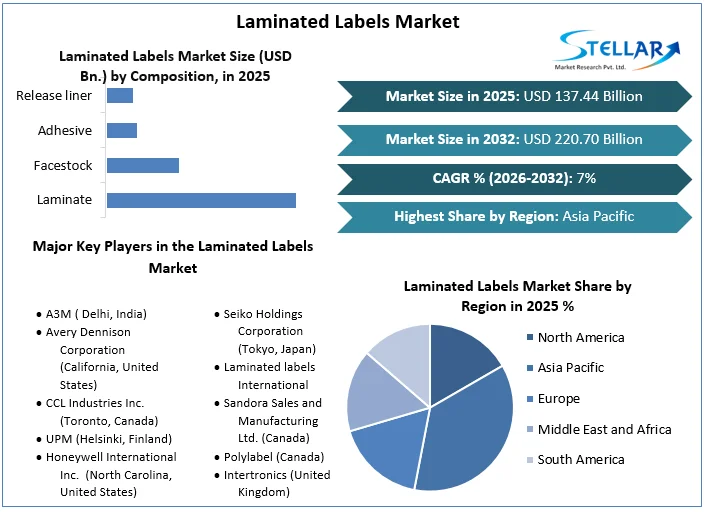
As global manufacturing expands and consumer expectations for high-quality packaging continue to evolve, laminated labels have become an essential component in sectors such as food and beverages, pharmaceuticals, personal care, chemicals, logistics, and consumer electronics. Advances in printing technology, sustainable packaging initiatives, and digital labeling solutions are further shaping the industry’s future, creating new opportunities for manufacturers and packaging providers worldwide. Laminated Labels Market was valued at USD 137.44 billion in 2025. Global Laminated Labels Market size is estimated to grow at a CAGR of 7% over the forecast period.
Understanding Laminated Labels
Laminated labels consist of printed label materials covered with a transparent protective film that enhances durability while preserving print quality. The lamination process shields labels from environmental damage, including moisture, scratches, oils, and harsh chemicals, ensuring that important product information remains legible throughout storage, transportation, and use.
These labels are available in various finishes, including gloss, matte, and textured coatings, allowing manufacturers to balance functional performance with aesthetic appeal. Modern laminated labels are compatible with barcode printing, QR codes, RFID integration, and variable data printing, making them increasingly valuable in today’s connected supply chains.
Key Market Growth Drivers
Rising Demand for Premium Product Packaging
Consumers increasingly associate attractive packaging with product quality. As brands seek to differentiate themselves in competitive retail environments, laminated labels have become a preferred solution for delivering vibrant graphics, enhanced shelf appeal, and long-lasting brand visibility.
Premium packaging is particularly important in cosmetics, beverages, luxury goods, and specialty food products, where product presentation directly influences purchasing decisions.
Expansion of Food and Beverage Industry
The global food and beverage industry continues to generate significant demand for durable labeling solutions. Products stored under refrigerated, frozen, or humid conditions require labels that can withstand challenging environments without peeling or fading.
Laminated labels help manufacturers maintain regulatory compliance by ensuring nutritional information, expiration dates, ingredients, and barcode data remain clearly visible throughout the product’s shelf life.
Growth in Pharmaceutical and Healthcare Packaging
The pharmaceutical sector relies heavily on high-performance labels to support patient safety, product authentication, and regulatory compliance. Laminated labels protect critical medical information from environmental exposure while improving resistance to sterilization processes and chemical handling.
As healthcare regulations become more stringent worldwide, demand for durable and tamper-resistant labeling solutions continues to increase.
Technology Transforming the Industry
Technological innovation is reshaping the Laminated Labels Market through advancements in digital printing, automation, and smart packaging.
Digital printing technologies allow manufacturers to produce shorter print runs with faster turnaround times while enabling product personalization and variable data printing. This flexibility supports evolving consumer preferences and increasingly customized packaging strategies.
Smart labeling technologies are also gaining momentum. QR codes, NFC tags, RFID-enabled labels, and digital authentication features provide consumers with instant access to product information, authenticity verification, sustainability data, and traceability throughout the supply chain.
Automation in label production has significantly improved manufacturing efficiency, reduced material waste, and enhanced quality consistency. Modern inspection systems powered by machine vision and artificial intelligence enable real-time quality control, minimizing defects during production.
Sustainability Driving Market Innovation
Sustainability has become one of the most influential trends in the packaging industry. Manufacturers are developing environmentally responsible laminated label solutions that reduce environmental impact without compromising performance.
Innovations include recyclable laminates, biodegradable films, water-based adhesives, and thinner protective coatings that minimize material consumption. Many companies are redesigning label structures to improve compatibility with recycling systems while reducing overall packaging waste.
Governments and brand owners are also encouraging sustainable packaging practices through environmental regulations and corporate ESG commitments. As a result, eco-friendly laminated labels are becoming an increasingly important area of product development and investment.
Regional Market Insights
North America
North America represents a mature market driven by advanced packaging technologies, strict labeling regulations, and strong demand across food, pharmaceutical, and consumer goods industries. Companies continue investing in digital printing and smart labeling solutions to improve supply chain efficiency and consumer engagement.
Europe
Europe remains a key market due to its emphasis on sustainable packaging, circular economy initiatives, and stringent product labeling requirements. Regulations promoting recyclable packaging materials are encouraging manufacturers to introduce environmentally friendly laminated label solutions.
The region also benefits from well-established pharmaceutical, food processing, and cosmetics industries that require high-quality labeling products.
Asia-Pacific
Asia-Pacific is the fastest-growing regional market, supported by rapid industrialization, expanding manufacturing capabilities, increasing retail activity, and rising consumer spending. Countries such as China, India, Japan, and South Korea are experiencing growing demand for packaged foods, personal care products, electronics, and pharmaceuticals.
The expansion of e-commerce platforms has further increased demand for durable shipping and logistics labels capable of withstanding complex transportation environments.
Latin America and Middle East & Africa
These emerging regions present promising growth opportunities as investments in food processing, healthcare infrastructure, retail modernization, and industrial manufacturing continue to expand. Improving packaging standards and growing exports are expected to support long-term market development.
Competitive Landscape
- A3M ( Delhi, India)
- Avery Dennison Corporation (California, United States)
- CCL Industries Inc. (Toronto, Canada)
- UPM (Helsinki, Finland)
- Honeywell International Inc. (North Carolina, United States)
- Tesa SE-A Beiersdorf Company (Hamburg, Germany)
- Seiko Holdings Corporation (Tokyo, Japan)
- Laminated labels International
- Sandora Sales and Manufacturing Ltd. (Canada)
Download Free PDF Brochure: https://www.stellarmr.com/report/req_sample/Laminated-Labels-Market/383
Challenges Facing the Market
Despite favorable growth prospects, the industry faces several challenges. Fluctuating raw material prices for films, adhesives, inks, and specialty papers can impact production costs and profitability. Environmental concerns regarding plastic-based laminates continue to encourage manufacturers to invest in more sustainable alternatives.
Additionally, maintaining compatibility between label materials, packaging substrates, and recycling systems requires continuous product innovation and collaboration across the packaging value chain.
Future Outlook
The future of the Laminated Labels Market will be shaped by increasing demand for durable packaging, digital transformation, and sustainable material innovation. As brands focus on improving consumer engagement, supply chain transparency, and regulatory compliance, advanced laminated labels will play an increasingly strategic role.
Emerging technologies such as intelligent packaging, digital authentication, AI-powered quality inspection, and environmentally friendly laminate materials are expected to create new business opportunities across multiple industries. Growing investments in e-commerce, pharmaceuticals, food processing, and consumer goods manufacturing will continue to drive demand for high-performance labeling solutions.
Organizations that prioritize innovation, sustainability, customization, and operational efficiency will be best positioned to capitalize on evolving market requirements. With packaging becoming an essential component of brand identity and product protection, the Laminated Labels Market is expected to remain a vital segment of the global packaging industry for years to come.
Media Contact
Stellar Market Research
Website: Stellar Market Research – Global Research Reports & Consulting
Email: sales@stellarmr.com
