Key Highlights
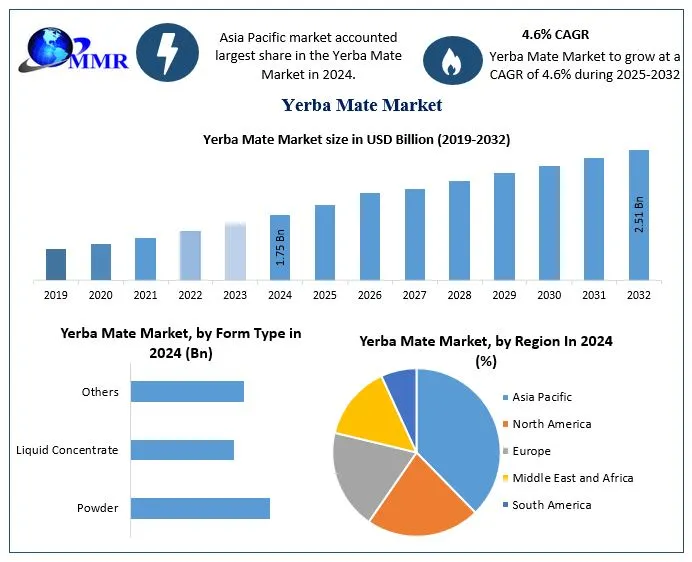
- The Yerba Mate Market was valued at USD 1.75 Bn in 2024 and is expected to reach nearly USD 2.51 Bn by 2032, giving beverage and supplement brands a larger natural-energy category to compete in.
- The market is forecast to grow at a 4.6% CAGR from 2025 to 2032, supported by health-conscious consumers and demand for alternatives to tea, coffee and other beverages.
- Powder is expected to hold the largest form-type share by 2032, making dry formats central to product innovation, retail distribution and supplement use.
- Food and beverage accounts for the majority market share by application, supported by yerba mate’s use as a herbal tea with caffeine-like characteristics.
- Asia Pacific held the highest share in 2024, with India and China driving demand through food and beverage and cosmetic and personal care applications.
Why This Matters Now
Energy drinks, coffee and tea are facing a quieter challenger. Yerba mate is moving from South American tradition into the global wellness aisle, where consumers want stimulation, antioxidants and functional positioning in one product.
The Yerba Mate Market rise from USD 1.75 Bn in 2024 to USD 2.51 Bn by 2032 shows that yerba mate is not only a beverage story. It is becoming an ingredient platform for drinks, supplements, functional food, and cosmetic and personal care brands.
Market Overview
Yerba mate is a herbal tea produced from the leaves and twigs of the Ilex paraguariensis plant. The leaves are usually dried over fire and steeped in boiling water, and the beverage is traditionally consumed from a gourd through a filtered metal straw.
The product has the energy profile of coffee, the health positioning of tea and the sensory appeal associated with chocolate. That combination gives beverage brands a route into natural caffeine, functional hydration and wellness-led refreshment without relying only on conventional tea or coffee formats.
The market is segmented by form type into powder, liquid concentrate and others; by distribution channel into offline and online; and by application into food and beverage, dietary supplement, cosmetic and personal care, functional food and others.
Key Trends Driving Growth
Health-led beverage substitution is the main driver. MMR states that yerba mate contains high levels of antioxidants, zinc, selenium and other nutrients, and is linked with immunity, digestion, lower heart-disease risk, lower blood sugar, reduced obesity and stress management. That health profile gives brands a strong reason to position yerba mate against coffee, tea and sugary beverages.
Consumer behavior is shifting toward functional routines. Rising use of yerba mate for physical and mental health is supporting demand, while consumers are becoming more health-conscious as disease awareness spreads. This favors brands that can explain benefits clearly without overcomplicating the product.
Cosmetic and personal care applications are widening the market. MMR states that yerba mate use is rising in hair care and skincare, giving ingredient suppliers a second demand channel beyond beverages and supplements.
E-commerce is supporting category access. Online platforms provide more discounts, wider purchase options and home delivery, which matters for a product still unfamiliar in many countries. Digital retail can reduce discovery barriers faster than traditional shelf expansion.
The main restraint is awareness. Yerba mate is consumed in fewer countries, and many consumers still do not know the product. Caffeine content can also cause insomnia, nervousness and elevated blood pressure in some people, which makes responsible positioning important.
Request a Free Sample Report for Comprehensive Market Insights
Segment Insights
- Dominant Segment Powder: Powder is expected to hold the largest form-type share by 2032. Its advantage comes from convenience, better absorption by the body, and use in capsules and tablets as a dietary supplement.
- Dominant Application Food and Beverage: Food and beverage accounts for the majority market share. Yerba mate’s use as a herbal tea with caffeine-like characteristics makes drinks the category’s core commercial base.
- Fastest-Growing Segment: The public MMR page says food and beverage and online distribution are expected to grow rapidly, but it does not identify a single fastest-growing segment or disclose numeric segment CAGRs.
- Distribution Opportunity Online: Online is expected to grow rapidly because retailers provide discounts, wider choice and home delivery. That gives emerging brands a lower-cost route to education and trial.
- Clean-Label and Sustainability: The public page does not disclose clean-label demand or sustainability initiatives. It does support a natural wellness narrative through yerba mate’s herbal origin and nutrient positioning.
Regional Growth Story
Asia Pacific dominates the market and held the highest share in 2024. Growth is tied to a rising middle-class population, changing living standards and increasing health awareness.
India and China are the key regional demand centers disclosed by MMR. Both countries are driving market growth through food and beverage and cosmetic and personal care industries, helped by middle-class expansion and western lifestyle influence.
The report also covers North America, Europe, the Middle East and Africa, and South America. Country coverage includes the United States, Canada, Mexico, the UK, France, Germany, Italy, Spain, China, South Korea, Japan, India, Brazil and Argentina, but the public page does not disclose country-level market values.
Competitive Landscape
The market includes Pure Leaf Naturals, Exalted Teas, Guayaki, Yerbaé, Wisdom Essentials, Bayu Drinks, Go Mate, Selecta Group, Mate Factor, Ésah Tea, ESTABLECIMIENTO LAS MARIAS, Amanda, Romance, Pajarito, Sara, Taragui, Kurupi, Rosamonte, Triunfo, Andresito, Molinos, Canarias and La Tranquera.
Competition is split between traditional yerba mate producers and newer wellness beverage brands. South American players carry origin credibility, while North American and European brands can package yerba mate for functional beverages, supplements and lifestyle retail.
The public page does not disclose dated M&A, partnerships or divestitures. It states that the report evaluates key players by product, price, financial position, product portfolio, growth strategies and regional presence, but transaction-level facts are not visible.
Over the next 12–24 months, competitive pressure will likely center on powder formats, online distribution, functional claims and personal care applications. Brands that educate consumers clearly will have an advantage over suppliers selling yerba mate only as a niche imported tea.
Recent Developments
- E-Commerce Expansion: Online distribution is expected to grow rapidly because of discounts, wider product choice and home delivery. This supports trial in markets where yerba mate awareness remains low.
- Personal Care Adoption: Rising use in hair care and skincare is supporting demand from the cosmetic and personal care industry. This expands the market beyond beverage-only applications.
- Social Media Awareness: Facebook, Instagram, Twitter and healthcare blogs are increasing health awareness, which is supporting the global yerba mate market.
Strategic Implications
For beverage companies, yerba mate offers a natural caffeine story with broader wellness positioning. The challenge is consumer education, because awareness remains limited outside established consumption markets.
For supplement brands, powder creates the clearest route to capsules, tablets and functional blends. Better absorption and convenience make powder the most commercially useful format in the visible source data.
For retailers, online channels matter because they allow product comparison, discounting and direct education. Yerba mate needs explanation, and digital product pages can do more selling work than a crowded beverage shelf.
Future Outlook
The Yerba Mate Market is forecast to grow from USD 1.75 Bn in 2024 to nearly USD 2.51 Bn by 2032 at a 4.6% CAGR. Growth will come from health-conscious consumers, beverage substitution, powder formats, online retail, dietary supplements, functional food and cosmetic and personal care use.
Winners will turn yerba mate into a clear wellness proposition across drinks, supplements and personal care; losers will remain trapped in a niche tea category with weak consumer education.
Analyst Perspective
“Yerba mate is gaining relevance as consumers look for natural energy, antioxidants and wellness-linked beverages beyond conventional tea and coffee,” said Siddhi Dole, Analyst at Maximize Market Research. “The strongest brands will combine powder-format convenience, credible health messaging, online availability and cross-category applications in supplements and personal care.”
About Maximize Market Research
Maximize Market Research Pvt. Ltd. (MMR) is a global market research and consulting company that provides reliable, data-focused, and practical business insights. The firm serves a wide range of industries, including healthcare, pharmaceuticals, technology, automotive, electronics, chemicals, personal care, and consumer goods. Through market forecasts, competitive analysis, strategic consulting, and industry impact assessments, MMR helps organizations understand changing market conditions, identify growth opportunities, and make informed business decisions for long-term success.
Contact Us
2nd Floor, Navale IT Park Phase 3
Pune Banglore Highway, Narhe
Pune, Maharashtra 411041, India
+91 9607365656
sales@maximizemarketresearch.com
