Pressure Sensor Market: Driving the Next Generation of Smart Sensing Technologies
The Pressure Sensor Market is experiencing remarkable growth as industries worldwide embrace automation, smart manufacturing, electric mobility, and connected healthcare systems. Pressure sensors have become indispensable components in modern electronic and industrial equipment, enabling accurate measurement of pressure variations in liquids, gases, and air. Their ability to enhance operational efficiency, safety, and process reliability has made them essential across automotive, consumer electronics, medical devices, industrial automation, aerospace, oil & gas, and energy sectors.
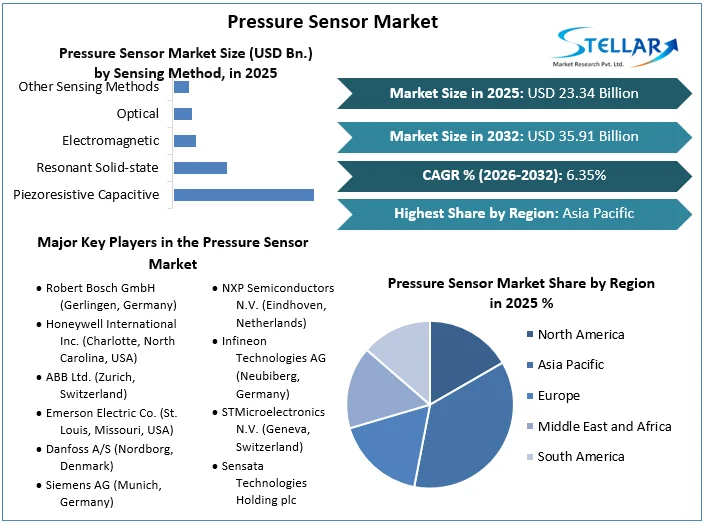
With the rapid adoption of Industry 4.0 technologies and Internet of Things (IoT)-enabled systems, demand for intelligent sensing solutions continues to accelerate. Pressure sensors are evolving beyond simple measurement devices into smart components capable of transmitting real-time data for predictive maintenance, process optimization, and remote monitoring. As industries prioritize digital transformation, the market is expected to witness sustained expansion throughout the forecast period. The Pressure Sensor Market size was valued at USD 23.34 Billion in 2025 and the total Global Pressure Sensor revenue is expected to grow at a CAGR of 6.35% from 2026 to 2032, reaching nearly USD 35.91 Billion by 2032
Growing Demand for Smart Industrial Automation
Industrial automation remains one of the strongest growth drivers for the Pressure Sensor Market. Manufacturers are increasingly deploying automated production lines equipped with advanced sensors to improve precision, minimize downtime, and reduce operational costs. Pressure sensors play a critical role in hydraulic systems, pneumatic equipment, compressors, pumps, boilers, and manufacturing machinery.
The rise of smart factories has significantly increased the need for continuous monitoring of industrial processes. Real-time pressure measurement enables predictive maintenance by identifying equipment abnormalities before failures occur, helping organizations reduce maintenance expenses while improving productivity.
As industries invest in digital manufacturing infrastructure, pressure sensors are becoming integral components of intelligent monitoring systems that support operational excellence.
Automotive Electrification Creates New Growth Opportunities
The global transition toward electric vehicles (EVs) is transforming the pressure sensor landscape. Modern EVs require sophisticated pressure monitoring across battery thermal management systems, braking systems, air conditioning units, tire pressure monitoring systems (TPMS), and cooling circuits.
Advanced driver assistance systems (ADAS), autonomous driving technologies, and connected vehicles also rely on highly accurate sensing technologies to ensure vehicle safety and performance. Pressure sensors help optimize fuel efficiency in conventional vehicles while improving battery efficiency and thermal stability in electric models.
Increasing government incentives for EV adoption, stricter emission regulations, and growing consumer demand for safer vehicles continue to create long-term opportunities for sensor manufacturers.
Healthcare Sector Expands Sensor Applications
Healthcare has emerged as another major application area for pressure sensors. Hospitals and medical device manufacturers increasingly use these sensors in ventilators, infusion pumps, blood pressure monitors, dialysis equipment, respiratory devices, and patient monitoring systems.
The growing emphasis on remote patient monitoring and wearable healthcare technologies has accelerated demand for compact, energy-efficient, and highly accurate pressure sensors. Miniaturization technologies now allow manufacturers to integrate sensors into portable medical devices without compromising measurement precision.
As aging populations increase worldwide and healthcare infrastructure expands in emerging economies, the medical sector is expected to remain a significant contributor to market growth.
MEMS Technology Revolutionizing Pressure Sensors
Micro-Electro-Mechanical Systems (MEMS) technology has fundamentally transformed pressure sensor manufacturing. MEMS-based pressure sensors offer smaller size, lower power consumption, improved durability, faster response times, and greater accuracy compared to traditional sensor technologies.
These advantages have enabled their widespread adoption in smartphones, wearable electronics, industrial equipment, automotive systems, drones, and consumer electronics. MEMS sensors also support large-scale production at competitive costs, making advanced sensing technology accessible across multiple industries.
Continuous innovation in semiconductor fabrication techniques is expected to further enhance sensor performance while reducing manufacturing costs.
IoT Integration Accelerates Market Growth
The rapid expansion of the Internet of Things has created significant opportunities for pressure sensor manufacturers. Connected sensors enable organizations to collect real-time operational data, monitor equipment remotely, and optimize maintenance schedules through cloud-based analytics.
Smart buildings utilize pressure sensors in HVAC systems to improve energy efficiency, while water management systems employ intelligent sensors to detect leaks and optimize distribution networks. Agriculture is another emerging application, where pressure sensors help automate irrigation systems and improve resource utilization.
As IoT ecosystems continue to expand globally, pressure sensors will become increasingly essential for intelligent infrastructure and connected industrial operations.
Industrial Safety and Environmental Monitoring
Pressure sensors are playing a growing role in industrial safety and environmental compliance. Chemical plants, oil refineries, power generation facilities, and manufacturing units rely on accurate pressure monitoring to prevent accidents and maintain operational safety.
Environmental monitoring applications also continue to expand. Pressure sensors help monitor air quality systems, water treatment facilities, renewable energy installations, and climate monitoring equipment. Governments worldwide are implementing stricter environmental regulations, encouraging industries to adopt advanced sensing technologies for regulatory compliance.
This regulatory environment continues to create new business opportunities for pressure sensor manufacturers.
Regional Market Trends
North America remains one of the leading markets due to strong investments in industrial automation, aerospace, medical technology, and automotive innovation. The presence of major technology companies and continuous research activities supports market expansion across the region.
Europe maintains steady growth through advanced manufacturing capabilities, increasing electric vehicle production, and stringent industrial safety standards. Countries such as Germany, France, and the United Kingdom continue investing heavily in smart manufacturing technologies.
Asia-Pacific is projected to register the fastest growth during the forecast period. Rapid industrialization, expanding electronics manufacturing, rising automotive production, and increasing infrastructure development in China, India, Japan, and South Korea are driving significant demand for pressure sensors. Government initiatives supporting digital manufacturing and semiconductor production further strengthen regional growth prospects.
Meanwhile, Latin America and the Middle East & Africa are witnessing growing adoption of pressure sensing technologies across oil & gas, water treatment, industrial automation, and energy sectors as infrastructure investments continue to rise.
Competitive Landscape
- Robert Bosch GmbH (Gerlingen, Germany)
- Honeywell International Inc. (Charlotte, North Carolina, USA)
- ABB Ltd. (Zurich, Switzerland)
- Emerson Electric Co. (St. Louis, Missouri, USA)
- Danfoss A/S (Nordborg, Denmark)
- Siemens AG (Munich, Germany)
- Schneider Electric SE (Rueil-Malmaison, France)
- TE Connectivity Ltd. (Schaffhausen, Switzerland)
- NXP Semiconductors N.V. (Eindhoven, Netherlands)
- Infineon Technologies AG (Neubiberg, Germany)
Download Free PDF Brochure: https://www.stellarmr.com/report/req_sample/Pressure-Sensor-Market/2262
Future Outlook
The future of the Pressure Sensor Market appears exceptionally promising as digital transformation reshapes industries worldwide. Rising adoption of Industry 4.0, smart factories, connected healthcare, electric vehicles, renewable energy systems, and intelligent infrastructure will continue generating substantial demand for advanced sensing technologies.
Continuous improvements in MEMS technology, wireless communication, artificial intelligence, and IoT integration are expected to create new opportunities for manufacturers while expanding application areas across multiple industries.
As organizations increasingly rely on real-time operational intelligence, pressure sensors will evolve from traditional measurement devices into intelligent data-generation platforms that support predictive maintenance, operational efficiency, and digital decision-making. Companies investing in innovative sensor technologies, sustainable manufacturing practices, and smart connectivity solutions will be well positioned to capitalize on the expanding global market throughout the coming decade.
Media Contact
Stellar Market Research
Website: Stellar Market Research – Global Research Reports & Consulting
Email: sales@stellarmr.com
