Antibody Production Market: Biologics Innovation Accelerating the Future of Precision Medicine
The Antibody Production Market has become one of the fastest-growing segments within the global biopharmaceutical industry as demand for targeted therapies, advanced diagnostics, and precision medicine continues to rise. Antibodies play a critical role in treating cancer, autoimmune diseases, infectious disorders, and rare genetic conditions while supporting research, drug discovery, and clinical diagnostics.
The increasing commercialization of monoclonal antibodies, rapid advances in recombinant DNA technology, and expanding investments in biologics manufacturing are creating new opportunities for pharmaceutical companies, biotechnology firms, and contract development and manufacturing organizations (CDMOs). As healthcare systems worldwide prioritize innovative biologic therapies, the antibody production market is expected to experience sustained growth over the coming years.
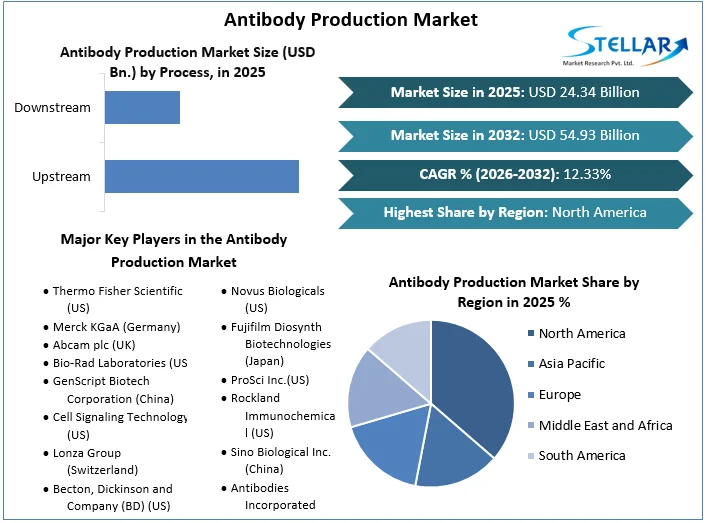
The Antibody Production Market size was valued at USD 24.34 Billion in 2025 and the total Antibody Production Market size is expected to grow at a CAGR of 12.33% from 2026 to 2032, reaching nearly USD 54.93 Billion by 2032.
Rising Demand for Biologics Fueling Market Expansion
The growing use of monoclonal antibodies in therapeutic applications is one of the strongest drivers of the antibody production market. These highly targeted therapies have transformed treatment approaches for oncology, immunology, hematology, and infectious diseases by offering improved efficacy with fewer off-target effects compared to conventional treatments.
The global expansion of biologics pipelines has significantly increased demand for efficient antibody manufacturing technologies. Pharmaceutical companies are investing heavily in production facilities capable of supporting large-scale commercial manufacturing while maintaining strict regulatory compliance and product quality.
In addition, increasing adoption of biosimilars is encouraging manufacturers to expand production capacity and improve manufacturing efficiency. As healthcare providers seek cost-effective biologic alternatives, antibody production continues to play a strategic role in improving patient access to advanced therapies.
Technological Advancements Revolutionizing Antibody Manufacturing
Innovation in bioprocessing technologies is transforming antibody production across the pharmaceutical industry. Modern manufacturing facilities increasingly utilize single-use bioreactors, continuous bioprocessing systems, and automated purification technologies to improve scalability, reduce contamination risks, and lower operational costs.
Artificial intelligence and machine learning are also beginning to influence antibody discovery and manufacturing by accelerating cell-line development, optimizing production parameters, and improving process consistency. These technologies help reduce development timelines while enhancing manufacturing efficiency.
Recombinant antibody production techniques are gaining widespread adoption because they provide higher reproducibility, greater specificity, and reduced dependence on traditional animal-based production methods. Continuous improvements in expression systems and downstream purification are enabling manufacturers to increase antibody yield while maintaining product quality.
Key Growth Drivers of the Antibody Production Market
Increasing Prevalence of Chronic Diseases
The rising incidence of cancer, autoimmune disorders, cardiovascular diseases, and infectious illnesses continues to increase demand for therapeutic antibodies. Healthcare providers increasingly rely on biologics for targeted treatment approaches that improve clinical outcomes while minimizing adverse effects.
Expansion of Precision Medicine
Personalized medicine is creating strong demand for highly specific antibody-based therapeutics. Advances in molecular diagnostics allow clinicians to identify disease-specific biomarkers, enabling more precise treatment selection and driving the need for innovative antibody production technologies.
Growing Investments in Biopharmaceutical Research
Governments, biotechnology companies, and pharmaceutical manufacturers continue investing in biologics research and development. Expanding clinical pipelines, increasing regulatory approvals, and growing collaboration between research organizations and contract manufacturers are accelerating market growth.
Challenges Facing the Market
Despite promising growth prospects, antibody production remains a highly complex and capital-intensive process. Building and operating large-scale biologics manufacturing facilities requires significant investment in specialized equipment, quality systems, and skilled personnel.
Stringent regulatory requirements also present challenges. Manufacturers must comply with Good Manufacturing Practices (GMP), maintain rigorous quality control, and meet international regulatory standards before products receive commercial approval.
Supply chain resilience is another critical consideration. The increasing global demand for biologics requires reliable sourcing of raw materials, cell culture media, and specialized manufacturing components to avoid production disruptions.
Emerging Trends in Antibody Production
The antibody production industry is witnessing rapid adoption of continuous manufacturing, automation, and digital process monitoring. These technologies improve manufacturing flexibility while reducing production costs and batch variability.
Bispecific antibodies and antibody-drug conjugates (ADCs) are emerging as important areas of innovation. These next-generation therapies offer improved targeting capabilities and expanded treatment options for complex diseases.
Contract Development and Manufacturing Organizations (CDMOs) are also becoming increasingly important as pharmaceutical companies outsource manufacturing to improve scalability, reduce capital expenditure, and accelerate commercialization.
Sustainability initiatives are gaining momentum as manufacturers implement energy-efficient facilities, reduce water consumption, adopt single-use manufacturing technologies, and optimize resource utilization throughout production operations.
Regional Market Insights
North America remains the largest antibody production market due to its advanced biotechnology ecosystem, strong pharmaceutical industry, and significant investment in biologics research. The United States continues to lead global antibody innovation through extensive clinical research, favorable regulatory pathways, and the presence of major biotechnology companies.
Europe represents another significant market, supported by strong pharmaceutical manufacturing capabilities, expanding biosimilar adoption, and increasing investment in precision medicine. Countries including Germany, Switzerland, and the United Kingdom continue strengthening biologics manufacturing infrastructure.
Asia-Pacific is expected to register the fastest growth during the forecast period. China, India, South Korea, Japan, and Singapore are rapidly expanding biopharmaceutical manufacturing capabilities through government support, infrastructure development, and increased foreign investment. The region’s growing CDMO sector is also attracting global pharmaceutical companies seeking cost-effective manufacturing solutions.
Competitive Landscape
The antibody production market is characterized by intense competition among global biotechnology companies, pharmaceutical manufacturers, and specialized life science suppliers. Leading companies continue investing in manufacturing expansion, advanced bioprocessing technologies, automation, and strategic partnerships to strengthen their competitive positions.
Major market participants include Thermo Fisher Scientific, Merck KGaA, Danaher Corporation, Sartorius AG, Lonza Group, Charles River Laboratories, WuXi Biologics, AGC Biologics, Bio-Rad Laboratories, and Eppendorf. These companies are expanding production capacity, enhancing process technologies, and collaborating with pharmaceutical firms to support the growing biologics pipeline.
Download Free PDF Brochure: https://www.stellarmr.com/report/req_sample/antibody-production-market/2476
Future Outlook
The future of the Antibody Production Market remains highly promising as biologics continue transforming modern healthcare. Rising demand for monoclonal antibodies, biosimilars, bispecific antibodies, and antibody-drug conjugates will drive sustained investment in advanced manufacturing technologies and production capacity.
Artificial intelligence, continuous bioprocessing, digital manufacturing, and automation will further improve production efficiency while reducing development timelines and operational costs. At the same time, expanding CDMO services and growing healthcare investments in emerging economies will create new opportunities for global market participants.
As precision medicine becomes increasingly central to disease management, antibody production will remain a cornerstone of pharmaceutical innovation. Companies that invest in scalable manufacturing, advanced technologies, regulatory excellence, and sustainable production practices will be well positioned to capitalize on the expanding global demand for antibody-based therapeutics and diagnostics.
Media Contact
Stellar Market Research
Website: Stellar Market Research – Global Research Reports & Consulting
Email: sales@stellarmr.com
