Drive-by-Wire Market: Accelerating the Shift Toward Software-Defined and Autonomous Vehicles
The Drive-by-Wire Market is rapidly transforming the global automotive industry as vehicle manufacturers replace traditional mechanical and hydraulic control systems with advanced electronic architectures. Drive-by-wire technology enables electronic control of steering, braking, throttle, and transmission systems, improving vehicle precision, reducing weight, and supporting the development of electric and autonomous vehicles. As automakers accelerate investments in software-defined vehicles, advanced driver assistance systems (ADAS), and connected mobility, demand for drive-by-wire solutions continues to rise across passenger and commercial vehicle segments. Industry analysts expect robust long-term growth, fueled by electrification, autonomous driving, and stringent vehicle safety regulations.
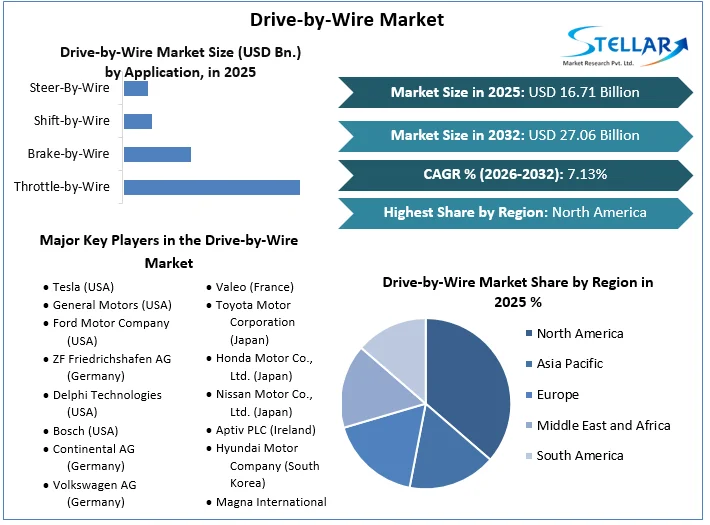
The Drive-by-Wire Market size was valued at USD 16.71 Billion in 2025 and the total Drive-by-Wire Market size is expected to grow at a CAGR of 7.13% from 2026 to 2032, reaching nearly USD 27.06 Billion by 2032.
Download Free PDF Brochure: https://www.stellarmr.com/report/req_sample/drive-by-wire-market/2490
Growing Demand for Electric and Autonomous Vehicles
The automotive industry is undergoing a significant transformation driven by the rapid adoption of electric vehicles (EVs). Unlike conventional vehicles, EV platforms are designed around electronic architectures that integrate seamlessly with drive-by-wire systems. By eliminating mechanical linkages, manufacturers can reduce vehicle weight, improve energy efficiency, and optimize cabin design while enhancing driving performance.
Autonomous driving technologies are creating another major growth opportunity. Higher levels of vehicle automation require electronically controlled steering, braking, and acceleration systems capable of responding instantly to sensor inputs. Drive-by-wire provides the foundation for these autonomous capabilities, making it an essential technology for next-generation mobility solutions.
Automotive manufacturers are increasingly integrating drive-by-wire technology into premium passenger vehicles before expanding adoption across mass-market models, reflecting growing consumer demand for enhanced safety, comfort, and intelligent driving experiences.
Technology Innovation Driving Market Growth
Continuous advances in automotive electronics are reshaping the drive-by-wire landscape. Modern systems combine electronic control units (ECUs), sensors, actuators, artificial intelligence, and high-speed communication networks to deliver accurate and reliable vehicle control.
Steer-by-wire technology is emerging as one of the most promising innovations, enabling adaptive steering ratios, improved maneuverability, and greater design flexibility. Brake-by-wire systems enhance braking precision while improving regenerative braking efficiency in electric vehicles.
Artificial intelligence and machine learning are also contributing to smarter vehicle control by analyzing driving conditions, optimizing system performance, and supporting predictive maintenance. Integration with vehicle-to-everything (V2X) communication and cloud-based software updates is expected to further improve drive-by-wire capabilities over the coming years.
Key Market Growth Drivers
Rapid Expansion of Electric Vehicles
Global EV adoption is significantly increasing demand for electronic vehicle control systems. Drive-by-wire technology reduces mechanical complexity while supporting lightweight vehicle designs that improve driving range and energy efficiency.
Growth of ADAS and Autonomous Driving
The increasing deployment of advanced driver assistance systems—including adaptive cruise control, lane-keeping assistance, automatic emergency braking, and autonomous parking—is accelerating demand for electronic steering and braking technologies.
As autonomous driving continues evolving, drive-by-wire systems will become indispensable for ensuring precise vehicle control and functional safety.
Increasing Focus on Vehicle Safety
Governments and automotive manufacturers continue prioritizing advanced safety technologies. Electronic control systems improve braking response, steering accuracy, and system redundancy, helping manufacturers meet increasingly stringent safety regulations while enhancing driver confidence.
Challenges Facing the Market
Despite strong growth prospects, the drive-by-wire market faces several challenges. Developing highly reliable electronic control systems requires substantial investment in research, testing, cybersecurity, and compliance with stringent automotive safety standards.
Consumer confidence also remains an important consideration. Manufacturers must demonstrate the long-term reliability and fail-safe performance of fully electronic steering and braking systems before achieving widespread adoption.
Additionally, integrating drive-by-wire technology into existing vehicle platforms requires significant engineering modifications and increased production costs, particularly for entry-level vehicles.
Emerging Technology and Sustainability Trends
Software-defined vehicles are emerging as a defining trend in the automotive industry. Drive-by-wire technology enables over-the-air software updates, continuous feature enhancements, and improved system diagnostics throughout a vehicle’s lifecycle.
Automotive manufacturers are also incorporating redundant electronic architectures to improve functional safety while complying with international standards such as ISO 26262. Advanced cybersecurity solutions are becoming increasingly important as connected vehicles exchange larger volumes of real-time data.
From a sustainability perspective, drive-by-wire contributes to lighter vehicle designs, improved fuel economy for internal combustion vehicles, and increased energy efficiency for battery electric vehicles by eliminating heavy mechanical components.
Regional Market Insights
Asia-Pacific remains the largest market for drive-by-wire technology, supported by strong automotive manufacturing capabilities, rapid electric vehicle adoption, and significant investments in intelligent transportation technologies. China, Japan, and South Korea continue leading regional innovation through aggressive EV production and autonomous vehicle development.
North America represents another important market due to increasing investments in autonomous driving, premium vehicle production, and advanced automotive electronics. The United States remains a key hub for software-defined vehicles and next-generation mobility technologies.
Europe is expected to witness strong growth as automakers accelerate electrification strategies while complying with strict emission regulations and advanced vehicle safety requirements. Germany, France, and Sweden continue investing heavily in intelligent automotive systems and autonomous mobility research.
Competitive Landscape
The drive-by-wire market is highly competitive, with global automotive suppliers investing in advanced electronic control technologies, software platforms, and strategic collaborations. Leading companies are developing next-generation steer-by-wire, brake-by-wire, and throttle-by-wire systems designed for electric and autonomous vehicles.
Major industry participants include Robert Bosch GmbH, ZF Friedrichshafen AG, Continental AG, DENSO Corporation, Nexteer Automotive, JTEKT Corporation, Hitachi Astemo, Infineon Technologies, Curtiss-Wright Corporation, and Kongsberg Automotive. These companies continue expanding research and development activities while partnering with automotive manufacturers to commercialize advanced drive-by-wire solutions.
Download Free PDF Brochure: https://www.stellarmr.com/report/req_sample/drive-by-wire-market/2490
Future Outlook
The future of the Drive-by-Wire Market is closely tied to the evolution of electric mobility, autonomous driving, and software-defined vehicles. As automotive manufacturers transition toward fully electronic vehicle architectures, drive-by-wire systems will become a fundamental technology enabling safer, smarter, and more efficient transportation.
Advances in artificial intelligence, cybersecurity, sensor fusion, and high-performance computing will continue enhancing the capabilities of electronic vehicle control systems. At the same time, increasing regulatory support for advanced safety technologies and rising consumer demand for intelligent mobility solutions will further accelerate market expansion.
Companies that prioritize innovation, functional safety, software integration, and scalable manufacturing will be well positioned to capitalize on the growing demand for drive-by-wire technologies as the automotive industry moves toward an increasingly connected, autonomous, and sustainable future.
Media Contact
Stellar Market Research
Website: Stellar Market Research – Global Research Reports & Consulting
Email: sales@stellarmr.com
