Key Highlights
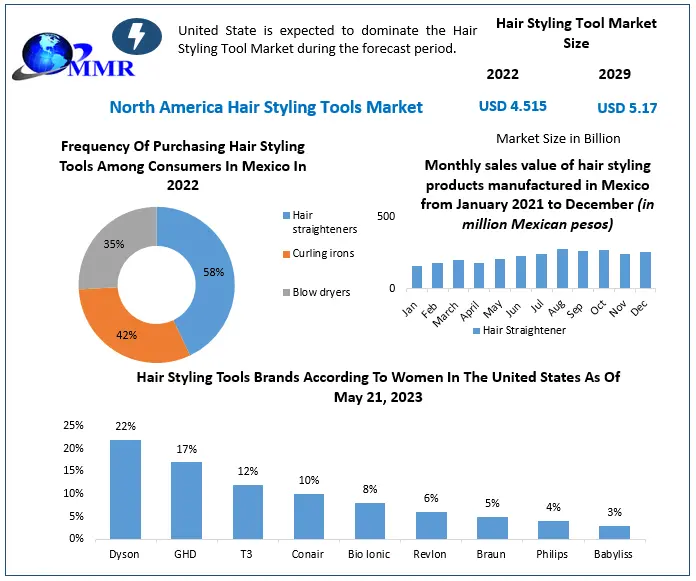
- The North America Hair Styling Tool Market was valued at USD 4.515 Bn in 2022 and is expected to reach nearly USD 5.17 Bn by 2029, making the category a mature but defensible beauty-device market.
- The market is forecast to grow at a 1.7% CAGR from 2023 to 2029, which shifts the competitive focus from volume expansion to premiumization, durability and product replacement cycles.
- The United States is expected to lead the regional market, giving brands a clear priority country for product launches, retail execution and consumer education.
- Premium tools such as the Dyson Airwrap, Dyson Supersonic, GHD Platinum+ straightener, T3 Whirl Trio and Bio Ionic 10X Ultralight Speed Dryer are cited as key branded products, showing that performance-led tools define the high-value lane.
- Heat-styling damage remains the main restraint, with flat irons and curling irons reported to damage up to 85% of hair keratin proteins, creating a commercial need for safer heat control.
Why This Matters Now
North America’s hair styling tool market is not short of devices; it is short of trust. Consumers want salon-grade results at home, but heat damage, treatment cost and product overload are turning safety and efficacy into boardroom issues.
The market’s 1.7% CAGR through 2029 signals a slow-growth category where share gains will come from premium tools, dermatology-backed claims and better consumer targeting rather than broad demand creation.
Market Overview
Hair styling tools cover devices and products used to improve appearance and manage hair-related concerns. The report includes manual and electric tools, dryers and blowers, straighteners, curlers, hair crimpers, hot brushes and other related products across household and commercial applications.
The market was valued at USD 4.515 Bn in 2022 and is forecast to reach nearly USD 5.17 Bn by 2029. That relatively narrow expansion puts pressure on brands to increase average selling prices, extend replacement cycles and win premium loyalty.
Demand is supported by product launches and approvals, rising disposable income, an ageing population, beauty-treatment awareness, entertainment-industry demand and salon growth. The market is also exposed to side-effect concerns from excessive use and high treatment costs.
Key Trends Driving Growth
Durability is the most direct commercial driver. MMR states that high-quality styling tools last longer than cheaper alternatives, making the upfront investment easier to justify for consumers and salon operators.
Premium tools are winning because they promise better heat distribution, airflow control, ergonomic design and quieter operation. That changes purchase logic: buyers are paying for performance consistency and reduced friction, not only heating capacity.
Health and beauty are merging. The report links demand to consumers placing more importance on appearance and health, with luxury brands incorporating health-related credibility through dermatologist partnerships and science-backed claims.
Consumer preferences are becoming more ingredient- and safety-conscious. In the United States, MMR notes stronger demand for natural, organic and eco-friendly products, with consumers seeking skin-friendly, hypo-allergenic or allergen-free, heat-resistant and UV-protected qualities.
Price dispersion is wide. Professional blow dryers range from USD 80 to USD 400, flat irons from USD 40 to USD 350, and long straight shears from USD 150 to USD 1125, giving brands room to build mass, professional and premium tiers.
Request a Sample Report for Strategic Business Intelligence
Segment Insights
- Dominant Segment: The public MMR page does not identify a dominant product, application or channel segment by share. Product categories include manual, electric, dryers/blowers, straighteners, curlers and others.
- Fastest-Growing Segment: The source does not identify a fastest-growing product, application or distribution segment by CAGR. No fastest-growing segment is inferred.
- Application Scope: Household and commercial applications are covered, giving brands access to both home grooming and salon-use demand. Exact application shares are not disclosed.
- Distribution Scope: Hypermarkets and supermarkets, specialty stores, online channels, salons, departmental stores and others are covered. E-commerce penetration is not quantified.
- Health-Risk Signal: Heat styling can cause dryness, frizz, breakage, split ends, hair fall, itchy scalp and allergic reactions, making safer heat tools and consumer education commercially important.
Regional Growth Story
The market covers the United States, Canada and Mexico, but the United States is expected to lead through the forecast period. The U.S. market includes straighteners, dryers, curlers, ironers and ongoing product innovation, making it the central launch and competition corridor.
U.S. demand is shaped by changing consumer preferences, higher disposable income and rising spending on personal hairstyling tools. That creates a market where consumers increasingly buy devices that help them achieve desired looks independently rather than relying only on salon visits.
The report does not disclose country-level market values for the United States, Canada or Mexico. It also does not provide city-level demand, quantified e-commerce penetration or production capacity by country.
Competitive Landscape
The market includes Conair Corporation, Helen of Troy, Panasonic Corporation, Revlon, BaBylissPRO, Philips, T3 Micro, GHD, Spectrum Brands, Hot Tools, Bio Ionic, HSI Professional, Andis Company, Remington Products Company, Drybar, NuMe and BioSilk.
Competition is moving from basic styling access to product credibility. Dyson, GHD, T3, Bio Ionic and Conair products cited by MMR show how premium brands compete around styling outcome, tool weight, airflow, heat control and user experience.
The public page does not disclose dated mergers, acquisitions, partnerships or divestitures. It states that the full report covers competitive benchmarking, market structure, consolidation and company developments, but transaction-level facts are not visible.
Over the next 12–24 months, rivals should expect pressure around health-safe positioning, dermatologist-backed claims, ergonomic design and premium device durability. Brands that cannot explain reduced damage or long-term value will face price pressure from lower-cost alternatives.
Recent Developments
- Premium Product Positioning: Dyson Airwrap, Supersonic, GHD Platinum+, T3 Whirl Trio and Bio Ionic 10X Ultralight Speed Dryer are cited as branded products, showing premium tools define the visible innovation set.
- Price-Tier Expansion: Cutting tools and finishing tools span wide price ranges, allowing suppliers to target students, salon professionals and premium consumers with different product ladders.
- Safety-Led Product Need: Reported hair damage from flat irons and curling irons creates a development opportunity for safer heat distribution, improved materials and clearer usage guidance.
Strategic Implications
For appliance and beauty-device brands, durability is now a value proposition. A premium device must show why it lasts longer, performs better and reduces replacement frequency.
For salons, tool selection affects both service quality and stylist health. Ergonomic shears, dryers, brushes and finishing devices can reduce repetitive strain risks and support longer professional careers.
For retailers, education is becoming a conversion tool. Consumers are weighing price, damage risk, product claims and brand credibility, so comparison-led selling can outperform simple shelf placement.
Future Outlook
The North America Hair Styling Tool Market is forecast to grow from USD 4.515 Bn in 2022 to nearly USD 5.17 Bn by 2029 at a 1.7% CAGR. Growth will come from premium durable tools, disposable-income gains, salon expansion, entertainment-sector demand, ageing consumers and beauty-health positioning.
The public page does not disclose dominant segment share, fastest-growing segment data, quantified e-commerce penetration, sustainability initiatives or dated competitive transactions. That limits the visible outlook to market size, category scope, U.S. leadership, pricing signals and disclosed consumer trends.
Winners will sell safer performance and long-term value; losers will be trapped between cheap devices, heat-damage concerns and premium brands with stronger credibility.
Analyst Perspective
“North America’s hair styling tool market is becoming a premium-performance category as consumers demand salon-quality results, safer heat control and longer-lasting devices,” said Siddhi Dole, Analyst at Maximize Market Research. “The strongest brands will combine durability, ergonomic design, science-backed claims and clear value across household and professional users.”
About Maximize Market Research
Maximize Market Research Pvt. Ltd. (MMR) is a global market research and consulting company that provides reliable, data-focused, and practical business insights. The firm serves a wide range of industries, including healthcare, pharmaceuticals, technology, automotive, electronics, chemicals, personal care, and consumer goods. Through market forecasts, competitive analysis, strategic consulting, and industry impact assessments, MMR helps organizations understand changing market conditions, identify growth opportunities, and make informed business decisions for long-term success.
Contact Us
2nd Floor, Navale IT Park Phase 3
Pune Banglore Highway, Narhe
Pune, Maharashtra 411041, India
+91 9607365656
sales@maximizemarketresearch.com
