Key Highlights
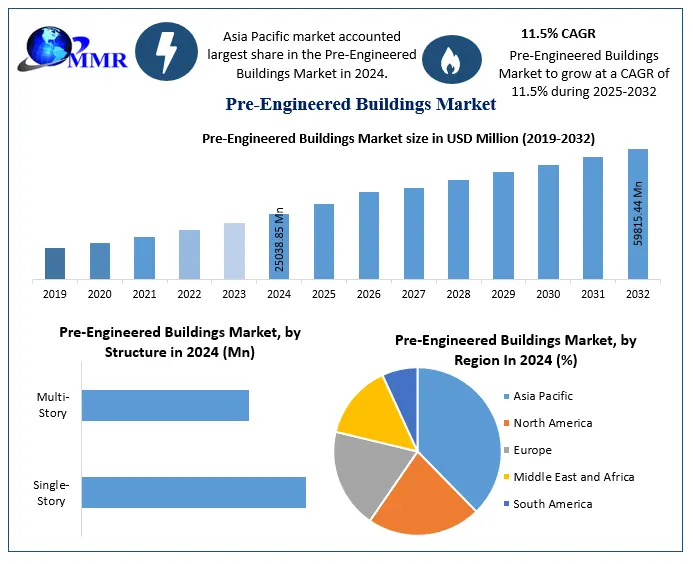
Pre-Engineered Buildings Market size was valued at USD 25,038.85 Million in 2024 and is projected to reach nearly USD 59,815.44 Million by 2032, growing at a CAGR of 11.5%—a construction growth rate that outpaces many core building segments.
PEB solutions rely on factory-fabricated steel structures designed, engineered and assembled with standardized components, drastically reducing construction time and labor intensity.
Key applications span industrial plants, warehouses, logistics hubs, commercial buildings and infrastructure support structures, all highly relevant to FMCG and food & beverage value chains.
Growth is driven by demand for rapid, scalable, cost-efficient, and increasingly sustainable facilities to support manufacturing, storage and distribution.
Why This Matters No
If your supply chain team still plans new plants and warehouses on conventional construction timelines, they are already lagging. A market moving from about USD 25 Billion in 2024 to nearly USD 60 Billion by 2032 at 11.5% CAGR signals that pre-engineered buildings have become the default answer to “how fast can we add capacity?”.
For FMCG and food & beverage boards, this is not a structural engineering story; it is a speed and agility story. Pre-engineered buildings compress build time from many months to a fraction, allowing companies to respond to demand surges, regionalization and new product launches without multi-year delays. Every percentage point of growth in this market is a signal that competitors are buying time-to-market advantages you may not yet have.
Market Overview
Pre-engineered buildings (PEBs) size are steel-based structures whose components—columns, beams, trusses, panels—are designed and fabricated in factories, then shipped and assembled on site. This model allows standardized design, precise engineering, and repeatable quality at scale, reducing waste and site complexity.
With market size at USD 25,038.85 Million in 2024 and expected to reach almost USD 59,815.44 Million by 2032, pre-engineered buildings are moving from niche industrial applications to mainstream solutions across sectors. An 11.5% CAGR indicates strong structural demand driven by industrialization, logistics expansion, and investors’ preference for faster, more predictable projects.
For food & beverage and FMCG, PEBs fulfill a broad spectrum of needs: manufacturing plants, bottling lines, dry and ambient warehouses, cold storage facilities, regional distribution centers, and even large-format retail boxes. The ability to replicate proven designs across multiple sites lets companies scale footprint without re-inventing each facility.
Key Trends Driving Growth
Speed and cost pressure
CEOs and CFOs want capacity that can be commissioned in months, not years. Pre-engineered buildings deliver shorter project timelines, lower on-site labor requirements, and optimized steel usage. Faster completion means earlier revenue and less exposure to construction cost inflation—critical for margin management in low-and mid-margin FMCG categories.
Standardization and scalability
PEB systems rely on modular, standardized components. This enables rapid replication of “model factories” and “model warehouses” across geographies. For multi-country food and beverage networks, standardization simplifies engineering, equipment layout, compliance and maintenance. It also facilitates vendor consolidation and better capex planning.
Design flexibility for industrial use
Modern PEB solutions offer large column-free spans, high clear heights and adaptable layouts. This matches the needs of high-throughput packaging lines, racking systems, and automated material-handling solutions common in FMCG and food logistics. Expansions and reconfigurations become more feasible without full rebuilds.
Sustainability initiatives
Steel structures enable recycling and deconstruction options and lend themselves to energy-efficient designs with better insulation, skylights, and rooftop solar integration. As ESG pressure rises, companies can use pre-engineered buildings to demonstrate lower embodied carbon, higher recyclability and better energy performance compared with traditional concrete-heavy builds.
E-commerce and omni-channel logistics
E-commerce growth demands more fulfillment centers, dark stores and high-throughput hubs, often close to urban demand. Pre-engineered buildings allow rapid deployment of standardized logistics boxes that can be tuned for last-mile FMCG delivery—ranging from ambient warehouses to temperature-controlled cross-docks.
Request a Free Sample Copy or View Report Summary: https://www.maximizemarketresearch.com/request-sample/30843/
Segment Insights
Dominant Segment – Application: Industrial and Warehousing Facilities
Industrial plants and warehouses form the dominant application segment. These facilities underpin manufacturing and logistics for FMCG and food & beverage companies—housing production lines, storage, and distribution operations. The need for large clear spans, high load-bearing capacity and fast construction makes PEBs the natural choice.Fastest-Growing Segment – Application: Logistics Hubs and E-commerce Fulfillment Centers
Logistics hubs, distribution centers and e-commerce fulfillment facilities are the fastest-growing segment. They require standardized, scalable building designs that can be replicated across regions as networks expand. Pre-engineered buildings support rapid deployment of new nodes, enabling FMCG and food brands to match rising omni-channel demand.By Structure – Single-Storey vs Multi-Storey Steel Buildings
Single-storey structures dominate industrial use, offering large footprints for manufacturing and warehousing. However, multi-storey PEBs are gaining momentum where land constraints and urban proximity drive vertical logistics and mixed-use assets, opening new possibilities for closer-to-market food & beverage facilities.By End-User – Industrial, Commercial, Infrastructure, Residential
Industrial and commercial end-users lead demand, reflecting factory and warehouse projects as well as retail, showrooms and service centers. Infrastructure and specialized uses—aircraft hangars, terminals, agricultural storage—add diversified volume. Residential adoption remains a smaller but emerging niche.
Regional Growth Story
Asia-Pacific industrialization
Rapid industrialization and infrastructure build-out in Asia-Pacific, particularly in India, Southeast Asia and parts of China, drive strong adoption of PEB solutions. Manufacturing plants for FMCG and food processing, along with new warehouses and distribution centers, increasingly rely on pre-engineered designs to meet tight timelines and capex constraints.
Middle East and emerging markets
In the Middle East and other emerging regions, large-scale logistics parks and industrial clusters are adopting PEBs to attract investment and provide ready-to-use facilities. Food & beverage and FMCG companies benefit from plug-and-play units that can be customized quickly for production, storage and distribution.
Developed markets
In North America and Europe, PEB adoption is reinforced by retrofit and expansion projects, as companies upgrade legacy facilities or add new capacity for automation and e-commerce. Sustainability agendas and labor constraints push owners toward off-site fabrication and more efficient construction techniques.
Competitive Landscape
The Pre-Engineered Buildings Market is characterized by steel producers, specialized PEB manufacturers, and integrated engineering–construction firms. Players compete on design capabilities, fabrication quality, speed of deployment, international reach and lifecycle service offerings.
Leading companies increasingly offer end-to-end solutions—from structural design and fabrication to erection and after-sales service—rather than just supplying components. This signals a shift toward turnkey models that appeal to FMCG and food & beverage clients wanting to minimize project management overhead and coordinate building design with process equipment layouts.
Over the next 12–24 months, expect deeper partnerships between PEB providers and logistics developers, industrial park operators and large FMCG manufacturers. Rivals that cannot support multi-site, multi-country programs, or that lack energy and sustainability engineering expertise, will struggle to compete for large, strategic projects.
Recent Developments
Increased roll-out of standardized PEB designs for warehouses and distribution centers supporting FMCG and food & beverage route-to-market.
Greater use of large-span, high-clear-height steel buildings for automated palletizing, high-bay racking and robotics integration.
Integration of energy-efficient features—insulated panels, skylights, ventilation and rooftop solar—into pre-engineered industrial facilities.
Expansion of PEB offerings for cold storage and temperature-controlled logistics, enabling faster build-out of regional cold chains.
Strategic Implications for FMCG & Food & Beverage
Pre-engineered buildings compress the cycle from board approval to operational capacity. For FMCG and food companies, this means faster response to market shifts—new plants near growth markets, rapid expansion of warehouse networks, and quick addition of capacity for co-packing or new categories.
Network planning teams can redesign footprints with PEBs as a constraint-relieving tool: rebalancing plants, adding regional DCs, and piloting micro-fulfillment hubs without multi-year construction risk. This is particularly powerful in emerging markets where demand is rising but infrastructure remains patchy.
Sustainability and compliance functions gain a new lever. Working with PEB suppliers that design for energy efficiency and material recyclability supports ESG targets and regulatory demands, while also reducing operating costs over the building lifecycle. The alignment of steel structures with rooftop solar and modern HVAC further strengthens this business case.
Future Outlook
With the Pre-Engineered Buildings Market expected to grow from USD 25,038.85 Million in 2024 to nearly USD 59,815.44 Million by 2032 at 11.5% CAGR, pre-engineered steel structures will increasingly define the tempo of industrial and logistics development. Companies that continue to build only in traditional ways will find themselves slower to add capacity, slower to pivot geographically, and slower to capture new demand.
As the market scales, design libraries, digital engineering tools and integrated project delivery models will mature, making PEB adoption easier and more predictable for FMCG and food & beverage boards. At the same time, competition for experienced suppliers and fabrication capacity will intensify.
In this environment, the winners will treat pre-engineered buildings as a core strategic instrument for capacity, resilience and sustainability, while the losers will still view them as a niche construction option—realizing too late that their ability to grow is constrained not by demand, but by the buildings they failed to build fast enough.
Related Reports
Global Compostable Packaging Materials Market https://www.maximizemarketresearch.com/market-report/global-compostable-packaging-materials-market/87381/
Global Hermetic Laser Packaging Market https://www.maximizemarketresearch.com/market-report/global-hermetic-laser-packaging-market/102413/
Global Waterproof Headphones Market https://www.maximizemarketresearch.com/market-report/global-waterproof-headphones-market/53538/
Analyst Perspective
“Pre-engineered buildings have moved from an alternative construction method to a primary lever for industrial and logistics capacity,” “With the market projected to rise from USD 25,038.85 Million to nearly USD 59,815.44 Million by 2032 at 11.5% CAGR, FMCG and food & beverage companies that embed PEBs into their expansion and network strategies will gain speed, flexibility and sustainability advantages that traditional builds simply cannot match.”-Siddhi Dole
About Maximize Market Research
Maximize Market Research Pvt. Ltd. (MMR) is a global market research and consulting company that provides reliable, data-focused, and practical business insights. The firm serves a wide range of industries, including healthcare, pharmaceuticals, technology, automotive, electronics, chemicals, personal care, and consumer goods. Through market forecasts, competitive analysis, strategic consulting, and industry impact assessments, MMR helps organizations understand changing market conditions, identify growth opportunities, and make informed business decisions for long-term success.
2nd Floor, Navale IT Park Phase 3
Pune Banglore Highway, Narhe
Pune, Maharashtra 411041, India
+91 9607365656
sales@maximizemarketresearch.com
