Molecular Biology Enzymes, Reagents, and Kits Market Expands as Genomics, Precision Medicine, and Biotech Research Accelerate
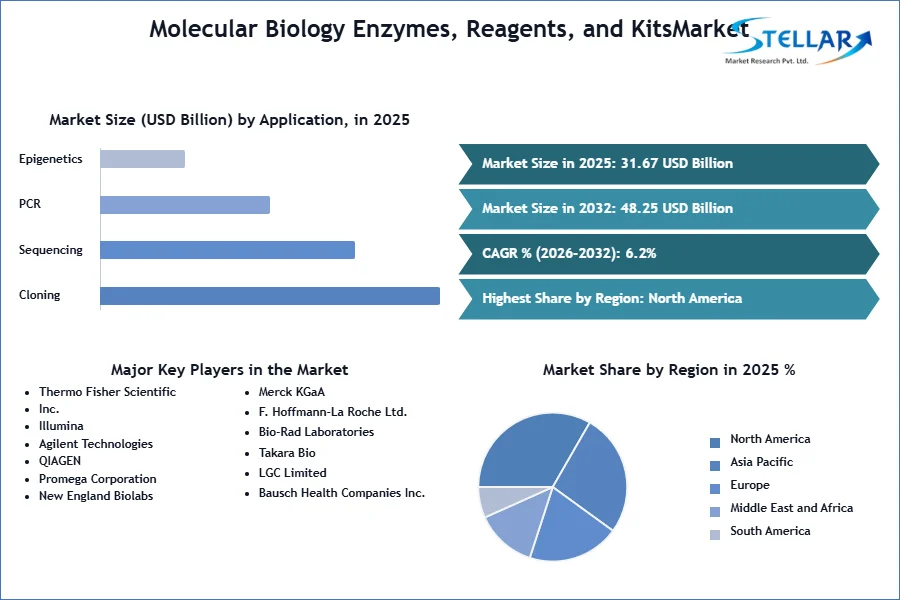
The global Molecular Biology Enzymes, Reagents, and Kits Market is experiencing robust growth as advances in genomics, molecular diagnostics, and precision medicine continue to transform life sciences research and clinical diagnostics. Increasing investments in biotechnology, pharmaceutical research, and next-generation sequencing (NGS) technologies are driving demand for high-performance molecular biology consumables. According to Stellar Market Research, the global Molecular Biology Enzymes, Reagents, and Kits Market was valued at USD 31.67 billion in 2025 and is projected to reach USD 48.25 billion by 2032, registering a CAGR of 6.2% during the forecast period (2026–2032).
Genomics and Precision Medicine Drive Market Growth
The growing adoption of molecular biology technologies in disease diagnosis, drug discovery, and genetic research is significantly expanding the market. Pharmaceutical and biotechnology companies are increasingly utilizing molecular biology enzymes, reagents, and kits for applications such as DNA sequencing, gene expression analysis, polymerase chain reaction (PCR), cloning, and gene editing.
The expansion of precision medicine initiatives is further increasing demand for reliable molecular tools capable of supporting personalized treatment strategies. As healthcare systems shift toward targeted therapies, laboratories require highly accurate and reproducible molecular testing solutions.
𝐃𝐨𝐰𝐧𝐥𝐨𝐚𝐝 𝐅𝐫𝐞𝐞 𝐏𝐃𝐅 𝐁𝐫𝐨𝐜𝐡𝐮𝐫𝐞: https://www.stellarmr.com/report/req_sample/Molecular-Biology-Enzymes-Reagents-and-Kits-Market/1388
Next-Generation Sequencing Increases Demand for Advanced Reagents
Next-generation sequencing has become one of the most influential technologies in molecular biology research. The declining cost of genome sequencing, combined with improvements in sequencing speed and accuracy, has accelerated adoption across academic institutions, pharmaceutical companies, and clinical laboratories.
Manufacturers continue introducing specialized enzymes and sequencing kits designed to improve workflow efficiency and data quality. Growing research into transcriptomics, proteomics, and multi-omics is also driving demand for innovative molecular biology consumables that support increasingly complex analytical applications.
PCR and Research Applications Continue to Lead the Market
Polymerase Chain Reaction (PCR) remains one of the largest application segments due to its widespread use in infectious disease diagnostics, oncology research, forensic analysis, and genetic testing. Kits and reagents account for a substantial share of market revenue because laboratories require standardized, high-quality consumables to ensure reproducible experimental results.
Increasing investment in CRISPR-based gene editing, molecular diagnostics, and vaccine development continues to create new opportunities for manufacturers of enzymes and specialized research reagents.
Technology Innovation Strengthens Research Capabilities
Continuous innovation is reshaping the molecular biology landscape through advanced automation and digital laboratory technologies.
Key industry trends include:
Next-generation sequencing (NGS) platforms
CRISPR gene-editing technologies
High-fidelity DNA polymerases
Automated molecular diagnostic workflows
Multi-omics research platforms
AI-assisted genomic data analysis
Single-cell sequencing technologies
Cloud-based bioinformatics solutions
These innovations enable researchers to improve analytical accuracy, reduce processing time, and accelerate discoveries across genomics, oncology, infectious diseases, and precision medicine.
North America Leads While Asia-Pacific Emerges as a High-Growth Region
North America remains the largest market due to strong biotechnology infrastructure, significant research funding, and widespread adoption of advanced molecular diagnostic technologies. The region benefits from substantial investments by pharmaceutical companies, academic institutions, and government research organizations.
Asia-Pacific is expected to record the fastest growth throughout the forecast period, supported by expanding biotechnology industries, increasing healthcare expenditure, government-sponsored genomics initiatives, and rising demand for molecular diagnostics in countries such as China, India, Japan, and South Korea.
𝐃𝐨𝐰𝐧𝐥𝐨𝐚𝐝 𝐅𝐫𝐞𝐞 𝐏𝐃𝐅 𝐁𝐫𝐨𝐜𝐡𝐮𝐫𝐞: https://www.stellarmr.com/report/req_sample/Molecular-Biology-Enzymes-Reagents-and-Kits-Market/1388
Competitive Landscape
The Molecular Biology Enzymes, Reagents, and Kits Market is highly competitive, with leading life sciences companies investing heavily in research, product innovation, and strategic collaborations.
Major companies operating in the market include:
Thermo Fisher Scientific
QIAGEN
Agilent Technologies
Merck KGaA
Promega Corporation
Bio-Rad Laboratories
New England Biolabs
Takara Bio Inc.
Illumina Inc.
F. Hoffmann-La Roche Ltd.
These companies continue expanding their portfolios of PCR reagents, sequencing kits, molecular enzymes, and automated laboratory solutions to support growing demand from pharmaceutical, biotechnology, clinical, and academic research sectors.
Future Outlook
The outlook for the Molecular Biology Enzymes, Reagents, and Kits Market remains highly positive as precision medicine, genomics research, molecular diagnostics, and biotechnology innovation continue to expand worldwide. Rising investments in drug discovery, personalized healthcare, and advanced genomic technologies are expected to sustain long-term market growth.
According to Stellar Market Research, continuous advancements in sequencing technologies, CRISPR-based research, bioinformatics, and laboratory automation will create significant opportunities for manufacturers, research institutions, and healthcare organizations through 2032. As demand for accurate molecular testing and next-generation research tools increases, the Molecular Biology Enzymes, Reagents, and Kits Market is expected to remain a critical component of the global life sciences industry.
