Key Highlights
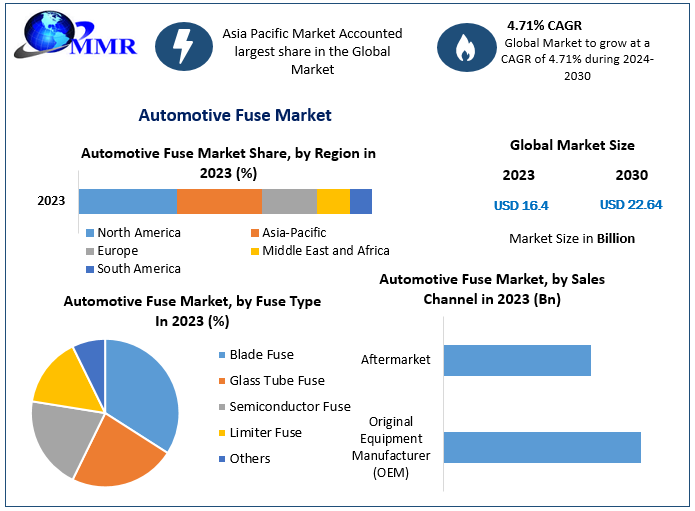
Market Valuation: The global automotive fuse market reached USD 16.4 Billion in 2023 and is on track to touch USD 22.64 Billion by 2030.
Electrification Tailwind: The transition from low-voltage internal combustion engine (ICE) electrical systems to high-voltage electric vehicle (EV) battery packs alters circuit architecture requirements.
Technological Substitution: Fast-acting semiconductor fuses are replacing conventional glass and mechanical blade fuses to safeguard delicate electronics.
Regional Dominance: The Asia-Pacific and European regions control the largest market shares, benefiting from localized component manufacturing and aggressive premium hybrid vehicle production.
Why This Matters Now
The rapid transition toward software-defined mobility and high-voltage architectures is pushing legacy circuit protection past its physical limits. Standard thermal fuses can no longer react fast enough to insulate sensitive Advanced Driver Assistance Systems (ADAS) or ultra-high-power lithium-ion battery strings from catastrophic short-circuit spikes. For Tier-1 suppliers and vehicle manufacturers, picking the next generation of smart overcurrent protection is critical to preventing immediate vehicle grounding, warranty liabilities, and thermal runaway events.
Market Overview
Automotive fuses serve Market as the primary defensive link within a vehicle’s electrical distribution network, cutting off current flow when faults threaten downstream modules. Valued at USD 16.4 Billion in 2023, the global automotive fuse market is expanding at a steady 4.71% CAGR, targeting USD 22.64 Billion by 2030. This growth is entirely non-linear when broken down by technical specifications.
The baseline architecture of cars has changed. Traditional luxury vehicle segments packed hundreds of basic blade fuses to run power windows and internal lighting. Modern electrical setups require specialized high-amperage limiter and fast-acting semiconductor components to isolate multi-kilowatt traction motors, inverters, and high-speed infotainment nodes.
Key Trends Driving Growth
Vehicle electrification is altering the core dynamics of the circuit protection supply chain. While conventional ICE powertrains function cleanly on standard 12V or 48V direct current loops, battery electric vehicles (BEVs) and plug-in hybrid electric vehicles (PHEVs) operate at 400V to 800V levels. This higher voltage increases the risk of intense electrical arcing during a component failure. Consequently, component suppliers are investing heavily in advanced ceramic-body and high-capacity limiter fuses that can extinguish high-energy faults in milliseconds.
Concurrently, the push toward Level 2+ and Level 3 autonomous driving is intensifying onboard data processing demands. Cameras, radar units, and centralized AI domain controllers require ultra-clean, surge-free power delivery. The need to preserve continuous, redundant operation for steering and braking systems means that circuit protection is shifting from simple, passive sacrificial wire elements to resettable and programmable smart electronics.
Segment Insights
Dominant Segment (Sales Channel): The Original Equipment Manufacturer (OEM) segment remains the dominant end-use channel, accounting for the highest volume of purchases due to rising vehicle production and complex wire harness integration.
Dominant Segment (Powertrain Integration): The hybrid electric vehicle (HEV) sub-segment represents the largest distinct volume footprint within electric powertrains, propelled by surging consumer demand for dual-power vehicles across Asia-Pacific and North America.
Fastest-Growing Segment (Component Type): Semiconductor fuses are expanding at the fastest rate because they offer the sub-millisecond reaction speeds required to save delicate microchips, infotainment units, and brake pedal sensor lines.
Regional Growth Story
The regional distribution of market value mirrors global automotive manufacturing capacity and infrastructure investments.
Asia-Pacific: This region retains its position as the largest and most dynamic regional market. China leads the growth curve, projected to reach a localized market size of USD 4.9 Billion by 2029 with an 8.6% CAGR from 2022 to 2029. This growth is driven by local supply chain density, government NEV subsidies, and rising consumer demand for advanced safety features such as multi-stage airbags. India and South Korea are similarly accelerating production capacity to back local export footprints.
North America: The United States market, evaluated at USD 4.3 Billion in 2022, is defined by large fleet electrification programs and heavy commercial light trucks requiring expanded fuse boxes with robust structural protection.
Europe: Germany anchors European growth with a 3.5% CAGR, supplemented by massive EV penetration rates in Norway, France, and the Netherlands. These nations demand ultra-high-reliability high-voltage fuses to match localized premium vehicle assembly.
Competitive Landscape
The competitive arena shows a deep division between legacy hardware manufacturers and advanced electronic component suppliers. Top-tier suppliers are consolidating their market control by rolling out holistic, integrated power distribution blocks rather than individual standalone fuses. This strategy increases their pricing power, as they sell complex, pre-tested power boxes containing embedded semiconductor fuses and smart telemetry straight to the OEM assembly line.
To hedge against raw material cost volatility in copper and silver, leading players are standardizing multi-layer alloy elements. These new alloys provide predictable thermal properties while reducing dependence on precious metals. This shift helps protect their margins from global metal market fluctuations.
Recent Developments
High-Voltage Expansion: Suppliers are launching dedicated 800V-rated automotive fuses specifically engineered to match the rapid-charging capabilities of next-generation EV platforms.
Smart In-Mold Integration: Tier-1 players are collaborating with wire harness manufacturers to integrate miniaturized blade fuses directly into structural plastic trays, cutting weight and assembly volume.
Localized Sourcing Hubs: Major component providers are expanding their production facilities inside India and Southeast Asia to bypass supply chain logjams and satisfy local content manufacturing mandates.
Strategic Implications
For automotive leadership, the evolution of circuit architecture demands a fundamental rethink of sourcing and product development workflows. Relying on commoditized, off-the-shelf blade fuses for modern high-voltage or autonomous lines creates significant long-term liability. OEMs must move away from post-design electrical planning and instead bring advanced circuit protection suppliers into the early vehicle design loop. Automakers who master this multi-voltage co-development strategy will successfully optimize their wire harness weight, reduce electrical failure rates, and compress their time-to-market.
Future Outlook
As vehicles transition to centralized zonal architectures where software controls localized electronic circuit breakers, the traditional mechanical fuse box will face steady downsizing. The future belongs exclusively to components that merge physical safety margins with digital speed. Ultimately, component suppliers that successfully pivot from standard thermal-sacrificial wire manufacturing to high-power semiconductor and intelligent protection systems will secure long-term OEM contracts, while legacy providers reliant on standard mechanical blade fuses will see their margins commoditized.
Analyst Perspective
“The rise of 800V electric vehicle architectures has changed the rules of vehicle safety. Circuit protection can no longer be an afterthought managed via basic wire melting points; it now demands fast-acting semiconductor precision to insulate the entire battery and computing platform from severe electrical faults.”Dharati Raut, Lead Automotive Analyst
About Maximize Market Research
Maximize Market Research Pvt. Ltd. (MMR) is a global market research and consulting company that provides reliable, data-focused, and practical business insights. The firm serves a wide range of industries, including healthcare, pharmaceuticals, technology, automotive, electronics, chemicals, personal care, and consumer goods. Through market forecasts, competitive analysis, strategic consulting, and industry impact assessments, MMR helps organizations understand changing market conditions, identify growth opportunities, and make informed business decisions for long-term success.
2nd Floor, Navale IT Park Phase 3
Pune Banglore Highway, Narhe
Pune, Maharashtra 411041, India
+91 9607365656
sales@maximizemarketresearch.com
