Epichlorohydrin Market Expands as Bio-Based Production and Epoxy Resin Demand Reshape Chemical Industry
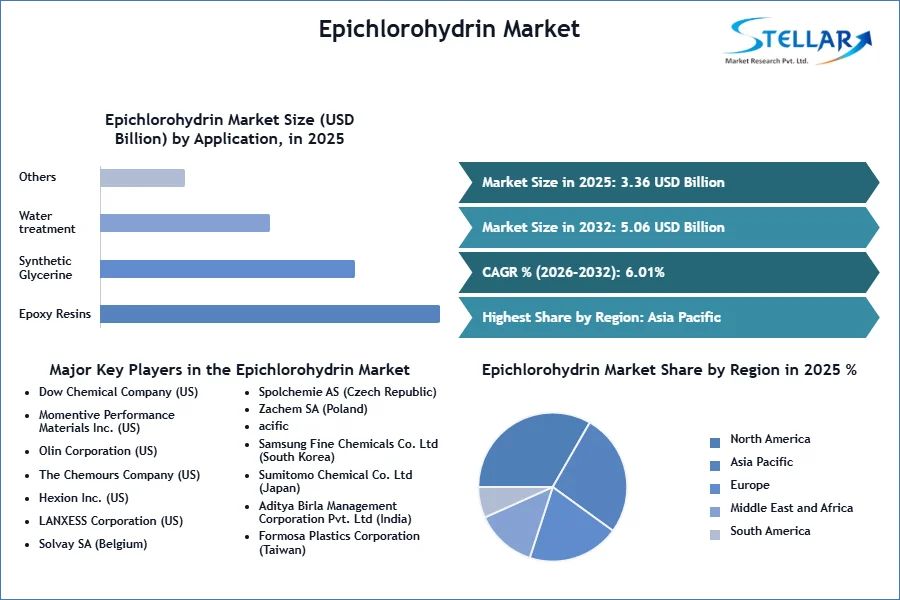
The global Epichlorohydrin Market is gaining momentum as rising demand for epoxy resins, advanced coatings, adhesives, water treatment chemicals, and specialty materials drives consumption across major industries. Growing infrastructure investments, expansion of electronics manufacturing, and increasing focus on sustainable chemical production are transforming the competitive landscape of the epichlorohydrin industry. According to Stellar Market Research, the global Epichlorohydrin Market was valued at USD 3.36 billion in 2025 and is projected to reach USD 5.06 billion by 2032, expanding at a CAGR of 6.02% during 2026–2032.
Rising Epoxy Resin Demand Drives Market Expansion
Epichlorohydrin (ECH) is an important chemical intermediate widely used in the production of epoxy resins, synthetic glycerin, elastomers, and specialty chemicals. Its excellent chemical resistance, durability, and adhesive properties make it essential for industries including construction, automotive, electronics, coatings, and pharmaceuticals.
The growing use of epoxy-based materials in protective coatings, industrial flooring, composites, electronic encapsulation, and renewable energy equipment is creating strong demand for epichlorohydrin. Infrastructure development projects worldwide are increasing the requirement for high-performance coatings and adhesives that provide corrosion protection and long-term durability.
𝐃𝐨𝐰𝐧𝐥𝐨𝐚𝐝 𝐅𝐫𝐞𝐞 𝐏𝐃𝐅 𝐁𝐫𝐨𝐜𝐡𝐮𝐫𝐞: https://www.stellarmr.com/report/req_sample/epichlorohydrin-market/2390
Bio-Based Epichlorohydrin Gains Industry Attention
Sustainability has become a major factor influencing the future direction of the epichlorohydrin industry. Traditional production methods rely heavily on petrochemical feedstocks, while manufacturers are increasingly exploring glycerin-based and bio-based production routes to reduce environmental impact.
The shift toward renewable raw materials is being supported by growing demand for environmentally responsible chemicals from industries such as coatings, automotive, and consumer goods. Bio-based epichlorohydrin provides manufacturers with opportunities to meet sustainability goals while maintaining the performance characteristics required for industrial applications.
Epoxy Resin Segment Maintains Market Leadership
Among applications, epoxy resins represent the dominant segment due to widespread adoption across multiple industries. Epoxy resins manufactured using epichlorohydrin are extensively used in:
Paints and protective coatings
Construction materials
Electrical and electronic components
Wind turbine composites
Industrial adhesives
Automotive components
The electronics industry is creating additional growth opportunities as manufacturers increasingly require advanced encapsulation materials, insulation systems, and high-performance coatings for electronic devices.
Water Treatment and Specialty Applications Create New Opportunities
Beyond epoxy resins, epichlorohydrin demand is increasing in water treatment chemicals, synthetic glycerin production, pharmaceuticals, and specialty elastomers.
Water treatment applications are gaining importance due to rising global concerns regarding water quality, industrial wastewater management, and environmental regulations. Epichlorohydrin-based materials are used in the production of water purification chemicals and ion exchange resins.
The pharmaceutical and personal care industries also utilize synthetic glycerin derived from epichlorohydrin for applications requiring controlled purity and consistent quality.
Technological Innovation Improves Production Efficiency
Chemical manufacturers are investing in advanced production technologies to improve efficiency, reduce emissions, and optimize raw material utilization.
Key technology trends shaping the Epichlorohydrin Market include:
Bio-based epichlorohydrin production
Advanced catalytic processes
Low-emission manufacturing technologies
Improved process automation
Sustainable chemical production methods
Integration of renewable feedstocks
These advancements are helping companies address environmental concerns while improving operational efficiency and maintaining competitiveness.
Asia-Pacific Leads Global Market Growth
Asia-Pacific dominates the global Epichlorohydrin Market due to strong chemical manufacturing capabilities, rapid industrialization, and high demand from construction, electronics, automotive, and coatings industries. Countries such as China, India, Japan, and South Korea continue expanding industrial production, creating significant demand for epoxy resin-based materials.
China remains one of the largest producers and consumers of epichlorohydrin, supported by its extensive chemical manufacturing ecosystem. India is also emerging as a promising market due to increasing infrastructure development, domestic manufacturing expansion, and rising demand from automotive and electronics industries.
North America and Europe continue focusing on sustainable chemical solutions, regulatory compliance, and advanced material applications, creating opportunities for bio-based epichlorohydrin technologies.
Supply Chain and Regulatory Factors Influence Market Dynamics
The epichlorohydrin industry is influenced by fluctuations in raw material prices, including propylene, chlorine, and glycerin. Changes in feedstock availability and energy costs can impact production economics and pricing strategies.
Environmental regulations related to chemical manufacturing are also encouraging companies to adopt cleaner production methods. Manufacturers are increasingly balancing cost efficiency with sustainability requirements to maintain long-term competitiveness.
Recent Industry Developments
Meghmani Finechem (2024): Announced plans to develop a 50,000-tonne-per-year epichlorohydrin plant using TechnipFMC’s EPICEROL technology to strengthen domestic production capacity and reduce dependence on imports.
OCIM Sdn. Bhd. and Kumho P&B Chemicals (2025): Partnered to develop epichlorohydrin manufacturing capabilities in Malaysia with an annual capacity target of 100 KTPA, focusing on bio-based raw materials for epoxy resin production.
Chemical manufacturers across Asia-Pacific (2025): Continued investments in sustainable production processes as demand increases for environmentally responsible epoxy resin materials.
𝐃𝐨𝐰𝐧𝐥𝐨𝐚𝐝 𝐅𝐫𝐞𝐞 𝐏𝐃𝐅 𝐁𝐫𝐨𝐜𝐡𝐮𝐫𝐞: https://www.stellarmr.com/report/req_sample/epichlorohydrin-market/2390
Competitive Landscape
The Epichlorohydrin Market is competitive, with leading chemical companies focusing on capacity expansion, sustainable production, technology development, and strategic partnerships.
Key companies operating in the market include:
Dow Inc.
Solvay S.A.
Lotte Fine Chemical
Shandong Haili Chemical Industry Co., Ltd.
Formosa Plastics Corporation
Sumitomo Chemical
Osaka Soda Co., Ltd.
Aditya Birla Chemicals
Companies are strengthening their positions through investments in bio-based technologies, expanded production facilities, and downstream integration with epoxy resin manufacturers.
Future Outlook
The future of the Epichlorohydrin Market remains positive as demand for high-performance materials continues rising across construction, automotive, electronics, renewable energy, and industrial applications.
According to Stellar Market Research, market growth will be supported by increasing epoxy resin consumption, sustainable chemical innovation, infrastructure development, and expanding industrial applications through 2032. Companies that successfully combine production efficiency, environmental responsibility, and advanced material solutions will gain a competitive advantage in the evolving global epichlorohydrin industry.
