Key Highlights
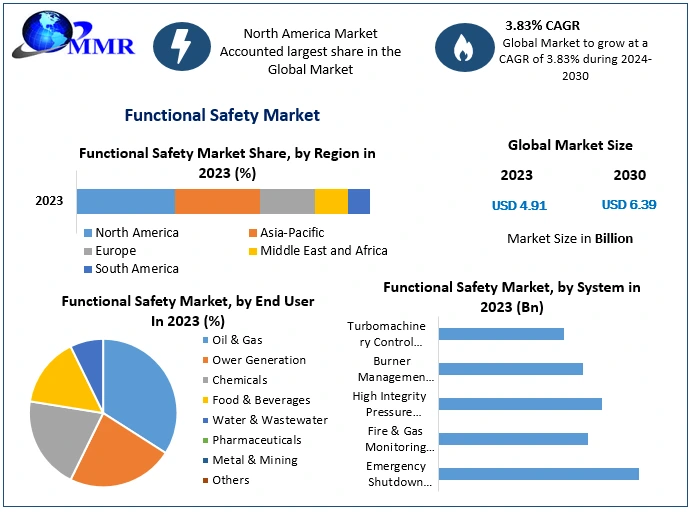
- The Functional Safety Market was valued at USD 4.91 Bn in 2023 and is expected to reach nearly USD 6.39 Bn by 2030, creating a steady investment case for safety systems, industrial electronics and automation suppliers.
- The market is forecast to grow at a 3.83% CAGR from 2024 to 2030, which makes compliance, uptime and safety certification more important than short-cycle hardware demand.
- Emergency Shutdown Systems dominate the system segment because high-risk industries need rapid shutdown capability during critical events.
- Europe is expected to lead the market, with Germany and the United Kingdom identified as important hubs for manufacturers, suppliers and advanced safety technologies.
- IoT integration, Industry 4.0, AI, machine learning and real-time monitoring are changing functional safety from stand-alone protection into connected industrial control.
Why This Matters Now
Functional safety is becoming a control-chip and industrial-electronics issue. As factories, grids, vehicles and medical systems become more automated, every sensor, controller, relay and programmable safety system carries higher operational risk.
The Functional Safety Market matters because safety is now tied to uptime, compliance and digital transformation. Industries adopting IoT devices, smart manufacturing and Industry 4.0 systems need integrated protection that can prevent accidents while keeping production efficient.
Market Overview
Functional safety systems protect people, assets and production processes by reducing risk in automated environments. The market covers Emergency Shutdown Systems, Fire and Gas Monitoring Systems, High Integrity Pressure Protection Systems, Burner Management Systems and Turbomachinery Control.
The device scope includes safety sensors, safety controllers, modules, relays, programmable safety systems, safety switches and other components. End users include oil and gas, power generation, chemicals, food and beverages, water and wastewater, pharmaceuticals, metal and mining, and other industries.
For semiconductor and electronics suppliers, the direct signal is demand for safety-grade controllers, sensors and programmable systems. Foundry investments, advanced packaging, chiplet architecture, high-bandwidth memory, display technology and chip manufacturing capacity expansion are not disclosed on the public page.
Key Trends Driving Growth
Automation is the central driver. Manufacturing, oil and gas, chemical processing, automotive, healthcare and aerospace systems are becoming more complex, raising the need for certified safety systems that can detect faults and trigger safe responses.
Regulation is forcing investment. Standards such as ISO 26262 for automotive and IEC 61508 for general industries compel companies to deploy functional safety systems, which makes compliance a procurement requirement rather than an optional engineering feature.
IoT is changing safety architecture. Rockwell Automation is cited for IoT-enabled functional safety solutions that improve equipment efficiency while maintaining safety, showing that connected safety systems are moving closer to production-performance metrics.
AI and real-time monitoring are entering the market. Siemens, Honeywell and ABB are identified as players developing advanced safety solutions that use artificial intelligence, machine learning and real-time monitoring to improve safety measures.
The main constraints are technical and human. High upfront costs, complex implementation, interoperability problems, cybersecurity exposure and shortages of skilled functional safety professionals can slow deployment, especially in critical infrastructure and complex industrial environments.
Request a Market Research Sample Before Making Decisions
Segment Insights
- Dominant Segment Emergency Shutdown Systems: ESD systems dominate because oil and gas, petrochemical and other high-risk industries need fast operational shutdown during emergencies. This makes ESD the core safety layer for plants where delay can create severe asset and personnel risk.
- Fastest-Growing Segment: The public MMR page does not identify a fastest-growing system, device or end-user segment by CAGR. No fastest-growing segment is inferred.
- Critical Device Layer Safety Sensors and Controllers: Safety sensors, controllers, modules, relays, programmable safety systems and safety switches are covered. The source does not disclose device-level shares, but these components form the electronics base of functional safety systems.
- Standards Signal Safety MCUs: The report’s standards table references CPU, memory, interrupt, clock, I/O and communication self-test requirements in standards for elevators, railways and home appliances, linking functional safety to embedded electronics design.
- Opportunity Segment Integrated Safety: Built-in safety functions such as safe torque off, CIP Safety I/O modules, smart sensors and smart proof testing create opportunities to reduce stand-alone system cost and extend proof-test intervals.
Regional Growth Story
Europe is expected to lead the market. Germany and the United Kingdom are identified as important producing hubs, with manufacturers and suppliers contributing to advanced safety technologies.
North America is a major producer and consumer. The United States is highlighted for technological innovation and safety-system development, while automotive, aerospace and energy industries show strong adoption.
Asia Pacific is gaining demand as China, Japan and other markets modernize automotive and manufacturing sectors. The report also identifies rapid industrialization in China and India as an opportunity for functional safety solutions.
Country-level values, export dynamics, government semiconductor incentives, Taiwan-specific activity and South Korea-specific functional safety data are not disclosed on the public page. Regional analysis is therefore limited to Europe, North America and Asia Pacific adoption signals.
Competitive Landscape
Key players include ABB, Balluff, Emerson Electric, Endress+Hauser, General Electric, HIMA, Honeywell, Intel, Mangan Software Solutions, Moore Industries, Omron, Pepperl+Fuchs, Perforce, PHOENIX CONTACT, Renesas, Rockwell Automation, Schneider Electric, Siemens, TÜV Rheinland and Yokogawa.
ABB’s memorandum of understanding with SKF signals a push to align safety, automation and production efficiency. For rivals, that points to a market where safety vendors must prove they can improve manufacturing performance, not only meet compliance.
Yokogawa’s acquisition of Votiva Singapore signals convergence between operational safety and enterprise software. ERP and CRM capability can help safety vendors move closer to end-to-end industrial service models.
Schneider Electric’s Grid Operations Platform as a Service shows that safety-critical grid operations are moving toward cloud-hosted control environments. That raises the bar for cybersecurity, software reliability and scalable operations platforms.
No fab investment, advanced packaging breakthrough, foundry expansion or semiconductor capacity addition is disclosed. The visible competitive direction is industrial control, connected safety, software integration and real-time monitoring.
Recent Developments
- July 2022 ABB and SKF: The companies initiated an MoU to explore collaboration in manufacturing-process automation, signaling tighter links between production efficiency and safety automation.
- September 2022 Yokogawa Electric: Yokogawa acquired Votiva Singapore, an IT consultancy focused on ERP and CRM deployment, expanding its ability to provide broader technology-linked functional safety services.
- May 2022 Schneider Electric: Schneider Electric introduced Grid Operations Platform as a Service under EcoStruxure Grid using Microsoft Azure, showing how cloud platforms are entering grid planning and operations.
Strategic Implications
For semiconductor and electronics companies, functional safety creates demand for embedded reliability. Safety MCUs, sensors, controllers and modules must support diagnostics, redundancy and standards compliance in automotive, machinery, elevator, railway and appliance systems.
For OEMs, the procurement question is shifting from component cost to lifecycle assurance. Skilled-labor shortages and rapid technology evolution make maintainability, interoperability and upgradability central to long-term ownership cost.
For investors, the market offers steady compliance-driven demand rather than explosive AI-compute growth. The public page does not disclose memory, logic, HBM, foundry or packaging trends, so diligence should focus on industrial automation exposure, software depth and standards coverage.
Future Outlook
The Functional Safety Market is forecast to grow from USD 4.91 Bn in 2023 to nearly USD 6.39 Bn by 2030 at a 3.83% CAGR. Growth will come from automation, IoT-enabled safety, Industry 4.0, regulatory compliance, autonomous vehicles, renewable energy, nuclear power, robotic surgery, smart sensors and integrated safety networking.
The next phase will reward suppliers that combine certified safety hardware, real-time diagnostics, software integration and cybersecurity. Future technology leaders will make safety part of connected industrial intelligence; laggards will remain trapped in stand-alone systems that cannot meet compliance, uptime and digital-control demands at once.
Analyst Perspective
“Functional safety is becoming a connected industrial-electronics market as automation, IoT and real-time monitoring raise the cost of unsafe failure,” said Rucha Deshpande, Analyst at Maximize Market Research. “The strongest players will combine certified sensors, controllers, programmable safety systems, AI-enabled monitoring and standards-led engineering.”
About Maximize Market Research
Maximize Market Research Pvt. Ltd. (MMR) is a global market research and consulting company that provides reliable, data-focused, and practical business insights. The firm serves a wide range of industries, including healthcare, pharmaceuticals, technology, automotive, electronics, chemicals, personal care, and consumer goods. Through market forecasts, competitive analysis, strategic consulting, and industry impact assessments, MMR helps organizations understand changing market conditions, identify growth opportunities, and make informed business decisions for long-term success.
Contact Us
2nd Floor, Navale IT Park Phase 3
Pune Banglore Highway, Narhe
Pune, Maharashtra 411041, India
+91 9607365656
sales@maximizemarketresearch.com
