Key Highlights
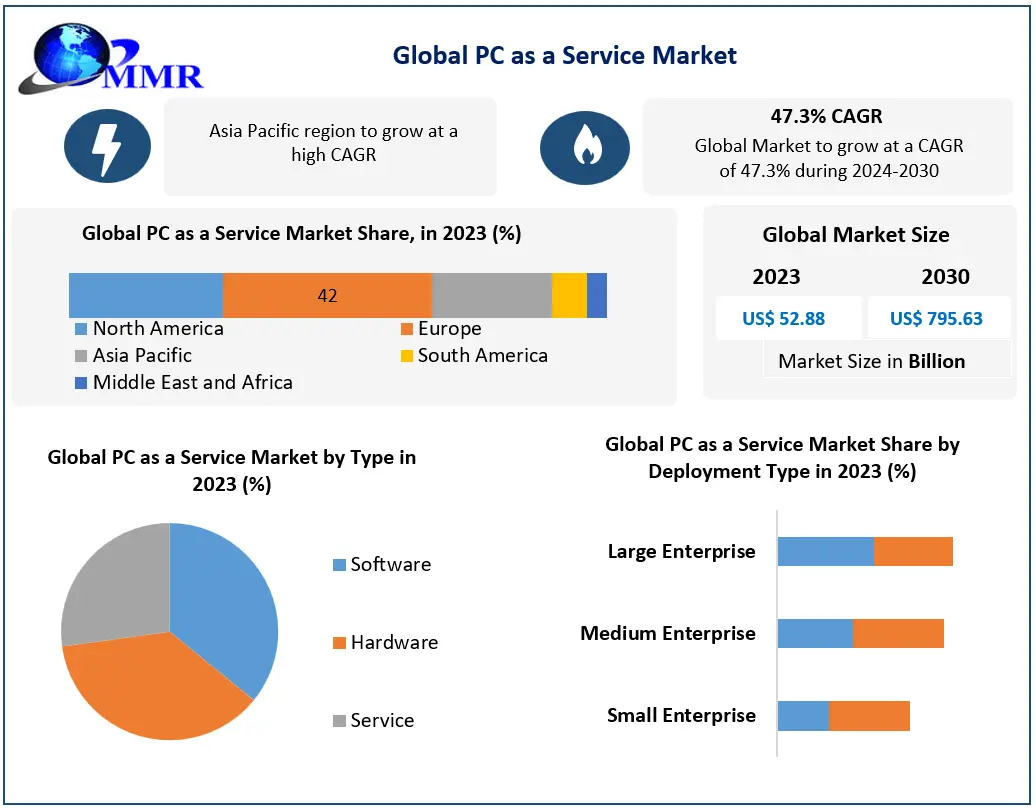
- The PC as a Service Market was valued at US$ 52.88 Bn in 2023 and is expected to reach nearly US$ 795.63 Bn by 2030, turning endpoint procurement into a major subscription-infrastructure opportunity.
- The market is forecast to grow at a 47.3% CAGR from 2024 to 2030, which makes PCaaS one of the strongest disclosed growth models in enterprise electronics lifecycle management.
- IT and Telecom held the largest end-user share in 2023, showing that digitally intensive enterprises are the earliest large-scale adopters.
- BFSI held the second-largest share in 2023, signaling demand from regulated industries seeking flexibility while reducing capital expenditure.
- North America is expected to hold the largest share, although the FAQ section also states Asia Pacific held the largest share in 2023; the public page therefore contains a regional inconsistency.
Why This Matters Now
Enterprise computing is moving from owned hardware to subscription endpoints. That shift changes demand signals for PC OEMs, semiconductor suppliers, IT service providers and investors tracking device refresh cycles.
PCaaS converts procurement, administration, retirement and periodic refresh into a monthly service model. For electronics manufacturers, the model makes installed-base control, service bundling and hardware refresh timing more valuable than one-time PC shipment volume.
Market Overview
PC as a Service is a device lifecycle management model where organizations lease endpoint hardware and access management services through a monthly subscription. The model covers procurement, administration, retirement and refresh cycles, giving enterprises a more predictable approach to PC ownership.
The PC as a Service Market is segmented by type into software, hardware and service. It is segmented by deployment type into small enterprise, medium enterprise and large enterprise, and by end user into BFSI, healthcare and life sciences, IT and telecom, government and defense, and education.
For the electronics and semiconductor sector, PCaaS does not create a single chip category. It reshapes endpoint replacement economics, lifting demand visibility for PC units, displays, processors, memory, device management software and service-led hardware bundles. The public page does not disclose foundry investments, HBM, advanced packaging, chiplet architecture or chip manufacturing capacity expansion.
Key Trends Driving Growth
Remote work is the main adoption driver. The surge in distributed workforces has increased demand for scalable PC management models that can support employees across locations.
Cloud computing changed the cost equation. PCaaS shifts personal computing away from conventional on-premise models and gives organizations more reliability, faster updates, stronger patching discipline and lower exposure to hardware-related downtime.
Scalability is the second driver. Organizations can increase storage or processing power on demand without buying new hardware, while pay-as-you-go models make endpoint management more flexible for fluctuating computing needs.
Sustainability is moving into procurement. PCaaS providers are using energy-efficient hardware, e-waste management and sustainable manufacturing practices, giving CIOs a way to connect device lifecycle management with environmental and financial benefits.
Security remains the main adoption barrier. The report identifies data protection concerns, lack of technical expertise, weak product differentiation and low awareness in developing countries as challenges, especially for BFSI and IT users handling confidential data.
Download a Free Sample to Explore Market Growth Trends
Segment Insights
- Dominant Segment IT and Telecom: IT and Telecom held the largest PC as a Service Market share in 2023. The segment benefits from rapid access to updated hardware and software, flexible infrastructure for remote work and reduced burden on internal IT teams.
- Second-Largest Segment BFSI: BFSI held the second-largest share in 2023. Demand is driven by scalability, flexibility and the need to reduce IT budgets and capital expenditure, but security and data-protection concerns remain material.
- Fastest-Growing Segment: The public MMR page does not identify a fastest-growing type, deployment type or end-user segment by CAGR. No fastest-growing segment is inferred.
- Deployment Scope: Small enterprise, medium enterprise and large enterprise are covered. Segment-level shares and growth rates are not disclosed on the public page.
- Type Scope: Software, hardware and service are covered. The source does not disclose which type dominates or grows fastest.
Regional Growth Story
North America is expected to hold the largest share in the global market. The region benefits from major players such as Dell, HP, Samsung and others, while the United States is described as one of the largest PC markets.
The report also notes strong growth in the display monitor market in 2021, driven by consumer and commercial demand. For OEMs, that signals endpoint demand extending beyond notebooks and desktops into monitors and workplace hardware ecosystems.
Asia Pacific is expected to grow at the highest CAGR during the forecast period. The region is adopting cutting-edge technologies, while governments and businesses are investing in technology infrastructure that aligns with PCaaS hardware and software refresh needs.
India is called out for startups in desktop virtualization, including NComputing, VDIworks and CloudDesktopOnline. These firms support virtual desktop infrastructure and Desktop-as-a-Service models, which strengthen the region’s remote-work and cloud-endpoint ecosystem.
Competitive Landscape
The competitive field includes Lenovo, Microsoft, HP, Dell, Amazon Web Services, CompuCom, Blueally, Broadview Networks, Computer Generated Solutions, Cybercore, Service IT Direct, Arrow Electronics, SHI International, PC Connection, Zones, Intel, Softcat, ATEA, Telia, Hemmersbach and HCL.
PC OEMs benefit because PCaaS gives them recurring revenue and closer control over enterprise refresh cycles. That reduces dependence on one-time hardware sales and strengthens pricing power when bundled with lifecycle services.
Cloud and service providers benefit differently. AWS, Microsoft and desktop-virtualization vendors can connect endpoint devices with cloud management, remote access and software orchestration, making the PC less of a standalone product and more of an enterprise access layer.
Intel’s presence signals semiconductor relevance at the platform level. The report does not disclose processor demand, memory trends or logic-chip forecasts, but subscription endpoints can create steadier replacement planning for PC silicon suppliers if adoption scales.
Recent Developments
- Remote Work Adoption: Distributed workforce demand is raising PCaaS adoption as companies seek scalable endpoint support. This makes device lifecycle outsourcing a strategic IT decision rather than a procurement shortcut.
- Green Computing Opportunity: Energy-efficient hardware, electronic waste management and sustainable manufacturing are identified as PCaaS opportunities, showing that device refresh strategy is entering ESG planning.
- India Desktop Virtualization Activity: NComputing, VDIworks and CloudDesktopOnline are identified as Indian startups providing VDI and Desktop-as-a-Service solutions, signaling regional momentum around cloud-based endpoints.
Strategic Implications
For semiconductor suppliers, PCaaS creates a demand-planning signal rather than a disclosed fabrication signal. The public page does not mention foundry investments, Taiwan capacity, South Korea memory trends, HBM, advanced packaging or chiplet architectures.
For PC OEMs, the winning model shifts from product shipment to lifecycle ownership. Hardware quality, service reliability, refresh timing, security controls and sustainability claims will decide enterprise retention.
For CIOs, PCaaS reduces hardware procurement and maintenance work. The trade-off is dependence on vendors for security, data protection, technical support and service differentiation.
Future Outlook
The PC as a Service Market is forecast to reach nearly US$ 795.63 Bn by 2030 at a 47.3% CAGR. Growth will come from remote work, cloud computing, predictable subscription pricing, flexible processing and storage capacity, endpoint refresh cycles and sustainability-linked device management.
The market will also test vendor credibility. Technical expertise gaps, product similarity, security concerns and low awareness in developing countries can slow conversion if providers fail to prove reliability and protection.
Future technology leaders will turn PCs into managed, secure and sustainable cloud endpoints; laggards will remain exposed to low-margin hardware cycles and enterprise buyers that no longer want to own device complexity.
Analyst Perspective
“PC as a Service is turning enterprise endpoints into managed cloud assets as remote work, lifecycle control and sustainability reshape PC procurement,” said Rucha Deshpande, Analyst at Maximize Market Research. “The strongest players will combine hardware access, security, service reliability, refresh management and e-waste discipline.”
About Maximize Market Research
Maximize Market Research Pvt. Ltd. (MMR) is a global market research and consulting company that provides reliable, data-focused, and practical business insights. The firm serves a wide range of industries, including healthcare, pharmaceuticals, technology, automotive, electronics, chemicals, personal care, and consumer goods. Through market forecasts, competitive analysis, strategic consulting, and industry impact assessments, MMR helps organizations understand changing market conditions, identify growth opportunities, and make informed business decisions for long-term success.
Contact Us
2nd Floor, Navale IT Park Phase 3
Pune Banglore Highway, Narhe
Pune, Maharashtra 411041, India
+91 9607365656
sales@maximizemarketresearch.com
