Key Highlights
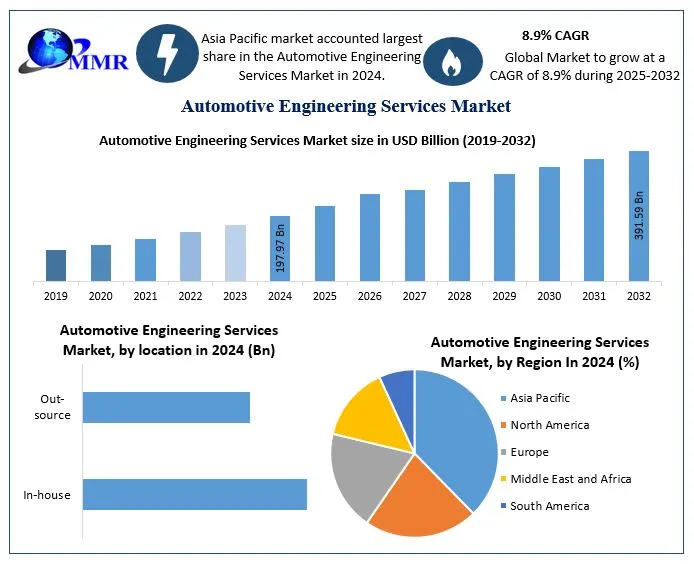
Capital Velocity Tracking: The global sector size expands from USD 197.97 billion in 2024 to USD 391.59 billion by 2032, recording an 8.9% compound annual growth rate.
Core Sourcing Architecture: Prototype services lead engineering volumes as manufacturers integrate 3D printing methodologies to accelerate complex system layout validations.
Growth Vector Acceleration: Connectivity services achieve the fastest development rates, supported by expanding global high-speed 5G telematics architectures.
Geographic Integration Epicenter: The Asia-Pacific theater controls the largest share of engineering service revenues, logging a 42.0% volume share in 2024.
Why This Matters Now
Automotive boardrooms, engineering executives, and technology investors face immediate pressure from shorter product lifecycles and shrinking development timelines. Shrinking vehicle creation cycles leave in-house technical workforces overstretched, creating a severe operational bottleneck. Original equipment manufacturers must quickly rebalance their research budgets toward specialized independent service providers to stay competitive. Companies that fail to deploy outside prototyping assets and advanced low-latency telematics engineering will lag in safety validation and software rollout schedules.
Market Overview
The global Automotive engineering services market serves as a fundamental innovation layer for vehicle design, electronic integration, and safety platform validation. Valued at USD 197.97 billion in 2024, this high-skill services sector has grown into an essential core business component for major automotive brands. The industry is projected to reach USD 391.59 billion by 2032, maintaining an 8.9% compound annual growth rate.
This consistent trajectory highlights an ongoing change in how automotive developers allocate engineering capital. Automakers like Renault, Volkswagen, BMW AG, Daimler AG, and Ford Motor Company increasingly turn to specialized third-party firms to manage design tasks. Partnering with external engineering groups allows legacy manufacturers to reduce overhead costs while incorporating modern technologies into new model releases.
Key Trends Driving Growth
Accelerating global investments in self-driving technologies and advanced active safety features are forcing automakers to alter their traditional product roadmaps. Developing fully autonomous driving platforms requires vast computing resources and extensive sensor verification arrays. Independent engineering service providers offer ready-to-use testing facilities and simulation environments, allowing automakers to bypass long software-building delays.
Simultaneously, the global rollout of reliable 5G telematics infrastructure reshapes underlying vehicle design principles. Modern connected vehicles require highly complex electronics that can handle massive data flows with minimal latency. Independent engineering specialists help automotive brands design, optimize, and secure these fast data networks. This structural demand shifts engineering work away from basic mechanical design toward advanced software architecture and over-the-air system optimization.
Segment Insights
Prototype Services (Dominant Segment): This service type held the largest market share in 2024. Widespread use of advanced 3D printing allows engineers to rapidly create complete vehicle mockups, intricate assembly models, and individual system components.
Connectivity Services (Fastest-Growing Segment): This service type exhibits the fastest growth rate throughout the forecast window. The rapid expansion of international 5G networks fuels intense demand for ultra-low latency vehicle communication platforms.
Asia-Pacific (Dominant Region): This geographic area generated approximately 42.0% of all market revenues in 2024, driven by high automotive manufacturing volume and large-scale product rollouts.
Regional Growth Story
The Asia-Pacific region continues to dictate global automotive engineering services market trends, holding its strong revenue lead through 2032. Rapid adoption of electric vehicles for personal transport in China serves as a primary regional catalyst. Additionally, major manufacturing hubs in Japan, South Korea, and India provide a solid foundation for specialized engineering work. Rising consumer vehicle demand, strict urban emission targets, and local traffic mitigation programs force regional brands to continuously update their powertrain and chassis electronics.
In contrast, the North American region is positioned for rapid expansion during the forecast period. Local engineering growth is accelerated by heavy corporate research investments in automated commercial fleets and complex logistics tracking platforms. Meanwhile, European design hubs focus their resources on structural intellectual property creation and advanced low-emission propulsion systems. These initiatives are designed to meet strict local carbon limits while maintaining high-speed highway performance standards.
Competitive Landscape
The global competitive landscape operates as an open, fast-moving environment where specialized independent firms compete alongside large IT service integrators. Main engineering entities include specialized providers like Altair Engineering, Pilot Systems International, HARMAN International, EPAM Systems, GlobalLogic, Belcan, Hunter Engineering Company, and Alten Group. Pricing power belongs to firms that maintain advanced testing laboratories and secure data centers.
To preserve operating margins, engineering firms must manage strict data protection protocols. Because external engineers regularly handle proprietary designs, service providers must execute highly disciplined security processes to eliminate intellectual property violations. Smaller local providers maintain their market position by offering flexible, on-demand staff augmentation for regional component suppliers.
Recent Developments
3D Printing Facility Scaling: Top tier engineering groups are adding large-format industrial additive manufacturing units to accelerate physical prototype testing cycles for global automotive customers.
Autonomous Drive Test Integration: Specialized service providers are expanding virtual simulation capabilities to let automakers test automated driving software across millions of virtual miles before final hardware validation.
Software-Defined Vehicle Expansion: Independent technical firms are establishing dedicated software engineering hubs to help legacy automakers transition from traditional mechanical setups to software-driven electronics.
Strategic Implications
The shifting balance between internal corporate engineering teams and external service specialists requires a major reallocation of long-term development capital. To avoid costly development delays, major automotive brands must structure transparent, collaborative partnerships with outside technology providers. Entrusting complex prototype tasks and connected data setups to specialized service firms allows automakers to optimize asset utilization and lower fixed facility costs.
At the same time, engineering suppliers must continuously update their technical skill sets to match rapidly changing vehicle electronics. Service firms need to secure engineering talent proficient in artificial intelligence, 5G network integration, and advanced lightweight materials. Operating leaders who establish clear communication channels and strong data protection boundaries with their manufacturing clients will build long-term contract stability.
Future Outlook
Global engineering volumes will increasingly shift toward connected vehicle software integration, high-yield system simulation, and automated fleet optimization platforms. The expansion of urban vehicle networks and low-emission shipping zones will remain a primary driver for advanced propulsion engineering services. Ongoing workflow automation, including cloud-based collaborative design tools, will assist engineering firms in managing overhead costs while executing complex global programs.
Looking ahead, tomorrow’s market leaders will be determined by a single factor: the ability to seamlessly integrate advanced software architectures into physical vehicle platforms while maintaining absolute intellectual property security across global teams.
Analyst Perspective
“The global automotive engineering services market is going through a structural transformation as automakers reallocate capital away from pure mechanical engineering toward software-centric vehicle layouts,” stated Tejaswini Kakade, Lead Analyst at Maximize Market Research.
About Maximize Market Research
Maximize Market Research Pvt. Ltd. (MMR) is a global market research and consulting company that provides reliable, data-focused, and practical business insights. The firm serves a wide range of industries, including healthcare, pharmaceuticals, technology, automotive, electronics, chemicals, personal care, and consumer goods. Through market forecasts, competitive analysis, strategic consulting, and industry impact assessments, MMR helps organizations understand changing market conditions, identify growth opportunities, and make informed business decisions for long-term success.
2nd Floor, Navale IT Park Phase 3
Pune Banglore Highway, Narhe
Pune, Maharashtra 411041, India
+91 9607365656
sales@maximizemarketresearch.com
