Key Highlights
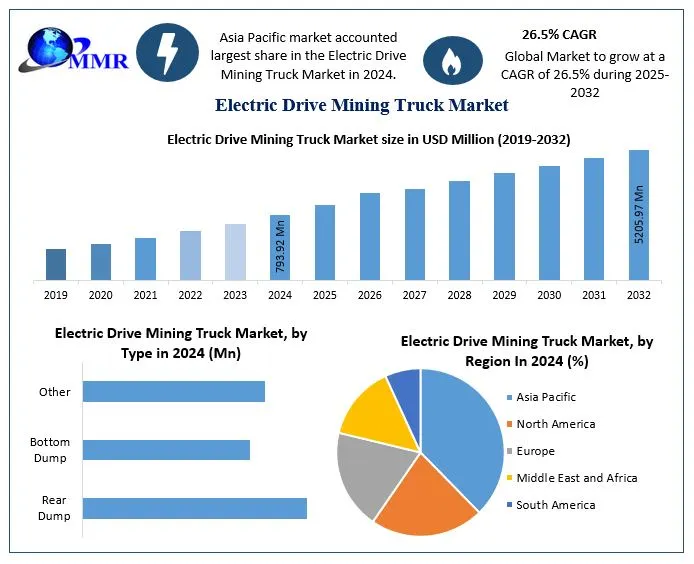
Exceptional Sector Acceleration: The global market size is establishing a strong 26.5% compound annual growth rate (CAGR) as mining firms replace aging mechanical haulage assets.
Payload Volume Superiority: Heavy configurations, particularly the 150-to-300-ton payload bracket, capture the highest market volume to optimize material movement.
Powertrain Dynamic Transition: Diesel-electric and full-battery architectures are capturing standard internal combustion engine market share, significantly lowering per-ton maintenance expenses.
Geographic Deployment Hubs: Resource-intensive regions across North America, Europe, and Asia-Pacific act as primary demand centers, backed by strict corporate ESG parameters.
Primary Infrastructural Priority: The development of megawatt-level high-power grid charging lines and continuous trolley-assist wires represents the major constraint for regional mine deployments.
Why This Matters Now
Global extraction corporations, heavy equipment original equipment manufacturers (OEMs), and specialized tier-1 industrial suppliers face an immediate operating ultimatum. Volatile diesel fuel prices and strict regional carbon taxation models have turned traditional mechanical-drive haulage fleets into major balance sheet liabilities. Open-pit operations require continuous, uninterrupted material throughput to remain profitable amid fluctuating global commodity valuations.
Deploying advanced electric-drive mining trucks lowers on-site operating costs, removes mechanical transmission wear points, and delivers instant, full-torque power on steep mine ramps. Equipment manufacturers that delay the production of high-payload, electric-drive haulage platforms risk missing long-term capital replacement cycles with the world’s largest mining conglomerates.
Market Overview
The global Electric drive mining truck market is transforming from a specialized niche segment into the primary design blueprint for high-capacity surface extraction haulage. Shifting away from legacy mechanical transmissions, modern heavy haulers utilize diesel engines paired with high-efficiency traction alternators or grid-tied battery assemblies to power wheels directly. This industrial equipment market is expanding at a projected 26.5% compound annual growth rate (CAGR) through 2032, making it one of the fastest-growing heavy machinery categories in the transportation sector.
This rapid expansion highlights a permanent change in how heavy industrial fleet buyers calculate long-term operating costs. Electric-drive systems remove complex mechanical gearboxes, drive shafts, and torque converters, which frequently fail under high loads. By switching to high-reliability electric wheel motors, mining operations can significantly increase vehicle uptime and reduce mechanical repair expenses in harsh environments.
Key Trends Driving Growth
The strict implementation of corporate net-zero carbon targets across multinational mining organizations is a primary driver expanding global production volumes. Industrial mining operations generate massive localized carbon footprints, with diesel-powered haulage fleets accounting for the vast majority of on-site emissions. By deploying electric-drive mining trucks, extraction companies can readily integrate vehicle systems with zero-emission renewable energy grids or high-efficiency overhead trolley lines, helping them meet carbon reduction targets.
Concurrently, the rapid deployment of autonomous driving software and advanced fleet telematics is accelerating market adoption. Modern electric-drive powertrains provide highly precise electronic torque control, making them ideal platforms for self-driving mine management software. Automated electric trucks can operate continuously with minimal speed variations, which optimizes tire life, regulates battery temperature, and increases overall hauling efficiency across deep open-pit operations.
Segment Insights
Dominant Fleet Type: Rigid Dump Trucks. This structural vehicle configuration commands the highest overall volume share. It is highly favored by global mining firms because its rigid chassis delivers exceptional payload capacities and structural durability when handling heavy rock and ore.
Dominant Payload Bracket: 150 to 300 Tons. This intermediate heavy payload segment leads procurement volume by balancing individual vehicle capital costs with the daily volume demands of large-scale mine operations.
Application Focus: Surface Mining. Growth is highly concentrated across massive open-pit iron ore, copper, gold, and coal extraction sites where travel distances and steep haul roads maximize electric regeneration benefits.
Alternative Payload Categories: Production remains active across smaller under-150-ton utility vehicles and ultra-class over-300-ton super haulers designed for high-volume mining operations.
Regional Growth Story
North America maintains a premier market position in the global electric drive mining truck landscape, supported by massive open-pit operations in the United States and Canada. Local extraction companies are making large capital investments to update existing machinery, driven by corporate sustainability mandates and a focus on lowering per-ton operating costs. Furthermore, close proximity to major heavy machinery research facilities accelerates the deployment of new electric vehicle platforms.
Europe mirrors this steady demand profile, driven by strict regional emission regulations and an expanding infrastructure network for clean industrial power. At the same time, the Asia-Pacific region is experiencing rapid growth in electric-drive adoption. This expansion is supported by expanding mineral extraction projects across Australia, China, and India, where operators rely on high-payload electric trucks to maximize output from deep surface mines.
Competitive Landscape
The global electric drive mining truck market is highly consolidated, led by an elite tier of multinational heavy equipment manufacturers with advanced engineering capabilities. Principal industry competitors include Caterpillar Inc., Komatsu Ltd., Hitachi Construction Machinery Co., Ltd., Liebherr Group, BelAZ, and XCMG Group. Competitive advantage belongs to manufacturers that maintain integrated component supply agreements for high-capacity traction motors, automated control software, and heavy-duty structural steel.
To protect their long-term market positioning, top-tier OEMs are establishing direct technology partnerships with large mining companies to test prototype electric vehicles in real-world conditions. These close collaborations allow manufacturers to optimize electric drivetrains for extreme temperatures and rugged terrain before scaling up factory production lines. Additionally, offering retrofitted electric-drive conversion kits for existing diesel trucks provides a steady, high-margin revenue stream through aftermarket channels.
Recent Developments
Megawatt Charging Innovations: High-capacity equipment manufacturers have deployed prototype megawatt-level charging interfaces to dramatically compress battery replenishment cycles during active mining shifts.
Overhead Trolley Integrations: Major industrial OEMs have expanded production lines for trolley-assist electric trucks, allowing haulers to draw power directly from overhead lines on steep mine climbs.
Autonomous Drivetrain Mergers: Premier mining tech suppliers have finalized engineering integrations to pair autonomous fleet dispatch software directly with digital electric-drive systems.
Composite Structural Components: Vehicle development teams have introduced lighter composite bed liners to reduce overall truck weight, maximizing the available payload capacity within strict axle load limits.
Strategic Implications
The integration of high-voltage electric propulsion systems into ultra-class mining machinery introduces unique technical and supply chain variables for engineering teams. Unlike smaller passenger electric vehicles, a fully loaded mining truck requires massive energy delivery, which places unique demands on local mine power grids. Fleet operators must make coordinated capital investments in on-site substations, high-capacity charging stations, or overhead trolley lines to support a growing fleet of electric vehicles.
Furthermore, heavy machinery OEMs must continuously safeguard their component supply chains against volatility in raw materials and specialized electronic modules. Sourcing high-grade copper for traction motors, rare-earth magnets for electric drives, and heavy-duty semiconductor components requires diversified procurement pipelines to prevent factory production delays. Mining operations that successfully integrate automated electric haulage with clean, on-site power generation will protect their margins from fuel price shocks and secure long-term operating advantages.
Future Outlook
The global electric drive mining truck market will increasingly reward heavy machinery manufacturers that can deliver high-payload haulers featuring modular, zero-emission powertrains and advanced autonomous software compatibility. As environmental regulations tighten around deep open-pit operations worldwide, demand for traditional mechanical-drive diesel fleets will naturally decline. The future market will be strictly divided between agile engineering leaders who build scalable, grid-connected electric haulage ecosystems, and legacy equipment manufacturers who fail to transition away from mechanical drivetrains.
Analyst Perspective
“The rapid shift toward electric-drive architectures across the global mining truck market marks a major turning point for heavy industrial transportation,” stated Tejaswini Kakade, Lead Analyst at Maximize Market Research.
About Maximize Market Research
Maximize Market Research Pvt. Ltd. (MMR) is a global market research and consulting company that provides reliable, data-focused, and practical business insights. The firm serves a wide range of industries, including healthcare, pharmaceuticals, technology, automotive, electronics, chemicals, personal care, and consumer goods. Through market forecasts, competitive analysis, strategic consulting, and industry impact assessments, MMR helps organizations understand changing market conditions, identify growth opportunities, and make informed business decisions for long-term success.
2nd Floor, Navale IT Park Phase 3
Pune Banglore Highway, Narhe
Pune, Maharashtra 411041, India
+91 9607365656
sales@maximizemarketresearch.com
