Key Highlights
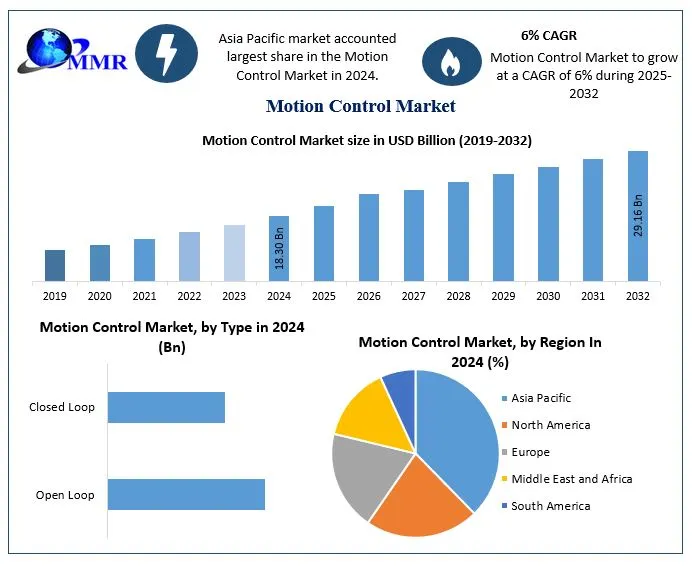
Market Capitalization Track: The global market valuation increases from USD 18.30 billion in 2024 to USD 29.16 billion by 2032, securing an annualized 6% compound growth rate.
Architecture Type Expansion: The open-loop segment is projected to grow at the highest CAGR during the forecast period due to its structural simplicity and lower manufacturing replacement costs.
Component Category Velocity: The controller segment is expanding at the fastest pace, driven by customizable programming needs across advanced automated palletizing and sorting networks.
Actuation Technology Acceleration: Pneumatic technology represents the fastest-growing technology segment, capitalizing on clean compressed-air mechanics for high-force, high-speed movements.
Industry Vertical Leadership: The automotive manufacturing vertical leads structural adoption rates, relying heavily on real-time speed, torque, and position synchronizations along assembly pipelines.
Why This Matters Now
Industrial electronics original equipment manufacturers (OEMs), foundry operators, and advanced semiconductor strategists face immediate operational pressure as modern manufacturing sites transition into autonomous, software-defined environments. Legacy mechanical handling systems lack the microsecond precision, real-time diagnostic connectivity, and adaptive torque variations required to safely guide multi-axis robotic arms or high-speed packaging machinery.
Firms must optimize their hardware development pipelines around specialized embedded microcontrollers, power transistors, and industrial communication processors to lock in high-margin supply agreements with global factory automation builders. System integrators and silicon suppliers that fail to integrate open-loop cost efficiencies and robust edge-computing control logic into their hardware modules will lose design-win velocity to highly integrated, software-programmable motor architectures.
Market Overview
The global Motion control market is converting from standalone mechanical hardware pieces into an interconnected network of highly intelligent, silicon-driven systems. Valued at USD 18.30 billion in 2024, this highly capital-intensive market is on a path to hit USD 29.16 billion by 2032, maintaining a 6% compound annual growth rate. This development highlights how modern factories depend on precise, continuous management of physical loads across automated production grids.
At its core, a contemporary motion control ecosystem utilizes a trio of dependent elements: an intelligent controller, a power drive or amplifier, and a high-efficiency motor to achieve micro-positioning accuracy. As global industries implement strict energy compliance policies and transition toward high-throughput operations, the demand for fast internal processing gates and low-latency motor control ICs is reshaping traditional component sheets. Electronics manufacturing services (EMS) providers are expanding their production lines to accommodate the high-density printed circuit boards that act as the neural centers for these automated industrial operations.
Key Trends Driving Growth
The rapid deployment of custom industrial robotics across diverse logistics, picking, and palletizing hubs serves as a primary demand vector for the global marketplace. Modern robots executing complicated tasks like box stacking on interlocking frameworks require continuous synchronization between the main robot controller and the embedded motion units. This trend drives steady microchip consumption, as every multi-axis arm depends on a dedicated layer of power semiconductors and signal processors to smoothly regulate acceleration profiles and eliminate sudden mechanical stresses.
Concurrently, structural evolution in additive manufacturing and 3D printing equipment is altering traditional component engineering priorities. Industrial 3D printing platforms require exceptionally precise multi-axis positioning systems to translate computer-aided design (CAD) blueprints into real physical layers with high repeatability. This technical mandate shifts spending away from bulky, legacy mechanical gearing mechanisms toward dynamic servo systems that leverage sophisticated microcontrollers to monitor and correct positional deviations in real time.
Segment Insights
Open Loop Systems (Fastest-Growing Type Segment): This technical architecture is projected to expand at the highest CAGR during the forecast period. Open-loop systems are simpler to build, require far less baseline componentry, and offer exceptional cost efficiencies alongside simplified maintenance routines for factory operators.
Controllers (Fastest-Growing Component Segment): This product group is expanding rapidly because of the urgent industrial requirement for customizable programming and advanced diagnostic features within complex packaging and textile machinery.
Pneumatic Actuators (Fastest-Growing Technology Segment): This technology group is scaling faster than alternative mechanisms, utilizing highly durable compressed-air engineering to deliver high force, clean operations, and reliable execution velocities.
Automotive Vertical (Fastest-Growing Industry Segment): The automotive manufacturing vertical leads growth, relying on controlled component movements along rapid assembly lines where exact position and speed management are directly tied to production yield.
Regional Growth Story
The Asia-Pacific region is projected to remain the largest global market for motion control solutions throughout the forecast period. This geographical dominance is supported by high-volume domestic machine tool production and substantial infrastructure clusters manufacturing cars, smartphones, and advanced semiconductor fabrication machinery across China, Japan, and India. Local manufacturing firms are investing heavily in customized robotic installations to combat localized labor shortages, allowing regional component suppliers to deliver high-performance motor drivers directly to domestic automotive and electronics assembly lines.
In parallel, North American and European industrial hubs are adjusting their procurement strategies to focus heavily on high-precision inspection, advanced multi-axis CNC machines, and aerospace production installations. Fabs and design houses across these regions are investing in high-end closed-loop systems and radiation-hardened control modules required for high-reliability medical equipment and defense applications. These regional developments are supported by extensive corporate investments in smart factory transformations, ensuring that local aerospace and vehicle OEMs maintain access to low-latency motion management setups.
Competitive Landscape
The global competitive landscape features a high concentration of engineering expertise, with established automation leaders dominating high-voltage power electronics and processing software through deep patent portfolios. Key industry players include ABB Ltd., FANUC Corporation, Parker Hannifin Corporation, Rockwell Automation, Inc., Siemens AG, Yaskawa Electric Corporation, Mitsubishi Electric Corporation, and Robert Bosch GmbH. Technology leadership belongs to corporations that can deliver flexible, open-architecture controllers that integrate easily with third-party software networks and factory-floor 5G links.
To secure pricing power and defend long-term margins against low-cost component hardware, major automation suppliers are moving toward comprehensive software-and-hardware integration models. Companies are enhancing their product lines with advanced simulation toolkits and predictive maintenance analytics that track motor health and component wear. This trend toward digital integration allows leading brands to capture high-margin diagnostic service revenues, positioning their hardware platforms as critical analytical nodes within modern smart manufacturing setups.
Recent Developments
Automation innovators have engineered modular motion controllers featuring open-source software interfaces, minimizing software integration barriers for specialized 3D printing and textile machine manufacturers.
Component suppliers have scaled production for low-cost open-loop stepper motor drivers, targeting high-volume applications where system cost and simple maintenance are primary considerations.
Industrial engineering groups have deployed advanced pneumatic actuator controllers that optimize compressed-air usage, supporting corporate green manufacturing initiatives.
System packagers have introduced high-speed inspection setups that connect directly to local factory networks to improve draw control precision and draw-tension repeatability.
Strategic Implications
The shifting balance from pure mechanical drivelines to complex electronic motion management introduces unique design considerations and supply-chain dependencies for management. Because modern programmable controllers rely on specialized logic gates and high-performance gate drivers, they are highly sensitive to global semiconductor foundry capacities and microchip distribution bottlenecks. Electronics OEMs must build multi-foundry relationships and maintain strategic buffer inventories of crucial microcontrollers to prevent product shipment delays during global component allocation cycles.
Furthermore, implementing automated motion systems across complex packaging and vehicle assembly lines requires careful attention to component inventory costs. Deploying a wide variety of mixed-manufacturer controllers and drives across a single factory floor increases the cost of spare parts inventories and complicates routine technician field training. Production directors must implement rigorous equipment standardization frameworks, ensuring that localized automation hardware utilizes interoperable protocols and unified control software to lower the long-term total cost of machine ownership.
Future Outlook
The global utilization of motion control technologies will accelerate as automated production systems, smart packaging networks, and advanced machine tools demand faster processing speeds and superior torque management. Future market progression will see independent drive electronics moving past large central control cabinets to sit directly on the motor frame, creating hyper-compact, decentralized units where power transistors, logic gates, and wireless links function on a unified silicon block. Ultimately, future market leadership will belong to integrated automation providers that combine flexible hardware layouts with self-configuring edge-computing software, while laggards remain restricted to selling isolated, disconnected mechanical parts into a shrinking base of traditional manufacturing lines.
Analyst Perspective
“The global motion control market has entered an era of rapid digital convergence as legacy physical actuators integrate directly with advanced programming logic and edge analytics,” stated Rucha Deshpande, Lead Analyst at Maximize Market Research.
About Maximize Market Research
Maximize Market Research Pvt. Ltd. (MMR) is a global market research and consulting company that provides reliable, data-focused, and practical business insights. The firm serves a wide range of industries, including healthcare, pharmaceuticals, technology, automotive, electronics, chemicals, personal care, and consumer goods. Through market forecasts, competitive analysis, strategic consulting, and industry impact assessments, MMR helps organizations understand changing market conditions, identify growth opportunities, and make informed business decisions for long-term success.
2nd Floor, Navale IT Park Phase 3
Pune Banglore Highway, Narhe
Pune, Maharashtra 411041, India
+91 9607365656
sales@maximizemarketresearch.com
