Key Highlights
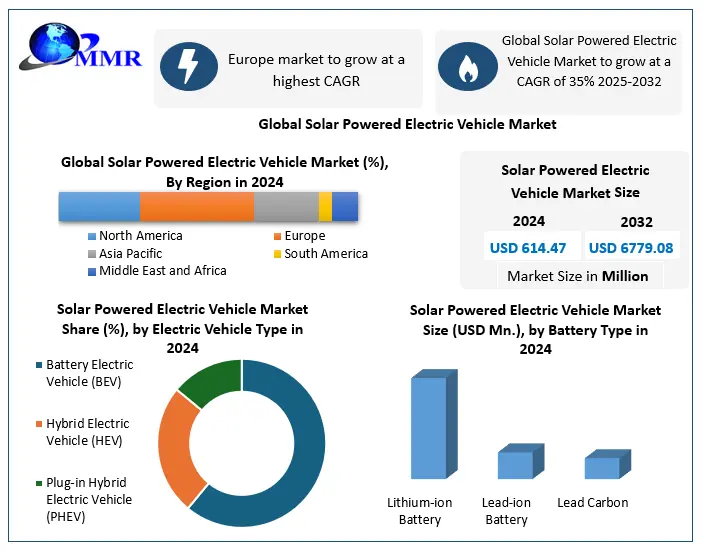
Stellar Market Expansion: The global solar powered electric vehicle market is on track to surge from USD 337.16 million in 2022 to USD 2755.34 million by 2029, recording a 35% CAGR.
Regulatory Compliance Mandate: Growing concerns regarding carbon emissions by global regulatory organizations serve as the primary catalyst for market adoption.
Powertrain Range Extension: Integrating photovoltaic arrays onto electric vehicles provides direct trickle-charging capabilities, reducing grid dependence and grid-tied charging infrastructure bottlenecks.
Advanced Technology Adoption: High-efficiency energy storage systems and specialized solar tracking materials are restructuring early-stage vehicle architectures.
Strategic Clean-Tech Pivots: Core automotive key players are reallocating R&D capital toward structural solar integration to differentiate their premium electric portfolios.
Why This Matters Now
Automotive OEMs, Tier-1 system suppliers, and transport energy strategists must rapidly commercialize onboard solar capture systems or risk losing technical differentiation in an increasingly crowded electric vehicle landscape. Traditional battery-electric vehicles remain heavily constrained by localized grid capacity, charging queue friction, and persistent consumer range anxiety. By embedding high-efficiency photovoltaic materials directly into the vehicle’s body panels, manufacturers can bypass external energy bottlenecks and deliver true off-grid energy generation. Global regulatory organizations are tightening emission baselines to unprecedented levels, making alternative zero-emission powertrains an absolute operational necessity. Corporate capital must flow into advanced solar-to-battery integration lines now to capture the initial wave of tech-forward consumer demand.
Market Overview
The global Solar Powered Electric Vehicle Market is transitioning from an experimental, low-volume engineering niche into a highly capital-backed automotive sub-sector. According to data published by Maximize Market Research, the global market achieved a baseline valuation of USD 337.16 million in 2022. Driven by non-stop pressure to optimize electric vehicle range and mitigate greenhouse gases, the industry is projected to advance at a compound annual growth rate (CAGR) of 35% through the forecast period. This intensive commercial expansion will elevate the global industry’s total valuation to USD 2755.34 million by the year 2029.
A solar-powered electric vehicle utilizes integrated photovoltaic cells, typically mounted on the roof, hood, or body panels, to convert solar radiation into usable electrical energy. This onboard generation feeds directly into the vehicle’s primary battery pack or auxiliary electronics via specialized charge controllers and power inverters. The market’s structural analysis incorporates extensive bottom-up data collection models, balancing component utilization rates against average retail vehicle pricing across multiple transportation channels. This strong market trajectory positions solar-integrated powertrains as a disruptive technological frontier that complements existing battery electric vehicle (BEV) and plug-in hybrid architectures.
Key Trends Driving Growth
The core structural driver accelerating the market is the intensifying level of concern about carbon emissions expressed by global regulatory organizations. Environmental protection bodies across major automotive manufacturing hubs are enacting strict carbon reduction mandates that penalize conventional fossil-fuel drivetrains. This regulatory pressure forces automotive manufacturers to look beyond traditional plug-in recharging, which often relies on fossil-fuel-dominated electrical grids. Solar integration offers a path to pure zero-emission transportation, where the primary fuel source is harvested directly from the environment without any mid-stream grid conversion losses.
Concurrently, rapid advancements in photovoltaic cell efficiency and lightweight automotive materials are altering the commercial viability of solar-integrated cars. Early iterations were restricted by heavy, rigid solar panels that compromised vehicle aerodynamics and added excessive weight. Modern manufacturing techniques are overcoming these limits through thin-film, curved, and highly flexible solar cells that match the styling profiles of passenger vehicles. These advanced materials optimize energy capture across varied weather conditions and angles of incidence, delivering a steady stream of supplementary power to the primary electric motor.
Furthermore, the continuous growth of consumer demand for self-sustaining, long-range transport platforms is reshaping vehicle procurement trends. Consumers in regions characterized by vast driving distances and decentralized charging networks are highly responsive to vehicles that can continuously self-charge while parked outdoors. This utility makes solar vehicles highly attractive for urban commuters who leave their vehicles exposed to daylight during normal working hours. This consumer pull encourages manufacturers to invest heavily in the electronic control systems needed to handle simultaneous solar charging and high-load power delivery.
Segment Insights
The global industry architecture is analyzed across specific product, vehicle, and technological parameters to monitor changing market structures:
Dominant Segment: Passenger Solar Cars represent the dominant segment by value and consumer interest, fueled by high urban commuter demand, premium tech positioning, and strict municipal carbon emission restrictions.
Fastest-Growing Segment: Solar-Integrated Commercial and Delivery Vehicles represent the fastest-growing application segment, driven by corporate fleet logistics managers seeking to reduce total cost of ownership (TCO) during long daylight routing cycles.
Photovoltaic Technology Distribution: The technical bill of materials tracks the shift from standard monocrystalline silicon cells toward high-efficiency, flexible thin-film crystalline silicon and emerging multi-junction solar cells.
Drivetrain Architecture: Structural engineering maps the integration of solar charging loops across pure Battery Electric Vehicles (BEVs) and extended-range Hybrid Electric Vehicles (HEVs).
Regional Growth Story
The regional deployment of solar-powered electric vehicles is tightly aligned with local solar irradiance levels, regional EV adoption curves, and proactive clean energy legislation. The Asia-Pacific region is emerging as a dominant production and consumption hub, supported by intensive manufacturing investments across China, Japan, and South Korea. These nations hold a commanding share of the global solar cell supply chain, allowing regional automakers to source high-grade photovoltaic components at low costs. This structural proximity helps Asia-Pacific manufacturers build economies of scale rapidly, helping them lower retail prices for solar-equipped passenger cars.
Simultaneously, North America is exhibiting robust growth, driven by high investments in clean-tech startups, a strong consumer base for premium electric cars, and state-level buying incentives in sun-dense regions of the United States. The regional business environment favors high-capacity, long-range solar integration to support cross-country traveling patterns. Europe follows a parallel path, focusing on integrating advanced solar roofing options into compact urban hatchbacks to satisfy strict zero-emission municipal transport zones across major European cities.
Competitive Landscape
The competitive matrix is defined by intense technical rivalries as legacy automakers and agile clean-tech startups compete for dominant intellectual property positions. Manufacturers are forming deep strategic alliances with Tier-1 solar panel manufacturers and specialized silicon foundries to secure highly efficient cells. These technical partnerships allow companies to co-develop custom vehicle body panels that double as active energy harvesters, protecting their long-term pricing power from generic market entrants.
The broader supply chain relies heavily on maintaining steady access to advanced semiconductor components, high-purity silicon raw materials, and high-efficiency power inverters. Leading automotive groups are rapidly restructuring their electronics assembly lines to integrate complex solar charge controllers that seamlessly manage energy flows between the solar array, the regenerative braking system, and the main battery pack. This high level of systems integration is vital for maximizing total vehicle efficiency and preventing thermal overload within the vehicle’s electrical framework.
Recent Developments
High-Efficiency Photovoltaic Integration: Advanced engineering groups successfully integrated curved thin-film solar arrays directly into standard vehicle panoramic roof designs, boosting auxiliary power generation.
Charge Controller Innovations: Specialized component suppliers commercialized smart solar charge controllers capable of balancing multi-directional power flows between solar panels and main lithium-ion battery packs.
Corporate Fleet Solar Trials: Commercial logistics operators initiated comprehensive field trials of solar-equipped urban delivery vans to calculate real-world total cost of ownership reductions.
Cross-Industry Silicon Alliances: Leading EV manufacturers formalized long-term supply agreements with specialized solar cell producers to lock in volume pricing for high-purity crystalline silicon.
Strategic Implications
The polarization of the clean vehicle supply chain means that onboard energy harvesting is becoming a major metric for automotive differentiation. OEMs can no longer rely purely on increasing battery pack sizes to solve range anxiety, as adding weight creates a cycle of diminishing returns. Instead, engineering capital must be directed toward perfecting lightweight, aerodynamic, solar-integrated body architectures. Tier-1 suppliers must transition away from basic electrical harnesses and secure exclusive patents for intelligent power management systems that optimize energy capture under low-light or shaded conditions.
Future Outlook
The ultimate expansion of the global market will belong to manufacturers that achieve cost parity with traditional electric vehicles by optimizing automated solar panel installation lines. As flexible solar cell efficiencies climb and vehicle power demands are optimized through lightweight materials, solar integration will become a standard option across mainstream vehicle lineups. The dividing line across the global automotive industry will separate future leaders who control the core power electronics and proprietary solar-body styling from laggards who remain entirely dependent on external grid charging systems.
Analyst Perspective
“The continuous growth of the global solar powered electric vehicle market proves that energy autonomy is the next major frontier for sustainable mobility,” states Dharati Raut, Analyst at Maximize Market Research. “As global regulatory organizations demand strict carbon accountability, the automotive entities that successfully embed high-efficiency photovoltaic materials directly into the vehicle’s footprint will secure a dominant competitive advantage.”
About Maximize Market Research
Maximize Market Research Pvt. Ltd. (MMR) is a global market research and consulting company that provides reliable, data-focused, and practical business insights. The firm serves a wide range of industries, including healthcare, pharmaceuticals, technology, automotive, electronics, chemicals, personal care, and consumer goods. Through market forecasts, competitive analysis, strategic consulting, and industry impact assessments, MMR helps organizations understand changing market conditions, identify growth opportunities, and make informed business decisions for long-term success.
2nd Floor, Navale IT Park Phase 3
Pune Banglore Highway, Narhe
Pune, Maharashtra 411041, India
+91 9607365656
sales@maximizemarketresearch.com
