Key Highlights
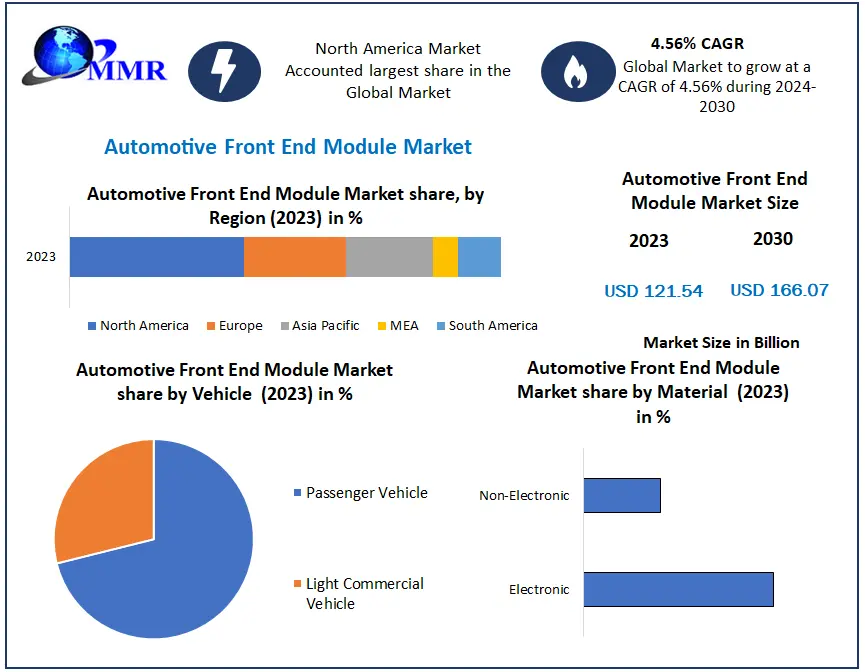
Substantial Sector Valuation: The global automotive front end module market is projected to expand from USD 121.54 billion in 2023 to USD 166.07 billion by 2030, registering a 4.56% CAGR.
Production Cost Optimization: Shifting to highly integrated modular front ends cuts vehicle assembly production costs by 20 to 30 percent for global automotive manufacturers.
Drivetrain Customization Demand: Accelerated electric car sales across major emerging regions are driving the demand for specialized modules engineered with dedicated battery cooling frameworks.
Advanced Material Substitution: The composite materials segment is capturing a substantial market share as engineering teams prioritize driving range extensions over legacy metal structures.
Safety Infrastructure Integration: Evolving collision safety standards and advanced driver-assistance sensor arrays are forcing the consolidation of lighting, electronics, and crumple zones.
Why This Matters Now
Automotive OEMs and Tier-1 structural component suppliers must immediately re-engineer their vehicle architecture strategies or face severe cost disadvantages in an increasingly commoditized vehicle assembly market. Traditional multi-piece front-end construction methods are becoming obsolete as manufacturers seek to protect shrinking profit margins by stripping out floor-space friction. Deploying pre-assembled multi-piece front end systems directly addresses these cost pressures, compressing localized production cycles and facilitating cross-vehicle platform standardizations. Furthermore, the aggressive global transition toward battery-electric platforms requires complex layout configurations to house advanced battery thermal management lines, structural crash protection, and high-density electronics simultaneously. Capital must move aggressively into automated sub-assembly lines and advanced composite bonding technologies right now. Failing to adapt to this consolidated component reality will lock legacy Tier-1 suppliers out of the primary volume manufacturing contracts dictating next-generation electric vehicle architecture.
Market Overview
The global Automotive Front End Module Market is executing a permanent migration away from highly fragmented vehicle nose architectures to unified, highly functional multi-piece assemblies. According to analytical data published by Maximize Market Research, the global industry achieved a baseline valuation of USD 121.54 billion in 2023. Backed by steady global vehicle production volumes and a strict corporate mandate to lower assembly line footprints, the sector is advancing at a compound annual growth rate (CAGR) of 4.56% through the 2024 to 2030 forecast window. This consistent industrial expansion will lift the total value of the global market to USD 166.07 billion by the year 2030.
An automotive front-end module (FEM) is a complex, composite structural frame that integrates a vast array of front-end automotive components into a single pre-assembled unit before it arrives at the main vehicle chassis attachment station. These multi-piece systems typically consolidate forward lighting housings, radiators, cooling fans, air conditioning condensers, grille-opening reinforcement (GOR) panels, crumple zones, hood latches, and decorative fascia bumpers. The structural boundaries of this evaluation track crucial application latches, diverse base materials including steel, plastic, hybrid, aluminum, and composites, alongside changing passenger and commercial vehicle distributions. This modular approach streamlines global manufacturing operations, allowing volume brands to achieve unprecedented economies of scale across international manufacturing platforms.
Key Trends Driving Growth
The core structural force accelerating the global industry is the dramatic reduction in vehicle manufacturing costs achieved through modern modular assembly practices. Integrating diverse components into a standardized front-end package allows automotive manufacturers to reduce localized production costs by 20 to 30 percent compared to legacy step-by-step methods. This cost deflation helps automakers reallocate capital toward software-defined features while simplifying the overall supply chain mechanics of the primary factory floor.
Concurrently, the rapid scaling of global electric car sales across emerging and mature automotive hubs is placing new structural demands on front-end layouts. Electric vehicle (EV) front ends differ substantially from internal combustion engine configurations because they eliminate massive engine bays while requiring optimized battery cooling loops, unique aerodynamic profiles, and advanced front-facing radar sensors. This architectural shift requires specialized, highly engineered front-end modules that maximize driving ranges by keeping aerodynamic drag coefficients minimized and component packaging density maximized.
Furthermore, the continuous tightening of vehicle collision safety standards and international emission regulations by global regulatory organizations is altering material procurement rules. To achieve maximum safety ratings, engineering teams are incorporating complex crumple zones and integrated sensor mounts for advanced driver-assistance systems (ADAS) directly into the front frame structure. This safety integration guarantees that automated collision avoidance arrays remain perfectly aligned throughout the operational lifecycle of the passenger vehicle.
Segment Insights
The global front end module marketplace is classified across mechanical components, vehicle segments, and raw material architectures to evaluate shifting demand patterns:
Fastest-Growing Vehicle Segment: Passenger Vehicles represent the fastest-growing application category, propelled by evolving safety standards, consumer demand for aesthetic customization, and the rapid rollout of global electric vehicle platforms.
Significant Material Share: The Composites segment is capturing a highly substantial market share over the forecast period, valued by vehicle weight-reduction teams for its exceptional strength-to-weight ratios and design flexibility.
Diverse Material Portfolio: Structural bills of materials track critical engineering design distributions across classic Steel, lightweight Plastic, Hybrid structures, high-grade Aluminum, and advanced Composite configurations.
Application Component Tracking: Operational data structures track manufacturing output variations across critical latch locations including Side Door, Hood, Tailgate, and Back Seat assemblies.
Regional Growth Story
The regional layout of the front-end module industry reflects the concentration of massive vehicle manufacturing hubs, with the Asia-Pacific region experiencing robust growth and volume leadership. This upward momentum is driven by the presence of dense automotive production bases across Japan, South Korea, China, and India. Rising disposable incomes across these developing economies, paired with rapid advancements in transit tech due to evolving regional emission laws, open up significant long-term growth loops for pre-assembled component systems.
Simultaneously, North America maintains an elite market position, fueled by a high concentration of large-scale premium utility truck lines and sport utility platforms within the United States. The regional commercial environment strongly rewards Tier-1 suppliers that can deliver heavy-duty, hybrid steel-plastic modules capable of managing complex thermal requirements for towing applications. Europe follows a highly technical path, driven by strict European Union carbon targets that mandate the immediate adoption of lightweight aluminum and advanced composite frames across high-volume passenger car lines.
Competitive Landscape
The competitive matrix features deep industrial rivalries among highly consolidated Tier-1 conglomerates and specialized component fabricators competing for multi-year platform contracts. Leading international entities leverage their massive manufacturing capacities to establish close proximity to OEM assembly lines, keeping shipping logistics friction down and ensuring just-in-time delivery efficiency. These prominent players invest heavily in proprietary hybrid material bonding technologies to lock in their long-term component pricing power against low-cost local suppliers.
The broader supply chain dynamics rely extensively on maintaining steady access to raw engineering polymers, high-purity structural aluminum, and specialized component electronics like electronic hood latches. Top-tier groups are restructuring their manufacturing lines to run automated sub-assembly processes that can build completely distinct front-end configurations on a single production line to satisfy varied brand styling rules. This structural agility allows Tier-1 organizations to protect their technology leadership while shielding their margins from raw material price volatility.
Leading automotive front end module key players include:
Aisin Seiki Co., Ltd. – Japan
Mitsui Mining and Smelting Co., Ltd. – Japan
Kiekert AG – Germany
Magna International – Canada
Prabha Engineering Pvt. Ltd – India
Strattec Security Co. – United States
U-Shin, Ltd. – Japan
Shivani Locks Pvt. Ltd. – India
Recent Developments
Assembly Floor Friction Reductions: Leading vehicle producers completed the factory implementation of pre-assembled front-end architectures, securing verified production cost reductions of up to 30 percent.
Specialized EV Cooling Integrations: Advanced engineering divisions commercialized specialized electric vehicle front modules configured with dedicated multi-channel battery cooling loops and aerodynamic grille shutting arrays.
Composite Material Scale Up: Major Tier-1 component fabricators successfully scaled up the automated production of high-strength composite frames to satisfy strict passenger vehicle weight-reduction targets.
Sensor Alignment Systemizations: Structural component engineers completed the integration of factory-calibrated radar and camera sensor mounts directly into front grille reinforcements to secure consistent ADAS performance.
Strategic Implications
The polarization of the global automotive component chain means that structural framing is converting from a basic stamping operation into a high-tech electronics and thermal engineering delivery platform. OEMs can no longer treat the front frame as a series of disconnected brackets; it must function as a core node that defines vehicle aerodynamics, collision safety pathways, and sensor layouts. Tier-1 suppliers must transition away from legacy metal bending and secure exclusive patents for multi-material hybrid joining methods and automated sensor calibration procedures. Manufacturing groups that remain limited to generic individual parts supply will face rapid margin compression as top automakers shift their entire procurement focus to single-source, fully integrated front-end modules.
Future Outlook
The ultimate expansion of the global automotive front end module market will belong to manufacturers that master advanced multi-material composite bonding while optimizing automated component installation practices. As alternative electric powertrains become the absolute baseline standard across international automotive assembly lines, structural front-end units will scale out into a universal design requirement. The dividing line across the global automotive sector will separate future leaders who control proprietary hybrid material molding and integrated sensor integration from laggards who remain restricted to delivering individual standalone components.
Analyst Perspective
“The continuous growth of the global automotive front end module market proves that modular consolidation is the ultimate mechanism for lowering production costs and managing complex electric vehicle layouts,” states Dharati Raut, Analyst at Maximize Market Research. “As safety standards and emission rules tighten worldwide, the component suppliers that master lightweight composite integration and automated multi-piece assembly will lock in dominant positions across the global supply chain.”
About Maximize Market Research
Maximize Market Research Pvt. Ltd. (MMR) is a global market research and consulting company that provides reliable, data-focused, and practical business insights. The firm serves a wide range of industries, including healthcare, pharmaceuticals, technology, automotive, electronics, chemicals, personal care, and consumer goods. Through market forecasts, competitive analysis, strategic consulting, and industry impact assessments, MMR helps organizations understand changing market conditions, identify growth opportunities, and make informed business decisions for long-term success.
2nd Floor, Navale IT Park Phase 3
Pune Banglore Highway, Narhe
Pune, Maharashtra 411041, India
+91 9607365656
sales@maximizemarketresearch.com
