Key Highlights
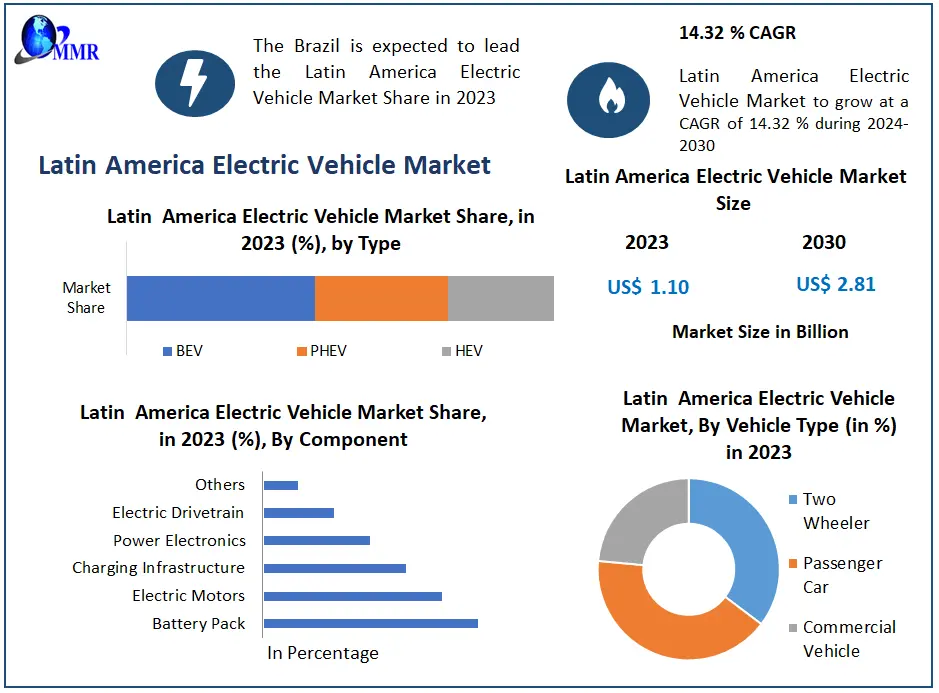
Consistent Capital Expansion: The Latin America electric vehicle market recorded a baseline valuation of USD 1.10 billion in 2023 and is projected to expand to USD 2.81 billion by 2030.
Strong Growth Trajectory: Industrial production lines are moving along a 14.32% compound annual growth rate (CAGR) from 2024 through the end of the decade.
Dominant Product Segment: Battery Electric Vehicles (BEVs) hold the major share of the market, gaining high traction within dense urban settings due to their clean operating profile.
Fastest-Growing Segment: Plug-in Hybrid Electric Vehicles (PHEVs) represent the fastest-growing technology group, serving consumers who need an engine backup for long-distance routes.
Regional Volume Leadership: Brazil leads regional production and component manufacturing, holding the highest overall share in the Latin American vehicle ecosystem.
Why This Matters Now
Automotive original equipment manufacturers (OEMs), regional transport operators, and infrastructure developers must immediately commit capital to zero-emission platforms or face exclusion from massive public-sector procurement contracts. Traditional internal combustion fleets are facing rising regulatory scrutiny as major capital cities enforce new urban clean air targets. By moving quickly to deploy electrified passenger networks and utility fleets, fleet operators can lower long-term maintenance overheads while bypassing fluctuating liquid fuel costs. At the same time, top global manufacturing groups are expanding their factory setups across South America, securing dominant supply positions before regional trade corridors are completely locked down. Strategic capital must target local battery assembly lines and grid infrastructure partnerships today to protect market share as urban boundaries restrict fossil-fuel vehicles.
Market Overview
The Latin America Electric Vehicle Market is moving past early imported testing phases to become a vital, highly organized territory for sustainable public and private transportation. Data compiled by Maximize Market Research demonstrates that the regional market established an initial industry size of USD 1.10 billion in 2023. Backed by expanding state incentives, rising environmental awareness, and a steady decline in battery component costs, the market is sustaining a solid upward path. Growing at an annual compound rate of 14.32% from 2024 through 2030, total revenue across the territory is on track to reach USD 2.81 billion by the end of the forecast period.
The structural scope of this market analysis covers multiple drivetrain configurations, including Battery Electric Vehicles (BEVs), Plug-in Hybrid Electric Vehicles (PHEVs), and Hybrid Electric Vehicles (HEVs). These platforms operate across diverse vehicle types such as Two-Wheelers, Passenger Cars, and Commercial Vehicles. To survive the local terrain and limited charging networks, vehicles are relying on advanced power controllers and optimized battery management systems. This technical evolution allows regional transport organizations to transition their fleets to a zero-emission status without triggering high infrastructure layout delays.
Key Trends Driving Growth
The primary force accelerating the regional industry is the aggressive deployment of supportive state regulations and buyer tax exemptions across key urban centers. Regional ministries are creating favorable environments by lowering import duties, cutting vehicle registration fees, and providing direct subsidies to alternative transport buyers. These structural programs help lower upfront buyer friction, encouraging fleet managers to purchase clean-energy models to replace aging mechanical vehicle setups.
Concurrently, a massive decline in international battery pack prices is altering retail accessibility for price-sensitive consumer demographics. Historically, the high initial cost of importing advanced battery sub-assemblies restricted electric vehicle ownership to premium luxury buyers. As battery production costs fall, automotive brands are introducing competitive entry-level electric cars and compact utility vans to capture middle-class suburban segments.
Furthermore, a significant volume push in public transport electrification is creating highly stable production lines for component suppliers. Municipal transit groups are actively replacing conventional diesel passenger buses with high-capacity electric alternatives to minimize toxic exhaust inside dense downtown corridors. This institutional purchasing trend provides local factories with large, multi-year vehicle orders, driving rapid supply-chain consolidation across regional manufacturing belts.
Segment Insights
The regional industry structure tracks multiple technological, vehicle type, and functional segments to monitor changing corporate investment priorities:
Dominant Product Segment: Battery Electric Vehicles (BEVs) dominate the product landscape by revenue share, driven by zero-emission mandates and high popularity across expanding urban transport grids.
Fastest-Growing Technology Category: Plug-in Hybrid Electric Vehicles (PHEVs) stand out as the fastest-growing technology segment, offering an ideal balance between electric range and emergency internal combustion backup.
Bridging Technology Performance: Hybrid Electric Vehicles (HEVs) retain a strong volume presence across remote provinces, acting as a crucial intermediary step where grid charging infrastructure remains limited.
Production Bottlenecks: Infrastructure data documents that inadequate charging station layouts across rural territories represent the primary obstacle holding back faster consumer adoption.
Regional Growth Story
The deployment of alternative vehicle architectures reveals distinct strategic variations based on local manufacturing foundations, grid setups, and legislative frameworks. Brazil is expected to hold the highest share in the Latin America electric vehicle market, leveraging its mature automotive factories to manufacture key vehicle components and battery sub-assemblies. Strong state tax frameworks within the country have triggered a significant surge in vehicle sales, allowing major brands to expand their local assembly positions.
Meanwhile, Chile and Colombia have emerged as highly active consumption regions, leading the continent in the adoption of electric public transit buses. Chile benefits from large-scale private partnerships that accelerate the layout of high-power charging corridors near major shipping hubs. Colombia utilizes targeted environmental programs to boost the popularity of compact passenger electric vehicles, satisfying a growing urban demand for eco-friendly transport options. Argentina also plays a substantial role by focusing on battery manufacturing and assembly operations, while countries like Peru, Bolivia, and Ecuador face a slower adoption curve due to upfront pricing barriers and limited grid access in remote provinces.
Competitive Landscape
The competitive matrix features intense engineering and market-entry rivalries as dominant Asian clean-tech giants and established Western automotive conglomerates compete for regional fleet contracts. Prominent brands like BYD, Volkswagen, Tesla, and Chery are expanding their footprints across South American corridors, utilizing their immense manufacturing capacities to establish reliable dealer frameworks. These global leaders are forming close alliances with local utility companies to set up dedicated charging points near major commercial centers, securing long-term customer loyalty.
Concurrently, brands like Renault are capitalizing on supportive government policies to increase sales volumes of compact urban electric models. To capture price-sensitive segments, manufacturers like Chery are rolling out affordable, direct-fit electric passenger models designed specifically to address the average income profiles of consumers in markets like Argentina. This localized pricing strategy allows major players to bypass high vehicle acquisition resistance while establishing strong footholds in the developing regional aftermarket.
Recent Developments
Commercial Infrastructure Partnerships: Regional energy companies completed joint ventures to install high-power charging corridors across major transport routes, improving consumer confidence for long-distance driving.
Affordable Model Launches: Leading automotive groups introduced compact, lower-priced electric car variants to target price-conscious buyer demographics across developing urban zones.
E-Bus Fleet Expansions: South American transport ministries finalized multi-year procurement deals for electric bus fleets to replace high-pollution diesel units in capital cities.
Local Battery Assembly Investments: Industrial engineering consortiums expanded component assembly locations in Argentina to localise traction battery manufacturing and reduce reliance on imported components.
Strategic Implications
The evolution of the Latin American automotive sector proves that classic mechanical manufacturing is transforming into an advanced electronic systems integration challenge. OEMs can no longer rely solely on legacy combustion technology; they must master high-efficiency thermal management, regional grid compatibility, and localized component sourcing. Tier-1 parts suppliers must shift their tooling toward producing specialized electric transaxles, smart power controllers, and durable wiring looms that handle extreme weather conditions. Organizations that fail to reallocate their development budgets toward alternative drivetrains face rapid obsolescence as public transit ministries implement strict carbon bans on fossil-fuel rolling stock.
Future Outlook
The ultimate expansion of the Latin America electric vehicle market will belong to manufacturing groups that successfully deploy street-legal vehicle platforms at competitive retail prices while actively building out public charging networks. As localized battery assembly lines mature and regional charging densities improve through private utility investments, electric vehicles will become the standard configuration for all urban commercial fleets across the territory. The dividing line across the South American transportation ecosystem will separate future leaders who control affordable, high-efficiency vehicle architectures and direct battery supply lines from laggards who remain entirely tied to legacy internal combustion engine assets.
Analyst Perspective
“The continuous growth of the Latin America electric vehicle market proves that alternative propulsion is a critical requirement for modernizing regional urban transportation networks,” states Dharati Raut, Analyst at Maximize Market Research. “As state transit authorities seek to reduce urban air pollution without incurring extreme budget overheads, the automotive brands that deliver affordable vehicle options paired with reliable charging solutions will secure dominant long-term fleet contracts.”
About Maximize Market Research
Maximize Market Research Pvt. Ltd. (MMR) is a global market research and consulting company that provides reliable, data-focused, and practical business insights. The firm serves a wide range of industries, including healthcare, pharmaceuticals, technology, automotive, electronics, chemicals, personal care, and consumer goods. Through market forecasts, competitive analysis, strategic consulting, and industry impact assessments, MMR helps organizations understand changing market conditions, identify growth opportunities, and make informed business decisions for long-term success.
2nd Floor, Navale IT Park Phase 3
Pune Banglore Highway, Narhe
Pune, Maharashtra 411041, India
+91 9607365656
sales@maximizemarketresearch.com
