Key Highlights
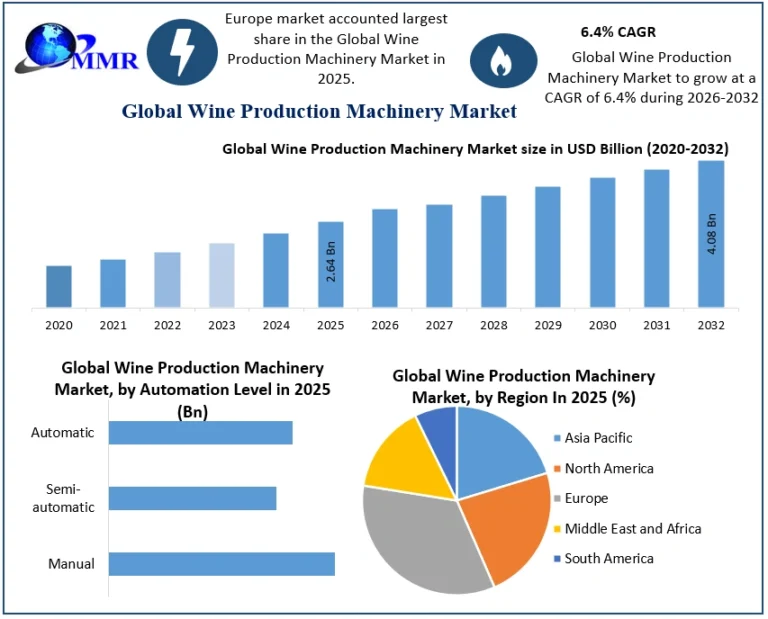
Consistent Market Escalation: The global wine production machinery market achieved a baseline valuation of USD 2.64 Billion in 2025. It is on track to hit USD 4.08 Billion by 2032, maintaining a healthy compound annual growth rate (CAGR) of 6.4%.
Equipment Type Dominance: Fermentation equipment, stainless steel tanks, and multi-zone cooling jackets remain the leading market segments by value, accounting for over 30% of total cleanroom and cellar hardware installations.
Wine Type Breakdown: Equipment configured for Red Wine production commands the dominant structural share at 38.6%, driven by the complex requirements of skin-contact maceration and automated punch-down systems.
Rapid Automation Upgrades: Fully automatic bottling lines, vision-guided sorting systems, and continuous cross-flow filtration units represent the fastest-growing technology segment, expanding at an estimated 6.9% CAGR.
Geographical Strongholds: Europe maintains its historic position as the largest regional market due to its dense network of multi-generational estates, while the Asia-Pacific region stands out as the fastest-growing geographical market for automated processing setups.
Why This Matters Now
The global viticultural processing ecosystem is managing a difficult structural transition: dealing with a tightening agricultural labor market while trying to satisfy rising global consumer demands for high-end premium and organic wines. Historically, boutique and mid-sized commercial estates relied heavily on manual sorting conveyor lines, open-top uninsulated fermentation vats, and basic mechanical presses.
Transitioning to automated, closed-loop wine production machinery addresses these processing vulnerabilities directly. Modern automated destemmers, vision-guided sorting tables, and jacketed stainless steel fermentation systems reduce manual handling needs by up to 40%. They also hold strict temperature tolerances to within fractions of a degree, protecting delicate juice extraction phases and ensuring high-yield, premium-tier output across variable harvest years.
Market Overview
The global wine production machinery market serves as the technological foundation for farm estates, urban crush facilities, micro-wineries, and mass-market beverage conglomerates. Because modern winemaking demands strict hygiene protocols, gentle fruit extraction, and rigorous environmental controls to avoid spoilage, specialized processing machinery has become essential for scaling up production without compromising varietal characteristics. The market’s steady path toward USD 4.08 Billion by 2032 reflects an industry-wide transition toward clean-in-place (CIP) designs, reduced chemical intervention
                        [HARVESTED GRAPE INTAKE]
                                   │
                                   ▼
             [AUTOMATED DESTEMMER & OPTICAL SORTING EYE]
                                   │
                                   ▼
              [PNEUMATIC PRESS / GENTLE CRUSH CELL]
                                   │
                                   ▼
             [JACKETED STAINLESS STEEL FERMENTATION TANK]
                                   │
                                   ▼
             [HIGH-EFFICIENCY CROSS-FLOW FILTRATION CORE]
                                   │
                                   ▼
                [AUTOMATED BOTTLING & CAPPING LINE]
The expectations for commercial viticultural processing equipment have shifted significantly under modern smart manufacturing frameworks. Winery operations directors no longer evaluate processing equipment purely on raw throughput speed or simple volumetric capacities. Modern cellar installations require fully networked processing loops where pneumatic presses, cooling jackets, and filtration systems share data continuously over centralized supervisory control and data acquisition (SCADA) systems.
Key Trends Driving Growth
The leading trend accelerating market expansion is the widespread integration of advanced optical sorting systems and machine vision at the receiving hopper. Instead of relying on manual sorting lines to catch sub-par fruit, modern crush facilities use ultra-high-speed cameras that scan thousands of berries per minute. These systems instantly reject under-ripe grapes, stems, and debris (material other than grapes, or MOG) via precise air knives. This automated accuracy prevents bitter compounds from entering the fermentation tank, yielding a cleaner base juice.
Another primary driver is the market-wide shift toward premium, estate-bottled, and organic wines, which requires highly precise, minimal-intervention equipment. To meet clean-label and low-sulfite demands, equipment manufacturers are designing fully sealed processing pathways equipped with automatic nitrogen gas injection. This layout blankets the grapes and fresh juice in an inert environment from the moment they enter the destemmer through the entire pressing stage, completely eliminating premature oxidation and preserving delicate aromas.
Additionally, climate volatility has made adaptive temperature control equipment a critical necessity in modern cellars. Hotter harvest cycles frequently cause grapes to arrive at the facility with high sugar concentrations and elevated ambient temperatures, which can over-stress wine yeasts. To combat this, modern winemakers are investing heavily in high-efficiency, multi-zone cooling jackets and automated pump-over setups. These systems track sugar consumption (Brix tracking) in real time, automatically shifting cooling levels to guide the fermentation smoothly to completion.
Segment Insights
Tanks and Fermenters: This segment commands a leading position in market value, supported by the widespread adoption of multi-zone jacketed stainless steel tanks that allow precise thermal tracking during cold stabilization and extended maceration.
Red Wine Equipment Configurations: Accounted for the largest share of equipment deployments in 2025, driven by the specialized mechanical requirements of red wine production, including automatic cap management and pomace pressing setups.
Semi-Automatic Machinery: Holds the largest operational volume footprint, as it provides a flexible, modular layout favored by small and medium-sized family estates looking to introduce automation without sacrificing artisan control.
Fully Automatic Lines: This high-throughput segment is expanding quickly at an estimated 6.9% CAGR, driven by industrial bottling and packaging plants looking to lower manual handling costs and maximize line efficiency.
Equipment Deployment & Utility Matrix
Selecting winery machinery requires balancing fruit skin characteristics, structural design limits, microbial protection needs, and targeted annual production volumes.
| Equipment Classification | Core Cellar Function | Primary Engineering Focus | Asset Optimization Target |
| Destemmers & Crushers | Separates berries from woody structures without cracking seeds | Variable-speed cage controls, food-grade adjustable rollers | Minimizes seed tannin extraction and phenolic bitterness. |
| Pneumatic Presses | Extracts juice from skins using gentle, uniform pressure | Inflatable membrane bladders, automated drainage channels | Optimizes clear free-run juice yields under low pressures. |
| Fermentation Tanks | Manages chemical conversion of sugars into alcohol | Multi-zone dimple cooling jackets, automated pump-over systems | Maintains tight temperature control to prevent stuck ferments. |
| Cross-Flow Filters | Clarifies the wine and removes yeasts before packaging | High-surface area membranes, automated back-pulse cycles | Reduces wine loss while maintaining color and body. |
Regional Growth Story
Concurrently, North America continues to drive high-value equipment sales, with commercial operations in California, Oregon, and Washington investing heavily in advanced, fully automatic bottling lines, integrated cellar management software, and large-scale industrial crush platforms. Meanwhile, the Asia-Pacific region stands out as the fastest-growing market by volume. Driven by expanding domestic vineyard investments in China and Australia, rising disposable incomes, and a growing interest in wine consumption among younger urban demographics, the region is seeing significant processing infrastructure upgrades.
Competitive Landscape
The competitive environment of the global wine production machinery market is defined by manufacturing quality, engineering certifications for food contact, and the integration of digital diagnostic tools. Major global marine and processing groups have shifted focus away from selling standalone mechanical crushers, moving toward providing complete, turnkey cellar systems.
Furthermore, engineering robust systems with minimal fluid loss and high sanitary ratings serves as a primary area of competitive differentiation. Leading global equipment brands such as Bucher Vaslin SA, GEA Group AG, Krones AG, Paul Mueller Company, Zambelli Enotech, and Alfa Laval AB maintain market leadership through continuous investments in automated clean-in-place (CIP) networks, low-maintenance cross-flow membranes, and robust international service groups. These full-service capabilities provide estate wineries and large-scale co-operatives with the mechanical reliability and technical support required to keep processing lines moving efficiently during intense, time-sensitive harvest windows.
Strategic Implications
For winery operations directors and head winemakers, operating legacy, uninsulated, or non-automated processing lines introduces a continuous risk of product spoils and erratic batch quality. Relying on outdated manual sorting and uncontrolled open fermentation setups results in higher energy costs, labor-intensive cleaning processes, and a lack of real-time temperature tracking.
For winery facility layout engineers, industrial equipment distributors, and automation contractors, providing open-architecture data integration and highly water-efficient cleaning modules is vital to securing profitable project contracts. As modern winery construction moves toward fully integrated smart cellars and resource-efficient processing, equipment providers who supply isolated mechanical components will be left behind during facility planning. Prioritizing NMEA/SCADA-compatible sensors, low-pressure pneumatic efficiency, and automated chemical-reduction loops is essential to maintaining long-term industry market share.
Future Outlook
The future of the wine production machinery market will be shaped by the deep integration of self-adjusting filtration units, predictive pump maintenance alerts, and machine-learning-driven fermentation profiles. As wineries focus on optimizing water usage and minimizing carbon footprints, production machinery must evolve into highly efficient, self-monitoring systems.
Ultimately, the market will separate along clear technical capabilities: forward-looking estate wineries and commercial bottling operations that invest in intelligent, fully automated, and closed-loop processing machinery will secure low operating costs, maximize juice yields, and maintain reliable quality across every vintage, while traditional operations relying on unmonitored mechanical designs will face higher operating costs and limited appeal in an increasingly competitive global wine market.
Analyst Perspective
“The global wine production machinery market has evolved from basic mechanical crushing into a highly controlled, data-driven discipline,” states a food and beverage industrial automation specialist at Maximize Market Research. “As modern winemakers look to balance climate-driven harvest variability with precise flavor targets, deploying smart, jacketed fermenters and integrated automated sorting lines gives cellars the exact thermal control and quality security needed to protect their vintage investments.”
About Maximize Market Research
Maximize Market Research Pvt. Ltd. (MMR) is a global market research and consulting company that provides reliable, data-focused, and practical business insights. The firm serves a wide range of industries, including healthcare, pharmaceuticals, technology, automotive, electronics, chemicals, personal care, and consumer goods. Through market forecasts, competitive analysis, strategic consulting, and industry impact assessments, MMR helps organizations understand changing market conditions, identify growth opportunities, and make informed business decisions for long-term success.
2nd Floor, Navale IT Park Phase 3
Pune Banglore Highway, Narhe
Pune, Maharashtra 411041, India
+91 9607365656
sales@maximizemarketresearch.com
