Key Highlights
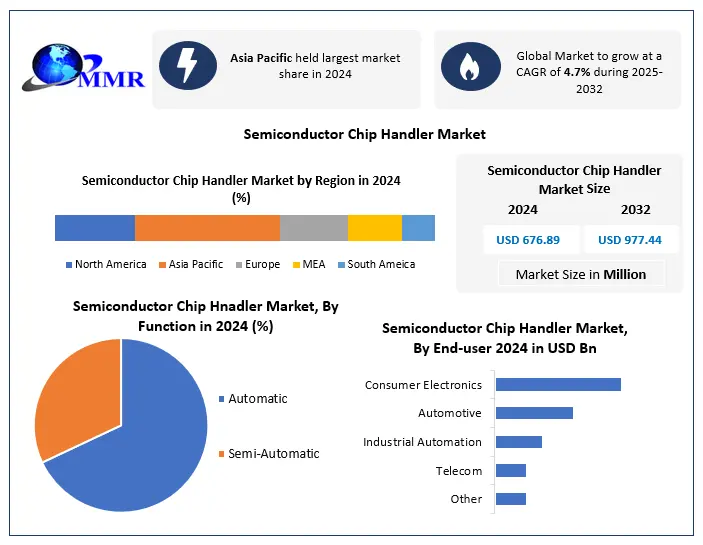
Capital Asset Expansion: The global market valuation is projected to increase from USD 676.89 million in 2024 to USD 977.44 million by 2032.
Steady Operational Compounding: Back-end equipment manufacturers navigate an industry growing at a 4.7% CAGR across the 2025 to 2032 forecast window.
Architectural Leadership: Pick-and-place handlers lead structural deployments, providing processing speed and precision during high-mix testing routines.
OSAT Dominance: Outsourced Semiconductor Assembly and Test providers act as the primary consumption channel, outfacing internal device manufacturers.
Regional Concentration: The Asia-Pacific corridor retains global market dominance, leveraging localized manufacturing density across China, South Korea, and Japan.
Why This Matters Now
The rapid scaling of high-performance computing silicon and next-generation mobile devices places unprecedented pressure on back-end semiconductor manufacturing test floors. Mechanical bottlenecks during final electrical verification neutralize the structural cost advantages gained through front-end wafer fabrication advancements. Foundries and fabless developers must scale testing throughput to protect gross margins as microchips grow more structurally complex. This operational stress forces immediate capital reallocation toward automated handling machinery capable of executing simultaneous, multi-site parallel testing.
This technical transition accelerates because advanced packaging trends—including chiplet architectures and 3D memory configurations—demand rigorous thermal conditioning and handling accuracy. Traditional handling equipment lacks the alignment precision and thermal regulation required to manage sensitive Micro-Electrical-Mechanical Systems (MEMS) or complex vertical logic stacks. Consequently, institutional supply chain leaders and technology executives are aggressively overhauling back-end test infrastructure to prevent manufacturing bottlenecks.
Market Overview
The Semiconductor Chip Handler Market is expanding due to the increasing volume of complex microchip architectures requiring strict quality assurance protocols. The sector achieved an asset valuation of USD 676.89 million in 2024 and is on a path to reach USD 977.44 million by 2032. This trajectory is sustained by a 4.7% CAGR, representing a steady expansion in manufacturing automation hardware. The historical period from 2019 to 2024 established the technical foundation for current high-throughput robotics integration.
This growth is driven by the global popularity of MEMS devices, 3D memory, and next-generation logic chips across consumer and industrial electronics lines. Industry regulations mandate precise structural inspection, lead forming, ink marking, and isolation processes, making automated handlers essential for production. However, high initial capital investment costs for automated machinery and complex integration cycles restrain faster adoption. Manufacturers address these limitations by targeting long-term yield improvements and reduced human error on the test floor.
Key Trends Driving Growth
The integration of advanced robotics and artificial intelligence directly into back-end testing lines alters the operational cost structures of the electronics sector. Historically, manual tracking and legacy rotary handlers introduced high error rates and processing latency during chip sorting. The modern deployment of AI-driven, fully automated chip handlers enables rapid processing times without compromising structural test accuracy. This technological shift optimizes overall floor throughput, minimizing scrap rates while maintaining a reliable record of device performance.
Concurrently, the manufacturing landscape experiences a major shift toward high thermal control and parallel, multi-site handling capabilities. Next-generation power devices and high-performance computing processors generate severe thermal variations that must be simulated accurately during final QA. Specialized handlers now feature localized thermal regulation chambers that subject devices to extreme operational environments prior to packaging. This capability allows manufacturers to verify system stability at the edge, satisfying strict enterprise validation criteria.
Segment Insights
Dominant Type Segment: Pick and Place Handlers hold a dominant position in the marketplace due to their versatility and efficiency in processing a wide variety of chip form factors.
Dominant Application Segment: OSATs represent the leading application segment, driven by an accelerating institutional trend where device manufacturers outsource back-end test and assembly functions.
Diverse Product Array: The technical architecture remains segmented across Pick and Place, Rotary, Goniometer, and Linearity Handlers to accommodate diverse packaging standards.
Key Application Portfolios: Industrial monetization is divided among Outsourced Semiconductor Assembly and Test providers, Integrated Device Manufacturers (IDMs), and boutique testing labs.
Functional Tasks: Equipment configurations execute multiple high-precision tasks on the factory floor, including IC tests, lead inspection, lead forming, epoxy operations, ink marking, and isolation functions.
Regional Growth Story
Asia-Pacific represents the primary geographical revenue hub, maintaining its market dominance driven by dense manufacturing infrastructure. China, South Korea, and Japan lead this regional concentration, hosting mega-scale assembly facilities that consume high volumes of robotic automation hardware. The proximity of these installations to major foundry ecosystems simplifies back-end logistics, allowing swift deployment of next-generation handling equipment. Government incentive programs aimed at enhancing local semiconductor self-sufficiency further accelerate capital deployment across APAC test floors.
Simultaneously, North America remains an important hub for back-end innovation, led by design houses and equipment vendors in the United States. While actual high-volume manufacturing remains heavily concentrated in Asia, North American players drive R&D investments, establishing the software baselines for AI-driven automation. European markets—spanning Germany, Belgium, and Italy—focus on niche automotive and industrial electronics testing applications. This European focus ensures continuous demand for specialized, high-reliability linearity and goniometer handling configurations.
Competitive Landscape
The competitive matrix features an alignment of established automated test equipment providers and specialized robotics innovators, illustrating high capital entry barriers. Key participants driving technology direction include Cohu, Inc. (U.S.), Teradyne, Inc. (U.S.), Boston Semi Equipment LLC (U.S.), Aehr Test Systems (U.S.), lATE Systems, Inc. (U.S.), National Instruments (U.S.), IPTE Factory Automation N.V. (Belgium), and Seica S.p.A. (Italy). Market leaders use deep intellectual property portfolios in precise positioning and high-speed multi-site parallel interfaces to lock in long-term procurement contracts with dominant OSATs.
This competitive dynamic emphasizes that market leadership depends on building handlers that adapt seamlessly to changing advanced packaging form factors. Leading vendors spend heavily on research and development to optimize handling mechanics, directly lowering total index times during high-speed sorting. Strategic corporate partnerships between test equipment developers and handling OEMs accelerate product validation timelines, delivering integrated, turnkey test cells to the market. Companies that fail to provide high thermal accuracy or struggle to support miniature chiplet pick-and-place routines lose pricing power to integrated automation platforms.
Recent Developments
High-Parallel Test Introductions: Equipment designers launch next-generation pick-and-place handlers capable of scaling multi-site parallel testing capabilities to maximize OSAT daily floor output.
Advanced Thermal Chamber Integrations: Manufacturers introduce specialized thermal conditioning modules designed to maintain stable testing conditions for automotive-grade power semiconductors.
AI-Enhanced Vision System Alliances: Handling vendors form strategic partnerships with machine vision developers to deploy real-time lead inspection and defect tracking directly on sorting arms.
Chiplet Architecture Adaptations: Automation companies roll out specialized ultra-thin handling accessories engineered to prevent edge cracking on fragile 3D stacked logic chips.
Cross-Continental Distribution Ventures: American test equipment providers expand distribution networks within the APAC corridor to secure consistent installation pipelines across expanding Chinese and South Korean test sites.
Strategic Implications
The technological move from basic, low-volume handlers to high-throughput, software-defined robotic systems requires a complete realignment of back-end investment strategies. Semiconductor executives cannot treat handling hardware as a minor secondary purchase; it represents a core operational asset that directly impacts packaging yield and production timelines. As advanced chiplet designs gain traction, any mechanical misalignment during final test validation risks destroying high-value silicon. This reality forces procurement teams to form deeper development partnerships with handling OEMs to align handling mechanics with evolving wafer designs.
Furthermore, the overall productivity of the global electronics supply chain relies on the capacity of OSAT assembly lines to process incoming wafer volumes efficiently. Any disruption in specialized automation components immediately halts final chip shipments, delaying product rollouts for automotive and smartphone OEMs. By embedding high-precision, flexible pick-and-place systems on the factory floor, assembly houses insulate their operations from unexpected layout shifts. Decision-makers must view automated handlers as a critical element within their broader manufacturing resilience models.
Future Outlook
The global semiconductor chip handler market is approaching a critical technology inflection point where AI-driven robotic autonomy and complex thermal conditioning capabilities will displace basic mechanical handling systems. As high-performance computing chips and advanced packaging methods expand internationally, the market will reward agile equipment innovators that deliver ultra-low index times and high-precision multi-site parallel testing interfaces. Conversely, machinery providers that fail to adapt to fragile 3D logic and chiplet architectures will face rapid margin erosion and exclusion from state-of-the-art OSAT assembly lines. Ultimately, leadership will belong to automation vendors that deliver seamless, zero-defect handling across dense electronics manufacturing ecosystems, while laggards remaining dependent on single-site analog sorting frameworks will lose relevance in a highly automated global semiconductor landscape.
Analyst Perspective
“The global semiconductor chip handler market is undergoing an irreversible transition toward fully automated, high-throughput robotic cells,” states Neha Nalawade, Research Analyst. “As institutional transaction volumes scale across advanced packaging and OSAT manufacturing lines, the capability to execute rapid, multi-site parallel testing with high precision becomes the primary metric for global equipment decision-makers.”
About Maximize Market Research
Maximize Market Research Pvt. Ltd. (MMR) is a global market research and consulting company that provides reliable, data-focused, and practical business insights. The firm serves a wide range of industries, including healthcare, pharmaceuticals, technology, automotive, electronics, chemicals, personal care, and consumer goods. Through market forecasts, competitive analysis, strategic consulting, and industry impact assessments, MMR helps organizations understand changing market conditions, identify growth opportunities, and make informed business decisions for long-term success.
2nd Floor, Navale IT Park Phase 3
Pune Banglore Highway, Narhe
Pune, Maharashtra 411041, India
+91 9607365656
sales@maximizemarketresearch.com
