Key Highlights
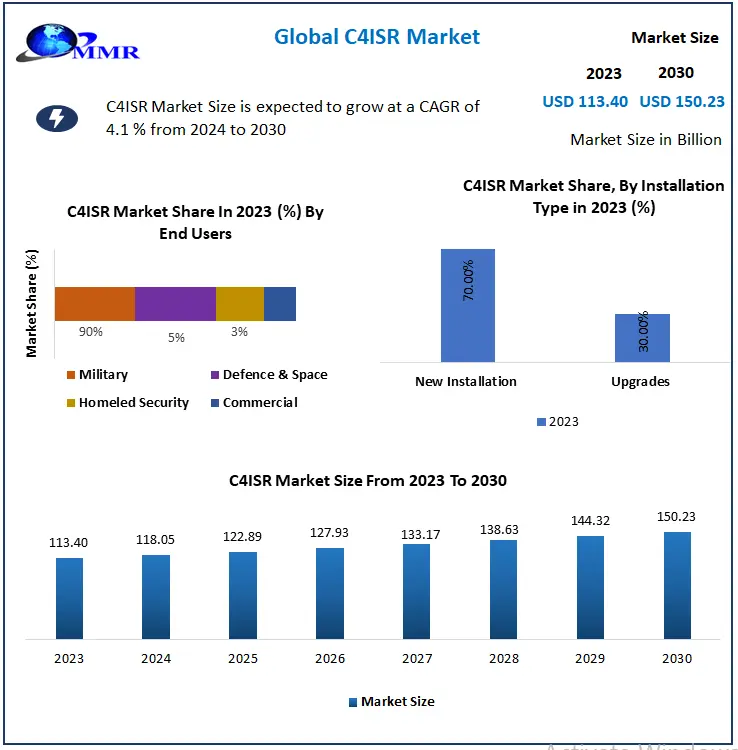
- The C4ISR Market was valued at USD 113.4 Bn in 2023 and is expected to reach nearly USD 150.63 Bn by 2030, creating a larger systems-integration opportunity for defense electronics, sensors, software and secure communications suppliers.
- The market is forecast to grow at a 4.1% CAGR from 2024 to 2030, making defense modernization and command-network upgrades steady rather than cyclical demand drivers.
- Space-based C4 systems held the largest platform share at 40% in 2023, making satellite ISR, secure communications and positioning systems the dominant disclosed technology lane.
- North America held the largest regional share at 35%, supported by U.S. defense spending, C4I funding and technological superiority priorities.
- Hensoldt’s USD 732.6 Mn acquisition of ESG was the largest disclosed C4ISR deal of 2023, signaling stronger demand for battlefield digitization and network integration capability.
Why This Matters Now
C4ISR is moving from command hardware to AI-enabled battle networks. Defense buyers now need platforms that compress the time between sensing, analysis and response across land, air, sea, space and cyberspace.
That shift turns RF communications, electro-optical components, satellite positioning sensors and onboard computing into strategic electronics demand. The U.S. Department of Defense Replicator initiative, announced in September 2023, aims to mass-produce thousands of smaller, lower-cost autonomous drones within 18 to 24 months, creating contracting opportunities for suppliers that can integrate unmanned systems into command-and-control networks.
Market Overview
C4ISR stands for Command, Control, Communications, Computers, Intelligence, Surveillance and Reconnaissance. Its role is to give military users situational awareness, knowledge of the adversary and environment, and faster response cycles.
The C4ISR Market is segmented by platform into land, air, water and space. Applications include intelligence, surveillance and reconnaissance, communication, command and control, computers and electronic warfare, while end users include defense and space, homeland security and commercial sectors.
For electronics and semiconductor decision-makers, C4ISR demand is linked to secure communications, sensors, mission computers, displays, RF systems, positioning modules and AI-enabled data processing. The public page does not disclose foundry investments, advanced packaging, chiplet architecture, HBM, memory trends, logic-chip trends or chip manufacturing capacity expansion.
Key Trends Driving Growth
Autonomous defense is the first growth driver. MMR states that the proliferation of autonomous aircraft and land vehicles has increased demand for C4ISR participants, while RF communications, EO components and satellite positioning sensors remain critical to autonomous systems and software.
Space-based defense is the second driver. Small satellites are increasing demand for C4 systems because they can deliver traditional satellite capability at lower cost, supporting secure communications, intelligence gathering, surveillance, reconnaissance, navigation, targeting and missile warning.
AI is changing the operating model. Artificial intelligence, machine learning and big data analytics allow more complex C4ISR systems to manage large data volumes and provide real-time insights, which helps military organizations make faster and more accurate decisions.
Cybersecurity is now part of C4ISR competitiveness. Intrusion detection and encryption are cited as technologies that protect C4ISR systems from cyberattacks, making security architecture a core buying criterion rather than a back-end add-on.
Land systems are becoming computing hubs. Armored and command vehicles in Brazil, Turkey, India, South Africa and Saudi Arabia are being equipped with open Vehicle Electronic Architecture to integrate communications, surveillance, navigation, detection, force tracking, fire control and survivability systems into common displays.
Segment Insights
- Dominant Segment Space-Based C4 Systems: Space-based C4 systems held the largest platform share at 40% in 2023. This gives satellite ISR, remote sensing, secure communications and data-routing systems the strongest disclosed platform position.
- Dominant Region North America: North America captured the largest share at 35%. U.S. defense spending and demand for intelligence, surveillance and reconnaissance across land and sea borders support the region’s lead.
- Fastest-Growing Segment: The public MMR page does not identify a fastest-growing platform, application or end-user segment by CAGR. Asia Pacific is expected to grow through the forecast period, but no segment-level fastest-growth claim is disclosed.
- AI and HPC Signal: AI, machine learning and big data analytics are disclosed as enablers of more complex C4ISR systems. High-performance computing, HBM and chiplet details are not disclosed.
- Emerging Opportunity Land C4ISR: Vehicle Electronic Architecture is creating opportunities in land systems by turning military vehicles into situational-awareness hubs with integrated displays and multi-role functionality.
Regional Growth Story
North America leads the market because the United States is investing in advanced C4ISR systems to maintain technological superiority. For FY2023, the Department of Defense requested about USD 12.8 Bn for C4I systems, which points to sustained funding for tactical networks, radios, cyber mission forces, naval networks and command programs.
The U.S. is also investing in space-based security systems to counter risks from Russia and China. That reinforces demand for satellite ISR, secure communications, missile-warning systems and resilient command networks.
Asia Pacific is expected to grow through the forecast period as China, India and Japan increase demand for electronic warfare. China is identified as the highest military spender in Asia Pacific and has allocated resources to space-related R&D and launch infrastructure.
China’s Beidou-2 satellite series and upgraded launch infrastructure signal regional momentum in space C4ISR. Country-level market values for China, Japan, South Korea, India, Taiwan and Germany are not disclosed on the public page.
Competitive Landscape
Key players include Lockheed Martin, Raytheon Technologies, Northrop Grumman, General Dynamics, BAE Systems, Thales, L3Harris, Boeing, SAIC, Leidos, Elbit Systems, CACI, Honeywell, Kratos, Rockwell Collins, General Atomics, Airbus, Leonardo and Rheinmetall.
Hensoldt’s acquisition of ESG for USD 732.6 Mn signals a race to own battlefield digitization and network integration skills. For rivals, the message is direct: software-defined command networks and CONOPS knowledge are becoming as important as platform hardware.
Elbit Systems’ Hermes 650 Spark launch signals demand for unmanned systems that can operate across land, air and sea. That strengthens the link between C4ISR, autonomous platforms and mission endurance.
Northrop Grumman’s U.S. Navy contract for next-generation Hawkeye cockpit and computer architecture shows that aircraft modernization is moving toward software configuration and mission-computing upgrades. Curtiss-Wright’s USD 34 Mn MOSA-based airborne data recorder contract signals demand for modular open systems that support U.S. and Australian maritime aircraft.
Recent Developments
- September 2023 U.S. DoD Replicator Initiative: The program aims to mass-produce thousands of smaller and less expensive autonomous drones within 18 to 24 months, creating demand for unmanned-system command integration.
- 2023 Hensoldt and ESG: Hensoldt acquired ESG for USD 732.6 Mn, adding battlefield digitization and network-solution integration capability.
- February 21, 2024 Elbit Systems: Elbit unveiled the Hermes 650 Spark UAS, signaling stronger demand for endurance, versatility and cost-effective unmanned operations.
- November 2023 Northrop Grumman: Northrop Grumman received a U.S. Navy contract to develop cockpit and computer architecture for the next generation of the E-2D Hawkeye.
- October 2023 Curtiss-Wright: Curtiss-Wright won a USD 34 Mn, five-year NSWC contract for MOSA-based airborne data recorder technology for U.S. and Australian maritime aircraft.
Request a Free Sample Report for Comprehensive Market Insights
Strategic Implications
For semiconductor and electronics suppliers, C4ISR creates demand for secure RF links, sensors, mission computers, embedded displays and onboard processing. The report does not disclose fabrication investments or advanced packaging, so supply-chain interpretation must remain tied to disclosed system demand.
For defense OEMs, the buying center is shifting toward integrated networks. Platforms that cannot connect ISR, communications, command and electronic warfare data into a single operating picture will lose relevance.
For investors, C4ISR offers a defense electronics cycle driven by autonomous systems, space assets, AI analytics and cyber resilience. The risk is cost, regulation, certification complexity and the technical expertise needed to deploy new systems across different national standards.
Future Outlook
The C4ISR Market is forecast to grow from USD 113.4 Bn in 2023 to nearly USD 150.63 Bn by 2030 at a 4.1% CAGR. Growth will come from space-based C4 systems, autonomous drones, RF communications, EO components, satellite positioning sensors, AI-enabled analytics, cybersecurity, electronic warfare and land-vehicle electronics.
The public page also shows USD 150.23 Bn in the scope and FAQ sections for 2030, creating a disclosed inconsistency against the overview figure of USD 150.63 Bn. This article uses the overview figure because it matches the market-size statement supplied for the article.
Future technology leaders will control the fusion of sensors, satellites, AI analytics and secure command networks; laggards will remain trapped in fragmented electronics architectures that cannot close the sensor-to-shooter loop fast enough.
Analyst Perspective
“C4ISR is becoming a high-value defense electronics market as autonomous systems, space-based ISR and AI-enabled decision support reshape military command networks,” said Rucha Deshpande, Analyst at Maximize Market Research. “The strongest players will combine secure communications, sensor fusion, mission computing, cyber resilience and integration capability across multiple domains.”
About Maximize Market Research
Maximize Market Research Pvt. Ltd. (MMR) is a global market research and consulting company that provides reliable, data-focused, and practical business insights. The firm serves a wide range of industries, including healthcare, pharmaceuticals, technology, automotive, electronics, chemicals, personal care, and consumer goods. Through market forecasts, competitive analysis, strategic consulting, and industry impact assessments, MMR helps organizations understand changing market conditions, identify growth opportunities, and make informed business decisions for long-term success.
Contact Us
2nd Floor, Navale IT Park Phase 3
Pune Banglore Highway, Narhe
Pune, Maharashtra 411041, India
+91 9607365656
sales@maximizemarketresearch.com
