Key Highlights
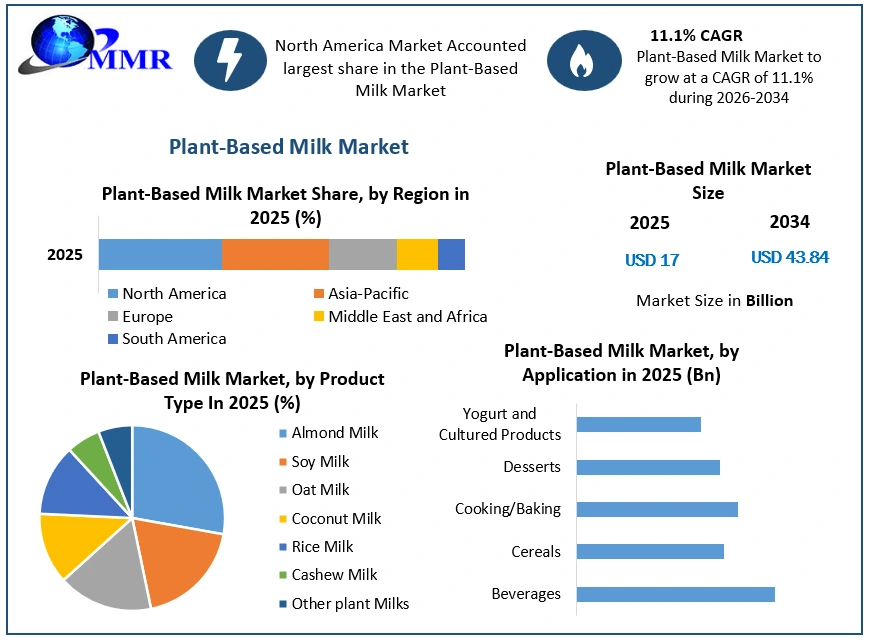
- Market valued at USD 17 billion in 2025.
- Forecast to reach USD 43.84 billion by 2034.
- Expected CAGR of 11.1% during 2026–2034.
- North America remains the leading regional market.
- Almond milk dominates global product demand.
- Cartons remain the preferred packaging format.
- Beverages account for the largest application segment.
- Product innovation and strategic acquisitions continue reshaping competition.
- Premium dairy alternatives attract mainstream consumers beyond vegan populations.
Why This Matters Now
Plant-based milk Market Size has evolved from a niche health product into a mainstream beverage category. Consumer demand now extends beyond vegan lifestyles to include lactose-intolerant consumers, environmentally conscious buyers, and health-focused households. Rapid investment, manufacturing expansion, and product innovation are transforming the competitive landscape while creating new opportunities across retail, foodservice, and functional beverage markets.
Market Overview
Plant-based milk includes dairy alternatives produced from almonds, oats, soy, coconut, rice, cashews, and other plant ingredients. These beverages replicate many functional characteristics of dairy milk while addressing consumer demand for lactose-free, vegan, and sustainable nutrition.
Market expansion is supported by growing health awareness, increasing concerns regarding environmental sustainability, and changing dietary preferences. Consumers increasingly select plant-based beverages because they align with clean-label lifestyles and ethical food consumption.
Demand continues to broaden beyond dedicated vegan consumers. Research cited in the report indicates that many consumers now regularly purchase both dairy and plant-based alternatives, reflecting growing dietary flexibility rather than complete dairy replacement.
Supply continues expanding as manufacturers invest in new production facilities, contract manufacturing, and innovative formulations. At the same time, premium pricing, ingredient availability, and evolving regulatory requirements continue influencing market dynamics.
Key Trends Driving Growth
Health and wellness drive mainstream adoption
Consumers increasingly associate plant-based milk with healthier lifestyles, lower cholesterol intake, and improved digestive comfort. Functional nutrition continues expanding demand across multiple demographic groups.
Oat milk gains competitive momentum
Oat milk continues strengthening its market position due to favorable taste, sustainability credentials, and growing consumer acceptance across cafés and retail channels.
Sustainability influences purchasing decisions
Consumers increasingly evaluate products based on environmental impact. Plant-based milk manufacturers continue promoting lower resource consumption and sustainable sourcing to strengthen brand positioning.
Product innovation expands consumer appeal
Manufacturers continue introducing protein-enriched, clean-label, preservative-free, and flavored beverages targeting athletes, families, and health-conscious consumers.
Premium pricing supports revenue growth
Although plant-based milk remains more expensive than dairy milk, strong consumer willingness to pay for perceived health and sustainability benefits continues supporting category expansion.
Explore detailed analysis, insights, and growth opportunities
Segment Insights
Dominant Segment: Almond Milk
Almond milk remains the largest product category due to strong consumer familiarity, broad retail availability, and long-standing market acceptance.
Manufacturers continue expanding almond-based product portfolios across flavored, fortified, and organic variants to serve diverse consumer preferences.
Business impact: Almond milk provides manufacturers with established brand recognition and consistent retail demand, supporting stable long-term revenues.
Fastest-Growing Segment: Oat Milk
Oat milk continues recording rapid adoption because of its creamy texture, favorable environmental profile, and compatibility with coffee and specialty beverages.
Growing café adoption further strengthens consumer familiarity and retail demand.
Business impact: Oat milk creates attractive growth opportunities for manufacturers seeking premium positioning within the dairy alternatives category.
Additional Key Segments
Carton Packaging
Cartons remain the leading packaging format due to strong product protection, recyclability, and effective brand communication.
Business impact: Sustainable packaging enhances brand perception while supporting environmental objectives.
Beverage Applications
Beverages represent the largest application segment as consumers increasingly use plant-based milk in coffee, tea, smoothies, and ready-to-drink products.
Business impact: Expanding café partnerships and retail beverage sales continue driving commercial growth.
Online Retail
Digital retail channels continue expanding market reach through subscription models, direct-to-consumer sales, and convenient product access.
Business impact: Online platforms strengthen customer engagement while reducing dependence on traditional retail channels.
Regional Growth Story
North America
North America leads the global market due to widespread consumer awareness, strong retail distribution, and increasing adoption of dairy alternatives.
Growing vegan populations, health-conscious consumers, and premium retail offerings continue supporting regional expansion.
Europe
Europe remains a mature market driven by sustainability initiatives, favorable consumer attitudes toward plant-based nutrition, and expanding retail availability.
The UK continues serving as a major oat milk consumption center supported by strong brand penetration.
Asia-Pacific
Asia-Pacific benefits from long-standing cultural familiarity with soy-based beverages while rapidly adopting newer plant-based alternatives such as oat and almond milk.
Rising urbanization and increasing disposable incomes continue expanding regional demand.
South America
Growing consumer awareness and expanding retail infrastructure support gradual market development, although adoption remains below North American and European levels.
Middle East & Africa
The market remains in an early development phase but benefits from growing interest in healthier beverage alternatives and expanding modern retail networks.
Competitive Landscape
The competitive landscape combines established dairy companies, dedicated plant-based beverage specialists, ingredient suppliers, and emerging startups.
Leading companies including Oatly, Groupe Danone, Blue Diamond Growers, Califia Farms, SunOpta Inc., Ripple Foods, Vitasoy International Holdings, and Archer Daniels Midland continue expanding manufacturing capacity while investing heavily in product innovation and international distribution.
Emerging brands such as Sproud, Minor Figures, Better Moo(d), Plenish, Malk Organics, Dug Drinks, and NotCo increasingly compete through differentiated formulations, sustainable sourcing, and premium branding.
Competition continues shifting beyond product availability toward innovation, functional nutrition, clean-label formulations, packaging sustainability, and strategic manufacturing partnerships.
Recent Developments
- May 7, 2026: Unternehmensgruppe Theo Müller acquired Berief Food to strengthen its plant-based beverage portfolio and accelerate expansion across Eastern Europe and the Benelux region.
- February 6, 2026: Refresco agreed to acquire SunOpta Inc. in a transaction valued at approximately USD 1.1 billion, significantly expanding its North American plant-based beverage manufacturing capabilities.
- August 18, 2025: SunOpta expanded production capacity for its Sown and West Life plant-based milk brands to improve manufacturing efficiency.
- June 15, 2025: Country Delight launched a clean-label oat beverage made from Australian oats targeting lactose-intolerant and vegan consumers.
- June 2, 2025: HRX introduced protein-enriched oat milk shakes containing 25 grams of plant protein per serving.
- May 14, 2025: Lantmännen Biorefineries acquired a 10% stake in Sproud to strengthen long-term pea protein supply and support production expansion.
Future Outlook
Companies that combine scalable manufacturing, clean-label innovation, sustainable sourcing, and premium plant-based nutrition will emerge as the strongest beneficiaries of the accelerating global transition toward dairy alternatives.
Key Highlights
- Market valued at USD 17 billion in 2025.
- Forecast to reach USD 43.84 billion by 2034.
- Expected CAGR of 11.1% during 2026–2034.
- North America remains the leading regional market.
- Almond milk dominates global product demand.
- Cartons remain the preferred packaging format.
- Beverages account for the largest application segment.
- Product innovation and strategic acquisitions continue reshaping competition.
- Premium dairy alternatives attract mainstream consumers beyond vegan populations.
Why This Matters Now
Plant-based milk has evolved from a niche health product into a mainstream beverage category. Consumer demand now extends beyond vegan lifestyles to include lactose-intolerant consumers, environmentally conscious buyers, and health-focused households. Rapid investment, manufacturing expansion, and product innovation are transforming the competitive landscape while creating new opportunities across retail, foodservice, and functional beverage markets.
Market Overview
Plant-based milk includes dairy alternatives produced from almonds, oats, soy, coconut, rice, cashews, and other plant ingredients. These beverages replicate many functional characteristics of dairy milk while addressing consumer demand for lactose-free, vegan, and sustainable nutrition.
Market expansion is supported by growing health awareness, increasing concerns regarding environmental sustainability, and changing dietary preferences. Consumers increasingly select plant-based beverages because they align with clean-label lifestyles and ethical food consumption.
Demand continues to broaden beyond dedicated vegan consumers. Research cited in the report indicates that many consumers now regularly purchase both dairy and plant-based alternatives, reflecting growing dietary flexibility rather than complete dairy replacement.
Supply continues expanding as manufacturers invest in new production facilities, contract manufacturing, and innovative formulations. At the same time, premium pricing, ingredient availability, and evolving regulatory requirements continue influencing market dynamics.
Key Trends Driving Growth
Health and wellness drive mainstream adoption
Consumers increasingly associate plant-based milk with healthier lifestyles, lower cholesterol intake, and improved digestive comfort. Functional nutrition continues expanding demand across multiple demographic groups.
Oat milk gains competitive momentum
Oat milk continues strengthening its market position due to favorable taste, sustainability credentials, and growing consumer acceptance across cafés and retail channels.
Sustainability influences purchasing decisions
Consumers increasingly evaluate products based on environmental impact. Plant-based milk manufacturers continue promoting lower resource consumption and sustainable sourcing to strengthen brand positioning.
Product innovation expands consumer appeal
Manufacturers continue introducing protein-enriched, clean-label, preservative-free, and flavored beverages targeting athletes, families, and health-conscious consumers.
Premium pricing supports revenue growth
Although plant-based milk remains more expensive than dairy milk, strong consumer willingness to pay for perceived health and sustainability benefits continues supporting category expansion.
Additional Key Segments
Carton Packaging
Cartons remain the leading packaging format due to strong product protection, recyclability, and effective brand communication.
Business impact: Sustainable packaging enhances brand perception while supporting environmental objectives.
Beverage Applications
Beverages represent the largest application segment as consumers increasingly use plant-based milk in coffee, tea, smoothies, and ready-to-drink products.
Business impact: Expanding café partnerships and retail beverage sales continue driving commercial growth.
Online Retail
Digital retail channels continue expanding market reach through subscription models, direct-to-consumer sales, and convenient product access.
Business impact: Online platforms strengthen customer engagement while reducing dependence on traditional retail channels.
Regional Growth Story
North America
North America leads the global market due to widespread consumer awareness, strong retail distribution, and increasing adoption of dairy alternatives.
Growing vegan populations, health-conscious consumers, and premium retail offerings continue supporting regional expansion.
Europe
Europe remains a mature market driven by sustainability initiatives, favorable consumer attitudes toward plant-based nutrition, and expanding retail availability.
The UK continues serving as a major oat milk consumption center supported by strong brand penetration.
Competitive Landscape
The competitive landscape combines established dairy companies, dedicated plant-based beverage specialists, ingredient suppliers, and emerging startups.
Leading companies including Oatly, Groupe Danone, Blue Diamond Growers, Califia Farms, SunOpta Inc., Ripple Foods, Vitasoy International Holdings, and Archer Daniels Midland continue expanding manufacturing capacity while investing heavily in product innovation and international distribution.
Emerging brands such as Sproud, Minor Figures, Better Moo(d), Plenish, Malk Organics, Dug Drinks, and NotCo increasingly compete through differentiated formulations, sustainable sourcing, and premium branding.
Competition continues shifting beyond product availability toward innovation, functional nutrition, clean-label formulations, packaging sustainability, and strategic manufacturing partnerships.
Recent Developments
- May 7, 2026: Unternehmensgruppe Theo Müller acquired Berief Food to strengthen its plant-based beverage portfolio and accelerate expansion across Eastern Europe and the Benelux region.
- February 6, 2026: Refresco agreed to acquire SunOpta Inc. in a transaction valued at approximately USD 1.1 billion, significantly expanding its North American plant-based beverage manufacturing capabilities.
- August 18, 2025: SunOpta expanded production capacity for its Sown and West Life plant-based milk brands to improve manufacturing efficiency.
- June 15, 2025: Country Delight launched a clean-label oat beverage made from Australian oats targeting lactose-intolerant and vegan consumers.
- June 2, 2025: HRX introduced protein-enriched oat milk shakes containing 25 grams of plant protein per serving.
- May 14, 2025: Lantmännen Biorefineries acquired a 10% stake in Sproud to strengthen long-term pea protein supply and support production expansion.
Future Outlook
Companies that combine scalable manufacturing, clean-label innovation, sustainable sourcing, and premium plant-based nutrition will emerge as the strongest beneficiaries of the accelerating global transition toward dairy alternatives.
Analyst Perspective: Siddhi Dole
The Plant-Based Milk Market is entering a high-growth phase as consumer preferences shift toward healthier, sustainable, and dairy-free nutrition. Plant-based milk is no longer limited to vegan consumers; it has become a mainstream beverage choice among flexitarians, lactose-intolerant individuals, and health-conscious consumers seeking clean-label products. Continuous innovation in formulations, improved taste, and functional nutrition is further strengthening product adoption across both retail and foodservice channels.
About Maximize Market Research
Maximize Market Research Pvt. Ltd. (MMR) is a global market research and consulting company that provides reliable, data-focused, and practical business insights. The firm serves a wide range of industries, including healthcare, pharmaceuticals, technology, automotive, electronics, chemicals, personal care, and consumer goods. Through market forecasts, competitive analysis, strategic consulting, and industry impact assessments, MMR helps organizations understand changing market conditions, identify growth opportunities, and make informed business decisions for long-term success.
Contact Us :
2nd Floor, Navale IT Park Phase 3
Pune Banglore Highway, Narhe
Pune, Maharashtra 411041, India
+91 9607365656
sales@maximizemarketresearch.com
