Supply Chain Analytics Market: How AI and Real-Time Data Are Transforming Global Supply Chains
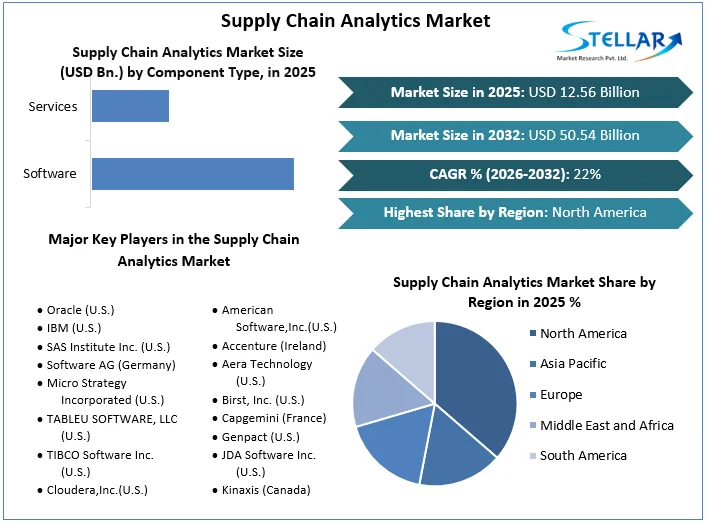
The Supply Chain Analytics Market was valued at USD 12.56 billion in the year 2025 and is expected to reach USD 50.54 billion by 2032 with a growing CAGR of 22% over the forecast period of 2026-2032
Global supply chains have become increasingly complex in recent years, driven by expanding international trade, evolving customer expectations, and unexpected disruptions ranging from geopolitical tensions to natural disasters. As organizations seek greater visibility and resilience, supply chain analytics has emerged as a critical business tool for improving operational efficiency, reducing costs, and enabling data-driven decision-making. From manufacturers and retailers to logistics providers and healthcare organizations, businesses are leveraging advanced analytics to optimize inventory, forecast demand, manage risks, and enhance customer satisfaction.
According to industry research, the global Supply Chain Analytics Market is expected to witness strong growth throughout the forecast period as companies accelerate investments in artificial intelligence (AI), machine learning (ML), cloud computing, and predictive analytics. Digital transformation initiatives across industries are creating new opportunities for analytics platforms that can process large volumes of operational data and generate actionable insights in real time.
Download Free PDF Brochure: https://www.stellarmr.com/report/req_sample/supply-chain-analytics-market/2318
Understanding Supply Chain Analytics
Supply chain analytics refers to the use of data analysis, statistical models, and advanced technologies to improve planning, sourcing, manufacturing, logistics, warehousing, and distribution activities. By collecting and analyzing data from multiple sources—including suppliers, transportation systems, enterprise resource planning (ERP) software, and customer demand—organizations can make informed decisions that improve operational performance.
Modern supply chain analytics solutions typically include descriptive, diagnostic, predictive, and prescriptive analytics. These capabilities enable businesses not only to understand historical performance but also to forecast future demand, identify potential disruptions, and recommend optimal actions to improve efficiency.
As supply chains become increasingly interconnected, analytics solutions help organizations transform raw operational data into strategic business intelligence.
Key Factors Driving Market Growth
One of the primary growth drivers is the increasing demand for real-time supply chain visibility. Organizations are investing in digital platforms that provide end-to-end monitoring of inventory levels, transportation status, supplier performance, and production schedules. Real-time insights enable businesses to respond quickly to disruptions while maintaining service quality.
Artificial intelligence and machine learning have also become major catalysts for market expansion. AI-powered analytics can identify demand patterns, optimize inventory management, detect anomalies, and automate routine decision-making processes. These technologies improve forecasting accuracy while reducing manual intervention.
Cloud-based analytics solutions are gaining widespread adoption because they offer scalability, flexibility, and lower infrastructure costs compared to traditional on-premise systems. Cloud deployment enables organizations to integrate data across multiple business units and geographic locations while supporting remote collaboration.
The rapid growth of e-commerce has further increased the need for advanced analytics. Online retailers must manage fluctuating demand, optimize warehouse operations, improve last-mile delivery, and maintain high customer satisfaction levels. Supply chain analytics provides valuable insights that help businesses meet these challenges efficiently.
Emerging Technologies Reshaping the Industry
Technological innovation continues to redefine the capabilities of supply chain analytics platforms.
Artificial intelligence is enabling autonomous decision-making, predictive maintenance, and intelligent demand forecasting. Machine learning algorithms continuously improve forecasting accuracy by learning from historical trends and real-time operational data.
The Internet of Things (IoT) allows organizations to collect real-time information from connected devices, sensors, vehicles, and manufacturing equipment. These data streams enhance supply chain visibility while enabling proactive maintenance and asset monitoring.
Digital twins are becoming increasingly important for supply chain optimization. By creating virtual replicas of physical supply chain networks, organizations can simulate different scenarios, evaluate risks, and optimize operations before implementing real-world changes.
Blockchain technology is also gaining attention for improving supply chain transparency and traceability. Secure digital records enhance product authentication, reduce fraud, and improve regulatory compliance across complex supplier networks.
Industry Applications
Supply chain analytics has applications across numerous industries.
Manufacturing companies use analytics to optimize production schedules, reduce inventory costs, and improve supplier collaboration. Predictive analytics helps manufacturers anticipate equipment failures and minimize production downtime.
Retail businesses leverage demand forecasting, customer behavior analysis, and inventory optimization to improve product availability while reducing excess stock.
Healthcare organizations utilize analytics to manage pharmaceutical supply chains, medical equipment distribution, and inventory planning for critical healthcare supplies.
The automotive industry benefits from analytics by improving supplier coordination, production planning, logistics optimization, and component traceability.
Food and beverage companies rely on analytics to manage perishable inventory, optimize transportation routes, reduce waste, and maintain product quality throughout distribution.
Regional Market Outlook
North America remains one of the leading markets for supply chain analytics due to its strong technology ecosystem, widespread cloud adoption, and significant investments in digital transformation. Large enterprises across manufacturing, retail, logistics, and healthcare continue to deploy advanced analytics platforms to improve operational resilience.
Europe is witnessing steady growth as organizations focus on sustainability, regulatory compliance, and supply chain transparency. Digital initiatives supported by governments are encouraging businesses to modernize their logistics and procurement operations.
Asia-Pacific is expected to experience the fastest growth during the forecast period. Rapid industrialization, expanding manufacturing capabilities, growing e-commerce activity, and increasing adoption of cloud technologies are driving market demand across China, India, Japan, South Korea, and Southeast Asia. Government initiatives promoting smart manufacturing and digital infrastructure are further supporting regional expansion.
Latin America and the Middle East & Africa are also emerging as promising markets as organizations invest in digital supply chain solutions to improve competitiveness and operational efficiency.
Challenges Facing the Market
Despite strong growth prospects, the market faces several challenges.
Many organizations struggle with integrating data from multiple legacy systems. Poor data quality and fragmented information can limit the effectiveness of analytics initiatives.
Cybersecurity concerns remain another major challenge as increasing digital connectivity creates new risks for sensitive operational data. Organizations must invest in robust security frameworks to protect supply chain information.
The shortage of skilled professionals with expertise in data science, artificial intelligence, and supply chain management also affects implementation success. Companies increasingly require specialized talent to maximize the value of advanced analytics platforms.
Additionally, high implementation costs and organizational resistance to digital transformation can slow adoption among small and medium-sized enterprises.
Competitive Landscape
The Supply Chain Analytics Market is highly competitive, with global technology providers continuously expanding their capabilities through innovation, acquisitions, and strategic partnerships. Leading companies are integrating artificial intelligence, machine learning, and automation into their analytics platforms while enhancing cloud-native solutions.
Major industry participants include IBM, SAP SE, Oracle Corporation, Microsoft, SAS Institute, Kinaxis, Blue Yonder, Infor, Accenture, and Manhattan Associates. These companies focus on improving predictive analytics, demand sensing, warehouse optimization, transportation management, and end-to-end supply chain visibility to meet evolving customer requirements.
Download Free PDF Brochure: https://www.stellarmr.com/report/req_sample/supply-chain-analytics-market/2318
Future Outlook
The future of the Supply Chain Analytics Market will be shaped by intelligent automation, AI-driven decision-making, and increasing demand for resilient supply chains. Businesses are expected to continue investing in predictive analytics, cloud-based platforms, and real-time monitoring technologies to improve operational efficiency and reduce risks.
As sustainability becomes a strategic priority, analytics solutions will play an increasingly important role in measuring carbon emissions, optimizing transportation routes, reducing waste, and supporting ESG initiatives. Organizations that successfully integrate advanced analytics into their supply chain operations will gain stronger competitive advantages through improved agility, enhanced customer service, and data-driven strategic planning.
With continuous innovation in artificial intelligence, IoT, blockchain, and cloud computing, supply chain analytics is expected to become an essential component of modern business operations, enabling organizations to navigate market uncertainty while driving long-term growth and resilience.
