Key Highlights
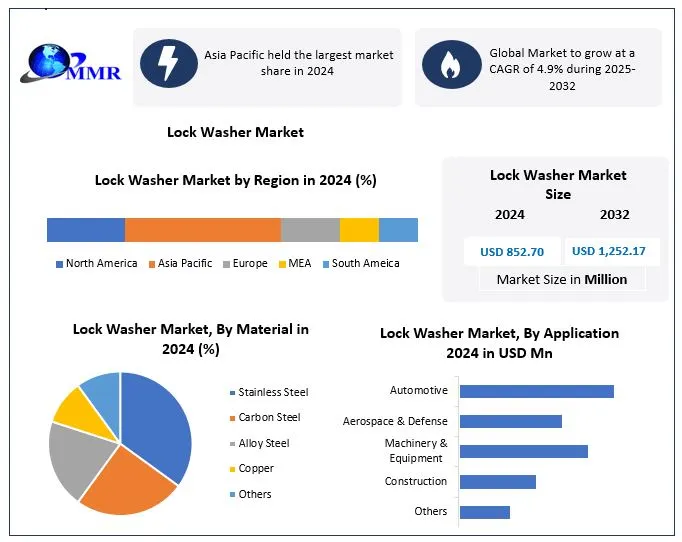
Market valuation expands from USD 852.70 million in 2024 to USD 1,252.17 million by 2032.
The split lock washer configuration commands the dominant type segment share due to its durable spring-like mechanical design.
Automotive applications represent the leading market driver, commanding the largest utilization share across global industrial lines.
Asia-Pacific positions itself as the primary regional engine, capturing a massive 47.8% market share in 2024.
Why This Matters Now
Extreme vibrational stresses within automated industrial machinery and high-speed robotic workcells are forcing heavy equipment manufacturers to completely re-engineer their joint retention protocols. When traditional threaded joints experience unexpected loosening due to thermal expansion or mechanical harmonics, it introduces localized joint fatigue that triggers unexpected assembly shutdowns and risks catastrophic automated line failures. For modern high-output manufacturing facilities, integrating advanced lock washers within automated precision fastening lines has become vital to maintaining system integrity.
This engineering focus is accelerating as industrial operators move toward continuous, high-velocity factory modernization frameworks. Maintaining tight structural tolerances across multi-axis robotic systems and manufacturing equipment requires consistent clamp load retention that cannot be achieved with legacy flat fasteners. Component manufacturing plants that fail to upgrade their production machinery with advanced stamping tooling and real-time vision-based quality control risk structural joint failures and expensive warranty claims compared to digitally advanced automated peers.
Market Overview
The global Lock Washer Market was valued at USD 852.70 million in 2024. Strategic market intelligence shows total sector revenue will expand at a steady compound annual growth rate (CAGR) of 4.9% from 2025 to 2032, reaching a forecasted market size of USD 1,252.17 million by the end of the study period. This steady growth reflects a clear long-term shift in industrial procurement budgets toward highly durable mechanical fastening elements, sustainable component options, and market-ready hardware solutions.
Lock washers function as critical mechanical locking elements designed to prevent accidental loosening caused by persistent operational vibration and heavy mechanical rotation. Fabricating these specialized fasteners requires forming offset edges or internal and external teeth that bite directly into mating surfaces to secure the joint assembly. By routing automated stamping data directly to factory manufacturing execution systems (MES), washer producers optimize raw material usage, eliminate manufacturing variations, and guarantee uniform tension characteristics across global supply shipments.
Key Trends Driving Growth
The primary trend transforming the market is the rapid deployment of automated assembly lines that connect directly to smart factory tool networks. Traditional fastening tasks relied entirely on manual torque wrenches and periodic visual inspections, which frequently introduced human error and uneven clamp force across critical machine joints. Modern automated fastening lines utilize electronic torque controllers and smart tooling stations to dynamically adjust the rotational energy applied during assembly, ensuring that lock washers are compressed perfectly without over-stressing the base material.
Additionally, changing structural demands and the rise of high-speed manufacturing networks are driving producers to focus heavily on cost-effective, sustainable material alternatives. Heavy-duty processing facilities are deploying specialized corrosion-resistant alloys to withstand punishing chemical and thermal cycles on the factory floor. Advanced precision fabrication shops are using integrated programmable logic controller (PLC) networks to effortlessly adjust press configurations between split, internal tooth, and external tooth designs on a single automated line.
Segment Insights
Split Lock Washer (Dominant Type Segment): This product group captured the largest market share in 2024, favored by plant operators due to its durable design and spring-like physical construction that maintains continuous mechanical tension.
Automotive Segment (Dominant Application Segment): This industrial sector held the largest market share in 2024, driven by the global expansion of automotive production lines and intensive vehicle assembly investments.
Internal and External Tooth Lock Washers: These critical sub-segments support deep deployment across electrical enclosures and machinery housings, where multiple biting points are required to ensure continuous grounding and joint locking.
Aerospace & Defense Application: This demanding end-use sector requires high-reliability materials designed to withstand extreme thermal fluctuations and severe atmospheric pressure cycles.
Machinery & Equipment Application: This foundational segment drives widespread operational technology (OT) usage, supporting high-vibration screening systems, heavy pumps, and rotating industrial machinery lines.
Regional Growth Story
The Asia-Pacific region dominates the global market, capturing a massive 47.8% share in 2024. Fuelled by intense industrial automation spending and rising automotive production infrastructure, countries like China, India, and Japan have emerged as high-volume centers for precision fastener deployment. In China, rapid growth in vehicle manufacturing and electrical assembly hubs drives heavy regional procurement, prompting fastener producers to optimize their localized automated production lines to meet high-volume manufacturing timelines.
North America continues to serve as an important market for technical fastening innovation, with manufacturing leaders heavily upgrading older production lines to counter persistent workforce shortages. Local facilities are integrating automated pick-and-place robotics with vision sensors to accelerate fastening speeds while maintaining absolute joint quality. Meanwhile, European markets, led by Germany, remain highly focused on advanced material coating processes to comply with strict regional sustainability metrics and environmental regulations.
Competitive Landscape
The global competitive space features specialized industrial fastener manufacturers and international precision metal forming corporations. Key market companies driving sector innovation include Schnorr, Nord-Lock, Shockproof, Midwest Acorn Nut Co., HEICO-LOCK (HEICO Group), Earnest Machine, Wrought Washer Manufacturing, Inc., and Disc-Lock Inc. Structural market leadership is shifting rapidly toward manufacturing companies that link heavy mechanical stamping with automated quality verification frameworks.
To protect their long-term position, leading fastener suppliers are investing heavily in automated progressive die presses and multi-stage testing setups to verify tension performance under harsh conditions. Companies are introducing smart packaging lines and automated labeling systems to ensure seamless integration with the automated inventory tracking networks used by tier-one industrial customers. This combination of advanced metal processing and automated logistics support ensures that market leadership belongs to companies capable of delivering highly repeatable fastener tolerances on a global scale.
Recent Developments
Tooling manufacturers engineered high-precision progressive dies equipped with inline sensor arrays to monitor metal strip thickness during continuous lock washer stamping cycles.
Equipment integrators introduced automated vision inspection systems into washer sorting lines, using high-resolution cameras to instantly reject parts showing microscopic surface fissures.
Software developers updated SCADA tracking tools to archive precise metallurgical batch numbers alongside specific torque profiles, ensuring absolute part traceability for safety-critical assemblies.
Materials laboratories formulated improved anti-corrosive surface treatments that extend the operational lifecycle of tooth lock washers operating in humid or chemical-heavy industrial environments.
Strategic Implications
For manufacturing executives, updating procurement and assembly specifications to support automated, high-precision lock washer installation is a vital strategy for protecting operating margins. Transitioning from legacy manual joint tracking to automated torque-control systems eliminates expensive assembly rework, maximizing production throughput across automated manufacturing lines. This direct reduction in joint failures helps companies maintain steady operating yields, even when managing multi-site manufacturing networks.
Furthermore, implementing automated quality validation loops provides the deep tracking data required to connect fastening operations with advanced enterprise digital twins. Modern electronic nutrunners can link specific part serialized numbers with exact compression forces and washer batch codes. By transferring this continuous data stream directly to central plant dashboards, automation providers ensure that operators can monitor joint stability across the entire equipment lifetime.
Future Outlook
The market will continue to evolve as edge computing brings smart diagnostics directly into localized robotic assembly cells. Future assembly lines will feature real-time torque sensors that automatically stop the installation cycle if an irregular washer thickness or improper seating angle is detected, preventing assembly defects without needing human intervention. This advanced process control will allow precision assembly plants to maintain perfect product quality, even when running high-volume, unmanned production shifts.
As factory digitization investments move closer to fully autonomous operations, connected fastening equipment will integrate directly with predictive maintenance platforms. Future production machinery will automatically track cumulative vibration cycles on bolted joints, cross-referencing this data with fastener specifications to predict when a joint needs inspection. Industrial companies that build these self-monitoring fastening systems into their production lines will secure a clear operational edge in facility uptime, while legacy operators will continue to face high repair expenditures, unexpected mechanical breakdowns, and costly production bottlenecks.
Analyst Perspective
“Integrating automated process monitoring with precision mechanical fastening is completely changing how modern industrial operators approach structural joint reliability. Manufacturing facilities can no longer tolerate the unpredictability of manual component checking when running high-speed, automated production lines. By deploying smart torque-control systems alongside high-durability lock washers, producers are actively protecting their equipment uptime, reducing maintenance costs, and securing the foundation needed for smart factory operations.”Gaurav Deshmukh, Lead Analyst, Maximize Market Research
About Maximize Market Research
Maximize Market Research Pvt. Ltd. (MMR) is a global market research and consulting company that provides reliable, data-focused, and practical business insights. The firm serves a wide range of industries, including healthcare, pharmaceuticals, technology, automotive, electronics, chemicals, personal care, and consumer goods. Through market forecasts, competitive analysis, strategic consulting, and industry impact assessments, MMR helps organizations understand changing market conditions, identify growth opportunities, and make informed business decisions for long-term success.
2nd Floor, Navale IT Park Phase 3
Pune Banglore Highway, Narhe
Pune, Maharashtra 411041, India
+91 9607365656
sales@maximizemarketresearch.com
