Automotive Fuel Cell Market: Hydrogen Mobility Accelerates the Future of Zero-Emission Transportation
The global automotive industry is undergoing a major transformation as governments, automakers, and energy companies accelerate the transition toward sustainable mobility. While battery electric vehicles (BEVs) continue to dominate headlines, hydrogen fuel cell electric vehicles (FCEVs) are emerging as a complementary solution, particularly for commercial transportation, long-haul trucking, buses, and heavy-duty logistics. With rapid refueling, long driving ranges, and zero tailpipe emissions, fuel cell technology is gaining momentum as countries invest heavily in hydrogen infrastructure and clean energy ecosystems.
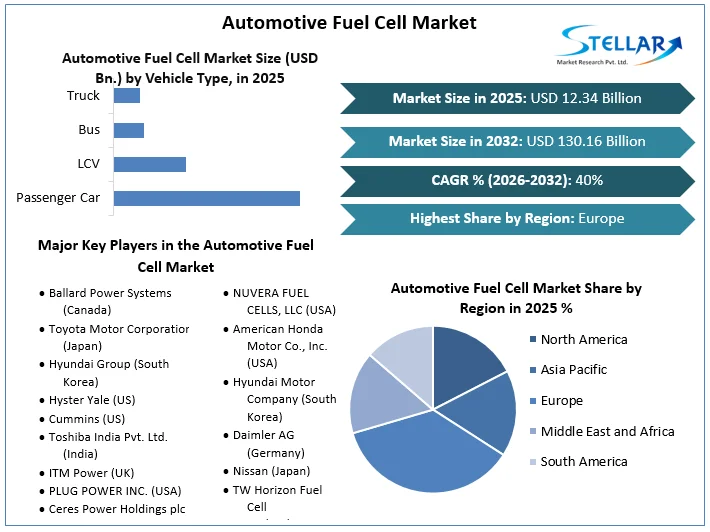
According to Stellar Market Research, the Automotive Fuel Cell Market was valued at USD 12.34 billion in 2025 and is projected to reach USD 130.16 billion by 2032, expanding at an impressive 40% CAGR during the forecast period. Rising government support for hydrogen mobility, advancements in fuel cell technology, and increasing investments in green hydrogen production are expected to drive significant market growth.
Download Free PDF Brochure: https://www.stellarmr.com/report/req_sample/Automotive-Fuel-Cell-Market/477
Understanding Automotive Fuel Cells
An automotive fuel cell is an electrochemical device that converts hydrogen and oxygen into electricity, producing only water vapor and heat as byproducts. Unlike conventional internal combustion engines, fuel cell electric vehicles generate electricity onboard without emitting carbon dioxide or harmful pollutants.
Fuel cell technology offers several advantages over traditional battery-powered vehicles, including shorter refueling times, longer driving ranges, lower vehicle weight for heavy-duty transportation, and consistent performance across varying weather conditions. These characteristics make fuel cells particularly suitable for buses, commercial trucks, logistics fleets, and industrial transportation where operational efficiency is critical.
Key Factors Driving Market Growth
One of the strongest growth drivers is the increasing global commitment to achieving net-zero carbon emissions. Governments across Europe, Asia-Pacific, and North America are introducing stricter emission regulations while providing incentives for hydrogen-powered transportation and clean energy infrastructure.
Growing investments in hydrogen production and refueling infrastructure are also accelerating market adoption. Public and private organizations are collaborating to establish hydrogen fueling networks that address one of the industry’s major barriers to commercialization.
Commercial vehicle electrification represents another important growth opportunity. Heavy-duty trucks, buses, mining equipment, and logistics fleets require longer driving ranges and faster refueling than battery-electric alternatives can often provide. Hydrogen fuel cells address these operational requirements effectively.
Technological advancements have significantly improved fuel cell durability, efficiency, and power density while reducing manufacturing costs. Continued research into proton exchange membrane (PEM) technology and hydrogen storage systems is making fuel cell vehicles increasingly competitive.
Emerging Technologies Reshaping the Industry
Innovation continues to transform the automotive fuel cell landscape.
Proton Exchange Membrane Fuel Cells (PEMFCs) remain the dominant technology due to their high efficiency, quick startup, and suitability for automotive applications. Manufacturers continue developing lighter and more compact fuel cell stacks capable of delivering greater power output with lower platinum usage.
Artificial intelligence is increasingly supporting fuel cell system optimization by improving energy management, predictive maintenance, thermal control, and performance monitoring. AI-driven diagnostics help maximize fuel efficiency while extending component lifespan.
Advancements in green hydrogen production using renewable energy sources are making hydrogen-powered transportation more environmentally sustainable. Electrolysis technologies powered by wind and solar energy are expected to significantly reduce the carbon footprint associated with hydrogen production.
Digital connectivity is also improving fleet management by enabling real-time monitoring of hydrogen consumption, vehicle performance, and predictive maintenance schedules.
Applications Across the Automotive Industry
Although passenger vehicles continue to represent an important market segment, commercial transportation is emerging as the primary growth engine for automotive fuel cells.
Fuel cell buses are increasingly being deployed in public transportation networks due to their long operating range and rapid refueling capabilities. Logistics companies are investing in hydrogen-powered trucks for long-distance freight transportation where battery charging time can affect operational efficiency.
Hydrogen-powered delivery vehicles, port equipment, airport ground support vehicles, and industrial forklifts are also gaining traction as organizations seek low-emission transportation alternatives.
Automotive manufacturers are expanding their fuel cell portfolios to support commercial mobility while exploring future passenger vehicle opportunities in regions with growing hydrogen infrastructure.
Regional Market Outlook
Asia-Pacific remains the largest market for automotive fuel cells, led by Japan, South Korea, and China. These countries have implemented comprehensive hydrogen strategies supporting vehicle production, infrastructure development, and clean energy investments. Major automakers continue expanding fuel cell vehicle manufacturing while governments provide financial incentives for hydrogen adoption.
Europe is expected to witness the fastest growth during the forecast period. The European Union’s ambitious climate goals, expanding hydrogen corridor projects, and investments in renewable hydrogen production are accelerating fuel cell vehicle adoption across Germany, France, and other European nations.
North America continues investing in hydrogen mobility through public-private partnerships, particularly for commercial transportation, freight logistics, and public transit applications. The United States and Canada are expanding hydrogen fueling infrastructure while supporting domestic fuel cell manufacturing.
Challenges Facing the Market
Despite its strong growth potential, the automotive fuel cell market faces several challenges.
Limited hydrogen refueling infrastructure remains one of the biggest obstacles to widespread adoption. Although governments continue investing in hydrogen stations, infrastructure expansion has not yet matched projected vehicle deployment in many regions.
High production costs also continue to affect commercialization. Fuel cell systems require specialized materials and complex manufacturing processes, making vehicles more expensive than conventional alternatives. However, economies of scale and technological advancements are expected to reduce costs over time.
Hydrogen production, storage, and transportation also require significant investment to establish reliable supply chains capable of supporting growing market demand.
Competitive Landscape
The Automotive Fuel Cell Market is highly competitive, with automotive manufacturers, fuel cell developers, and hydrogen technology companies investing heavily in research, strategic partnerships, and manufacturing expansion. Industry participants are focusing on improving fuel cell efficiency, reducing platinum usage, expanding hydrogen infrastructure, and developing commercial vehicle solutions.
Major companies operating in the market include Toyota Motor Corporation, Hyundai Motor Company, Honda Motor Co., Ballard Power Systems, Cummins Inc., Plug Power Inc., Ceres Power, ITM Power, Nedstack Fuel Cell Technology, and Daimler Truck. Strategic collaborations between vehicle manufacturers, hydrogen producers, and infrastructure providers continue shaping the competitive landscape.
Download Free PDF Brochure: https://www.stellarmr.com/report/req_sample/Automotive-Fuel-Cell-Market/477
Future Outlook
The future of the Automotive Fuel Cell Market appears highly promising as hydrogen becomes an increasingly important component of global decarbonization strategies. While battery-electric vehicles will continue dominating passenger mobility in many regions, fuel cell technology is expected to play a vital role in commercial transportation, heavy-duty logistics, and long-range mobility applications.
Continued investments in hydrogen infrastructure, green hydrogen production, advanced fuel cell materials, and AI-enabled energy management systems will strengthen the industry’s long-term growth prospects. Governments, automotive manufacturers, and energy companies are expected to increase collaboration to accelerate commercialization and reduce production costs.
As the global transportation sector transitions toward cleaner mobility solutions, automotive fuel cells are poised to become a critical technology supporting sustainable freight movement, public transportation, and zero-emission commercial vehicles. With strong policy support, rapid technological innovation, and expanding hydrogen ecosystems, the Automotive Fuel Cell Market is expected to remain one of the fastest-growing segments within the global clean mobility industry.
