Key Highlights
- Retrofit electrification is becoming a power-electronics opportunity as fleets and vehicle owners look for lower-emission alternatives without buying new vehicles. Hybrid EV conversion kits combine electric motors, battery packs, power electronics and control systems, making the market relevant to automotive semiconductor and component suppliers.
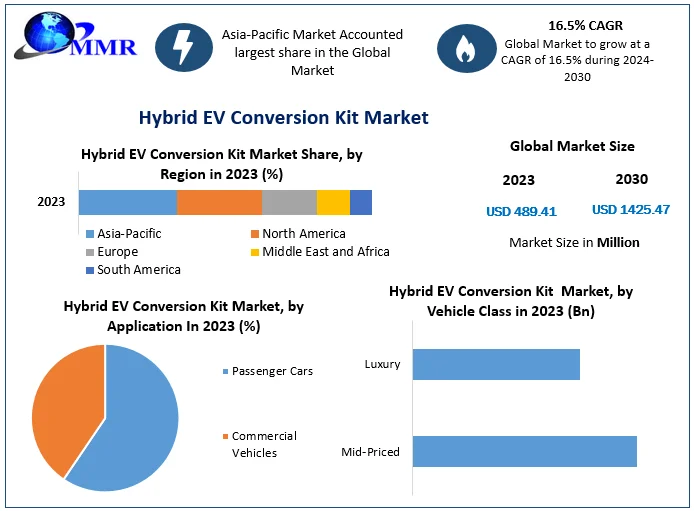
- The Hybrid EV Conversion Kit Market was valued at USD 489.41 Mn in 2023 and is expected to reach USD 1425.47 Mn by 2030, giving retrofit electrification companies a defined scale-up window.
- The market is forecast to grow at a 16.5% CAGR from 2024 to 2030, showing strong demand for cost-effective hybridization options across fleets and individual vehicle owners.
- Mid-priced vehicle conversion kits are expected to dominate during the forecast period because improved fuel economy and lower emissions fit cost-sensitive buyers.
- Asia Pacific is expected to lead the global market, supported by clean-vehicle initiatives, fuel-cost pressure and consumer awareness of hybrid and electric vehicle benefits.
Why This Matters Now
Automotive electrification is no longer limited to factory-built EVs. Conversion kits create a second route to cleaner mobility by upgrading existing vehicles with battery packs, motors, charging systems and control units.
That route matters for fleets. MMR states that the market remains relatively small because automakers increasingly produce hybrid and electric vehicles directly from factories, but demand persists among fleet operators and individual owners seeking lower environmental impact and better fuel efficiency.
Market Overview
Hybrid EV Conversion Kit Market is installed in a conventional vehicle to convert it into a hybrid electric vehicle using both an internal combustion engine and an electric motor. The kit typically includes an electric motor, battery pack, power electronics and control systems.
The electric motor assists the engine during acceleration and supports regenerative braking to recharge the battery pack. That makes the kit a systems-integration product rather than a simple mechanical accessory.
The report segments the market by vehicle class into mid-priced and luxury vehicles, and by application into passenger cars and commercial vehicles. The public FAQ contains an unrelated chronic-pain driver line, so this article relies on the overview, dynamics, segment and regional sections for market interpretation.
AI chip demand, high-performance computing, foundry investments, advanced packaging, chiplet architecture, HBM, memory and logic chip trends, display technology and chip manufacturing capacity expansion are not disclosed on the public page. The disclosed semiconductor lens is power electronics, control systems, battery integration and charging systems.
Key Trends Driving Growth
PHEV conversion kits are the clearest technology driver. These kits typically include a larger battery pack, charging system and additional control systems that allow vehicles to operate in electric-only mode for longer distances.
Cost avoidance is central to adoption. MMR states that PHEV conversion kits can be more cost-effective than purchasing a new plug-in hybrid or all-electric vehicle, especially for fleet operators upgrading multiple vehicles.
Modular and scalable kits are creating the next opportunity. Modular designs can be assembled and reconfigured for specific requirements, while scalable kits can expand or contract as user needs change, reducing redesign costs and improving production flexibility.
Battery and charging advances are also important. The Asia Pacific outlook links future adoption to improvements in battery technology and charging infrastructure, which directly affects the performance and practicality of conversion kits.
Sustainability is a demand driver, but e-waste management is not disclosed. The report links conversion kits to reduced emissions, improved fuel efficiency and lower environmental impact, making retrofit electrification a bridge between existing vehicle fleets and cleaner mobility targets.
Request a Detailed Industry Report Sample Instantly
Segment Insights
- Dominant Segment Mid-Priced Vehicle Class: Mid-priced hybrid EV conversion kits are expected to dominate during the forecast period because they offer improved fuel economy and lower emissions for environmentally conscious and cost-sensitive drivers.
- Fastest-Growing Segment: The public MMR page does not identify a fastest-growing vehicle class or application segment with a usable CAGR. No fastest-growing segment is inferred.
- Technology Signal PHEV Conversion Kits: PHEV conversion kits are an emerging trend because they add larger battery packs, charging systems and control units to extend electric-only operation.
- Application Scope Passenger and Commercial Vehicles: The market covers passenger cars and commercial vehicles, but application-level market shares and CAGRs are not disclosed.
- Cost Example Hymotion L5: The Hymotion L5 kit converted the Toyota Prius into a PHEV using an additional lithium-ion battery pack and external charging capability, with the kit priced around USD 10,000 at release.
Regional Growth Story
Asia Pacific is expected to lead the global Hybrid EV Conversion Kit Market. Demand is supported by government initiatives for clean energy vehicles, rising fuel prices and growing consumer awareness of hybrid and electric vehicle benefits.
China is a disclosed conversion-kit activity hub. Jirui Electric and Yiyang New Energy Technology have developed conversion kits for models including the Volkswagen Golf and Honda Fit, signaling demand for model-specific retrofit engineering.
Japan is also active. ECOVE and FDK Energy offer conversion kits for models such as the Toyota Prius and Nissan Leaf, aimed at improving range and performance.
The regional scope includes China, South Korea, Japan, India, Australia, Indonesia, Malaysia, Vietnam, Taiwan, Bangladesh and Pakistan in Asia Pacific; the United States, Canada and Mexico in North America; and Germany within Europe. Country-level revenues, semiconductor incentives, export dynamics and fabrication investments are not disclosed.
Competitive Landscape
Key players include Altigreen Propulsion Labs, XL Fleet, A123 Systems, Enginer, EVDrive, Hybrid Design Services, IX Energy, KPIT Technologies, Odyne Systems, Stealth EV, XL Hybrids and ALTe Technologies. This competitive base spans fleet electrification, battery systems, retrofit engineering and automotive controls.
XL Fleet is identified as a leading provider of vehicle electrification solutions for commercial and municipal fleets, with its XL Hybrid system installable on Class 2-6 commercial vehicles including vans, trucks and buses. That signals the fleet market’s importance because payback is easier when vehicles run high utilization cycles.
EV West specializes in converting vintage and classic cars into electric vehicles, while Hymotion focuses on Toyota Prius PHEV conversions. These examples show two different competitive lanes: enthusiast conversions and practical efficiency upgrades for existing hybrids.
A123 Systems is identified as a provider of advanced lithium-ion batteries and energy storage systems, with customizable HEV conversion kits. That positions battery capability as a control point because kit performance depends on pack quality, integration and use-case fit.
Named fab investments, acquisitions, advanced-packaging breakthroughs, chip capacity expansions and AI R&D initiatives are not disclosed. Competition will likely center on battery integration, control software, fleet economics, vehicle compatibility and regulatory compliance.
Recent Developments
- Enginer PHEV Kits: Enginer offers PHEV conversion kits for the Toyota Prius and other hybrid vehicles, including a larger battery pack, charging system and control unit for electric-only operation up to 40 miles.
- Plug-In Supply Kits: Plug-In Supply offers PHEV conversion kits for vehicles including the Ford Escape, Toyota Highlander and Lexus RX400h, enabling electric-only operation up to 35 miles.
- REVOLT Conversion Kits: Germany-based REVOLT offers PHEV conversion kits for hybrid and non-hybrid vehicles including the BMW 3 Series, Mercedes-Benz E-Class and Audi A4, with electric-only operation up to 50 miles.
- Asia Pacific Kit Development: Chinese and Japanese companies are developing kits for popular vehicle models, supporting regional growth in lower-emission retrofit mobility.
Strategic Implications
For semiconductor suppliers, the opportunity sits in vehicle power electronics, battery management, motor control and charging systems. The public page does not quantify chip content, so the market should be read as a system-level electrification opportunity rather than a disclosed wafer-demand forecast.
For fleet operators, conversion kits offer a capex alternative to full vehicle replacement. PHEV kits can extend electric operation, lower fuel use and reduce emissions while preserving existing vehicle assets.
For investors, the market has high growth but visible constraints. Factory-built hybrid and electric vehicles limit the retrofit ceiling, while stringent government regulations are identified in the FAQ as a restraining factor.
Future Outlook
The Hybrid EV Conversion Kit Market is forecast to grow from USD 489.41 Mn in 2023 to nearly USD 1425.47 Mn by 2030 at a 16.5% CAGR. Growth will come from PHEV conversion kits, fleet electrification, modular systems, scalable architectures, fuel-price pressure, clean-vehicle initiatives, battery improvements and charging-infrastructure development.
The next phase will test whether kit makers can industrialize retrofit electrification with reliable power electronics, battery integration and repeatable vehicle compatibility. Future technology leaders will turn existing fleets into software-controlled hybrid platforms; laggards will be trapped selling one-off conversions that cannot scale across cost, compliance and performance demands.
Analyst Perspective
“Hybrid EV conversion kits are becoming a practical electrification pathway for fleets and vehicle owners that need lower emissions without immediate full vehicle replacement,” said Rucha Deshpande, Analyst at Maximize Market Research. “The strongest suppliers will combine battery systems, power electronics, control software, vehicle compatibility and fleet economics into scalable retrofit platforms.”
About Maximize Market Research
Maximize Market Research Pvt. Ltd. (MMR) is a global market research and consulting company that provides reliable, data-focused, and practical business insights. The firm serves a wide range of industries, including healthcare, pharmaceuticals, technology, automotive, electronics, chemicals, personal care, and consumer goods. Through market forecasts, competitive analysis, strategic consulting, and industry impact assessments, MMR helps organizations understand changing market conditions, identify growth opportunities, and make informed business decisions for long-term success.
Contact Us
2nd Floor, Navale IT Park Phase 3
Pune Banglore Highway, Narhe
Pune, Maharashtra 411041, India
+91 9607365656
sales@maximizemarketresearch.com
