Product Information Management Market: AI-Powered Commerce Drives Enterprise Growth
Product information has become one of the most valuable business assets in today’s digital economy. As organizations expand across e-commerce platforms, marketplaces, mobile applications, and omnichannel retail environments, maintaining accurate, consistent, and centralized product data has become essential for business success. Product Information Management (PIM) solutions enable organizations to manage product descriptions, specifications, digital assets, pricing, and marketing content from a single platform, ensuring seamless customer experiences across every sales channel.
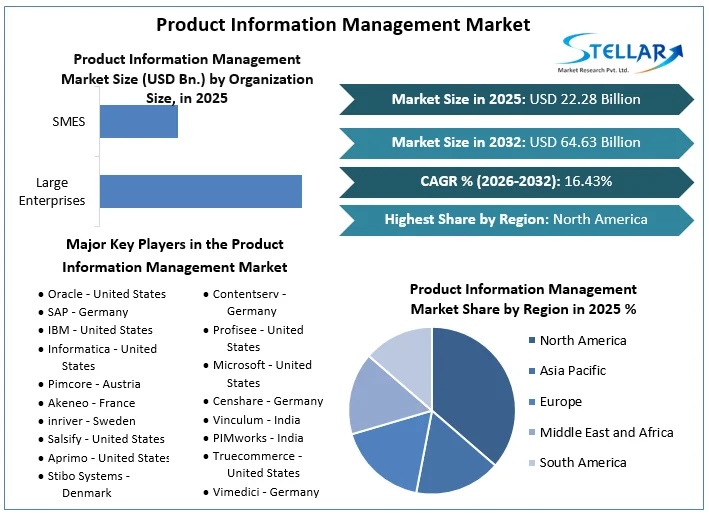
According to the latest industry analysis by Stellar Market Research, the Product Information Management (PIM) Market was valued at USD 22.28 billion in 2025 and is projected to reach nearly USD 64.63 billion by 2032, growing at a robust CAGR of 16.43% during the forecast period. The rapid expansion of digital commerce, cloud computing, AI-driven product data management, and omnichannel retail strategies continues to fuel market growth.
Download Free PDF Brochure: https://www.stellarmr.com/report/req_sample/product-information-management-market/2494
Understanding Product Information Management
Product Information Management (PIM) is a centralized software solution that collects, organizes, enriches, and distributes product information across multiple sales and marketing channels. Rather than storing product data in disconnected spreadsheets or multiple databases, organizations use PIM platforms to create a single source of truth for all product-related information.
Modern PIM systems manage product descriptions, technical specifications, pricing, images, videos, digital assets, compliance information, and multilingual content while synchronizing data across e-commerce websites, ERP systems, CRM platforms, marketplaces, mobile applications, and retail channels.
By improving data accuracy and consistency, PIM solutions help businesses accelerate product launches, reduce operational errors, and enhance customer experiences.
Key Drivers Fueling Market Growth
One of the strongest drivers is the explosive growth of e-commerce. Online retailers and manufacturers manage thousands—or even millions—of product listings across multiple digital platforms. PIM solutions simplify catalog management while ensuring customers receive accurate and up-to-date product information.
The increasing adoption of omnichannel retail strategies is another major growth factor. Consumers expect consistent product information whether shopping online, through mobile apps, marketplaces, or physical stores. PIM platforms ensure synchronized product data across every customer touchpoint.
Cloud-based deployment has also accelerated market adoption. Cloud PIM solutions provide scalability, lower infrastructure costs, remote accessibility, and faster implementation compared to traditional on-premises systems, making them attractive for organizations of all sizes.
Businesses are also investing in digital transformation initiatives to improve operational efficiency. Centralized product data management reduces manual work, eliminates duplicate records, improves collaboration across departments, and speeds up time-to-market for new products.
AI and Automation Are Reshaping PIM
Artificial intelligence has become one of the most significant innovations in the Product Information Management market.
AI-powered PIM platforms can automatically generate product descriptions, classify products, detect missing information, recommend product attributes, and translate content into multiple languages. These capabilities significantly reduce manual effort while improving product data quality.
Machine learning algorithms continuously analyze customer behavior and product performance to recommend optimized content that improves search rankings and conversion rates.
Automation is streamlining workflows by enabling automatic approval processes, product enrichment, digital asset management, and synchronization across multiple channels.
Integration with Digital Asset Management (DAM), Master Data Management (MDM), Enterprise Resource Planning (ERP), and Customer Relationship Management (CRM) systems further enhances enterprise-wide productivity and data governance.
Industry Applications
PIM solutions are widely adopted across multiple industries.
Retail and e-commerce companies use PIM platforms to manage large product catalogs, improve online merchandising, and support omnichannel commerce.
Manufacturing organizations utilize PIM to maintain accurate technical specifications, engineering documentation, and product lifecycle information.
Healthcare and pharmaceutical companies rely on centralized product information to maintain regulatory compliance while managing complex product portfolios.
Consumer goods companies use PIM systems to launch products faster, improve marketing efficiency, and deliver consistent product experiences across global markets.
Automotive, electronics, telecommunications, and industrial equipment manufacturers also depend on PIM platforms to manage increasingly complex product information throughout global supply chains.
Regional Market Outlook
North America continues to dominate the Product Information Management Market due to widespread cloud adoption, advanced digital infrastructure, and the strong presence of leading software providers. Large retailers, manufacturers, and technology companies are investing heavily in AI-enabled product information platforms to improve customer experiences and operational efficiency.
Europe remains a significant market, supported by digital commerce growth, stringent product data regulations, and increasing investments in enterprise software modernization.
Asia-Pacific is expected to experience the fastest growth during the forecast period. Rapid expansion of e-commerce, increasing smartphone penetration, digital transformation initiatives, and growing investments in retail technology across China, India, Japan, and Southeast Asia are creating substantial opportunities for PIM vendors.
Challenges Facing the Market
Despite strong growth potential, several challenges remain.
Integrating PIM platforms with existing ERP, CRM, and legacy business systems can be technically complex, particularly for large enterprises with multiple data sources.
Maintaining high-quality product information across global operations requires continuous governance, standardized processes, and dedicated data management teams.
Data security and regulatory compliance also remain important concerns, particularly as organizations increasingly store sensitive business information in cloud-based environments.
Additionally, implementation costs and organizational change management can slow adoption among small and medium-sized enterprises.
Competitive Landscape
The Product Information Management Market is highly competitive, with software providers continuously expanding their capabilities through artificial intelligence, cloud-native platforms, automation, and strategic partnerships.
Major companies operating in the market include Salsify, Akeneo, Pimcore, Stibo Systems, SAP, Oracle, IBM, Informatica, inRiver, and Aprimo. These companies continue investing in AI-powered automation, omnichannel commerce integration, product experience management (PXM), and advanced analytics to strengthen their competitive positions and meet the evolving needs of global enterprises.
Download Free PDF Brochure: https://www.stellarmr.com/report/req_sample/product-information-management-market/2494
Future Outlook
The future of the Product Information Management Market will be shaped by artificial intelligence, generative AI, cloud computing, and the continued expansion of digital commerce. Organizations are increasingly recognizing that high-quality product information is essential for improving customer engagement, accelerating digital sales, and supporting omnichannel business models.
As businesses expand into global markets, demand for multilingual product content, automated data enrichment, and real-time product synchronization will continue to grow. AI-powered product information management platforms will become more intelligent, enabling predictive content optimization, automated compliance management, and personalized customer experiences.
With continued investments in digital transformation, e-commerce infrastructure, and enterprise automation, Product Information Management will remain a strategic technology for organizations seeking operational efficiency, faster product launches, and sustainable competitive advantage in an increasingly digital marketplace.
