Key Highlights
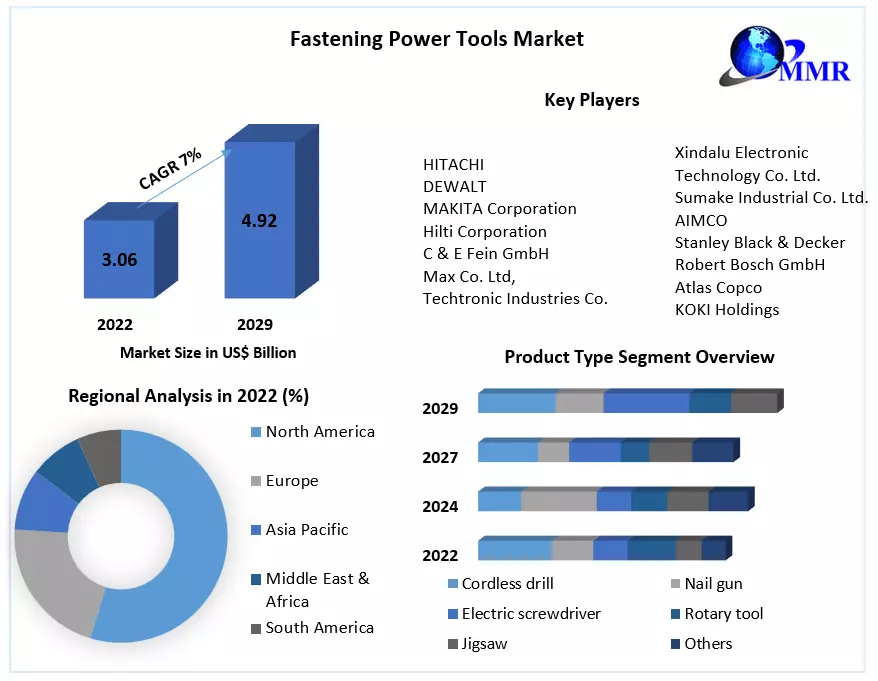
Market valuation expands from USD 3.06 billion in 2022 to USD 4.92 billion by 2029, exhibiting a steady 7.0% CAGR.
The automotive industry commands the dominant application segment share, accounting for approximately 38% of global utilization.
The semiconductor application segment establishes rapid growth traction, representing approximately 20% of unit sales with an annual expansion rate of 15%.
North America positions itself as the primary regional engine, anchoring global procurement through extensive infrastructure modernization and commercial DIY trends.
Why This Matters Now
Uncontrolled torque variations within high-speed assembly lines and automated robotic workcells are forcing manufacturing plant operators to completely re-engineer their mechanical joint retention protocols. When traditional fastening equipment experiences unexpected torque deviation or irregular pressure control, it introduces localized joint stress that triggers expensive product re-work and risks sudden structural failures. For modern high-output manufacturing facilities and aerospace production plants, integrating advanced fastening power tools within connected assembly lines has become vital to maintaining complete process repeatability.
This engineering focus is accelerating as industrial operators move toward continuous, data-driven factory modernization frameworks to counter persistent skilled workforce shortages. Maintaining tight assembly tolerances across complex electronic enclosures, vehicle chassis, and heavy industrial machinery requires high-performance smart tooling networks that cannot be achieved with legacy, unmonitored hardware. Assembly plants that fail to upgrade their production machinery with precision-controlled electric tools and real-time data tracking risk severe quality variances and costly product recall liability compared to digitally advanced automated peers.
Market Overview
The global Fastening Power Tools Market was valued at USD 3.06 billion in 2022 and is projected to scale up to USD 4.92 billion by 2029, expanding at a steady compound annual growth rate (CAGR) of 7.0%. Strategic market intelligence reveals that this growth is driven by increasing advancements in machine tooling, precision manufacturing, and the rising adoption of lightweight metal parts across global assembly operations. This long-term growth reflects a clear shift in industrial procurement budgets toward highly durable mechanical fastening elements, automated torque-monitoring systems, and highly repeatable hardware solutions.
Fastening power tools function as critical mechanical elements designed to ensure absolute joint security across high-vibration and heavy-rotation manufacturing environments. Fabricating and deploying specialized tools—such as cordless drills, nail guns, electric screwdrivers, and rotary tools—allows assembly operators to secure joints with absolute precision while maintaining high operational throughput. By routing real-time torque profiles and tool usage metrics directly to factory manufacturing execution systems (MES), industrial facilities optimize their production quality, eliminate assembly variations, and guarantee uniform tension characteristics across high-volume production runs.
Key Trends Driving Growth
The primary trend transforming the market is the rapid deployment of smart, connected fastening networks that integrate directly with advanced factory automation architectures. Traditional fastening tasks relied entirely on standalone hand tools, which frequently introduced human error, over-tightening risks, and uneven clamp force across critical machine joints. Modern automated assembly lines utilize electronic torque controllers and gas-operated or electric smart tools to dynamically adjust rotational energy during installation, ensuring that each fastener is compressed perfectly without damaging the base material.
Additionally, changing production demands and the rise of high-speed electronics manufacturing are driving producers to focus heavily on lightweight and ergonomic tool alternatives. High-volume semiconductor assembly facilities are deploying specialized precision electric screwdrivers to safeguard fragile micro-components from electrostatic discharge and mechanical over-stress. Advanced precision assembly shops are using integrated programmable logic controller (PLC) networks to seamlessly adjust tool speed and torque limits between different product runs on a single production line.
Segment Insights
Automotive Segment (Dominant Application Segment): This industrial sector held the largest market share, accounting for approximately 38% of the fastening power tools market, driven by intense vehicle assembly investments and a year-over-year sector growth of 9.2%.
Semiconductor Segment (Fastest-Growing Application Segment): This advanced electronics division represents approximately 20% of overall unit sales, showing rapid growth of approximately 15% due to strict cleanroom precision requirements.
Gas-operated Fastening Tools: This specialized product type provides high accuracy and sturdiness, making it an ideal choice for heavy fabrication, mining, and remote construction works where overdrive issues must be completely eliminated.
Cordless Drills and Electric Screwdrivers: These versatile sub-segments support deep deployment across household and commercial DIY activities, which grew by approximately 39% according to MEMA Analytics.
Aerospace & Defense Application: This demanding end-use sector requires high-reliability fastening tools designed to maintain the safety, accuracy, and structural integrity of safety-critical heavy machinery lines.
Regional Growth Story
North America dominates the global fastening power tools market, anchoring a significant portion of worldwide procurement and technological innovation. Fuelled by increasing improvement policies across various industry verticals and an increasing trend toward household and commercial DIY projects, countries like the United States lead regional market expansion. Major regional players, including Hilti and DeWalt, are investing actively in advanced product integration, prompting local facilities to adopt automated pick-and-place systems and smart assembly tools to maximize floor productivity.
The Asia-Pacific region continues to serve as an important high-growth engine for production line investments, with manufacturing leaders heavily upgrading older assembly lines to meet tight global supply timelines. Local facilities across China, South Korea, India, and Japan are integrating automated fastening power tools with vision sensors to accelerate assembly speeds while maintaining absolute joint quality. Meanwhile, European markets remain highly focused on advanced material tracking and tool electrification to comply with strict regional energy efficiency guidelines and strict worker safety regulations.
Competitive Landscape
The global competitive space features specialized industrial tool manufacturers and international precision engineering corporations. Key market companies driving sector innovation include Hilti, DeWalt, and other prominent international tool producers. Structural market leadership is shifting rapidly toward manufacturing companies that link heavy mechanical assembly tools with automated quality verification frameworks and centralized operational technology (OT).
To protect their long-term position, leading fastening tool suppliers are investing heavily in product integration, developing wireless tool networks and multi-stage testing setups to verify torque performance under harsh conditions. Companies are introducing smart battery management platforms and automated data-logging systems to ensure seamless integration with the factory supervisory control and data acquisition (SCADA) networks used by tier-one industrial customers. This combination of advanced tool ergonomics and automated data support ensures that market leadership belongs to companies capable of delivering highly repeatable torque tolerances on a global scale.
Recent Developments
Tooling manufacturers engineered high-precision cordless drills equipped with inline electronic sensors to monitor real-time torque resistance during continuous assembly operations.
Equipment integrators introduced automated vision inspection loops into robotic fastening cells, using high-resolution cameras to instantly verify the final seating depth of driven fasteners.
Software developers updated SCADA tracking tools to archive precise fastening torque profiles alongside specific product serial numbers, ensuring absolute part traceability for safety-critical manufacturing.
Materials laboratories formulated improved ergonomic grip housings and vibration-dampening components that extend the operational lifecycle of heavy-duty pneumatic and gas-operated fastening tools.
Strategic Implications
For manufacturing executives, updating procurement and assembly specifications to support automated, data-linked fastening power tool installation is a vital strategy for protecting operating margins. Transitioning from legacy manual joint tracking to automated, torque-controlled fastening systems eliminates expensive assembly rework, maximizing production throughput across automated manufacturing lines. This direct reduction in joint failures helps companies maintain steady operating yields, even when managing multi-site manufacturing networks.
Furthermore, implementing automated quality validation loops provides the deep tracking data required to connect fastening operations with advanced enterprise digital twins. Modern electronic nutrunners and electric screwdrivers can link specific part serial numbers with exact compression forces and tool calibration profiles. By transferring this continuous data stream directly to central plant dashboards, automation providers ensure that operators can monitor joint stability and tool wear across the entire equipment lifetime.
Future Outlook
The market will continue to evolve as edge computing brings smart diagnostics directly into localized robotic assembly cells and handheld industrial tools. Future assembly tools will feature real-time gyroscopic sensors that automatically stop the installation cycle if an irregular tool angle or cross-threading is detected, preventing assembly defects without needing human intervention. This advanced process control will allow precision assembly plants to maintain perfect product quality, even when running high-volume, unmanned production shifts.
As factory digitization investments move closer to fully autonomous operations, connected fastening equipment will integrate directly with predictive maintenance platforms. Future assembly tools will automatically track cumulative torque cycles, cross-referencing this data with internal calibration metrics to predict exactly when a tool needs inspection or recalibration. Industrial companies that build these self-monitoring fastening systems into their production lines will secure a clear operational edge in facility uptime, while legacy operators will continue to face high repair expenditures, unexpected mechanical breakdowns, and costly production bottlenecks.
Analyst Perspective
“Integrating automated process monitoring with smart fastening power tools is completely changing how modern industrial operators approach assembly line reliability. Manufacturing facilities can no longer tolerate the unpredictability of manual component tightening when running high-speed, automated production lines. By deploying smart torque-control systems alongside high-durability power tools, producers are actively protecting their equipment uptime, reducing assembly errors, and securing the foundation needed for smart factory operations.”Gaurav Deshmukh, Lead Analyst, Maximize Market Research
About Maximize Market Research
Maximize Market Research Pvt. Ltd. (MMR) is a global market research and consulting company that provides reliable, data-focused, and practical business insights. The firm serves a wide range of industries, including healthcare, pharmaceuticals, technology, automotive, electronics, chemicals, personal care, and consumer goods. Through market forecasts, competitive analysis, strategic consulting, and industry impact assessments, MMR helps organizations understand changing market conditions, identify growth opportunities, and make informed business decisions for long-term success.
2nd Floor, Navale IT Park Phase 3
Pune Banglore Highway, Narhe
Pune, Maharashtra 411041, India
+91 9607365656
sales@maximizemarketresearch.com
