Key Highlights
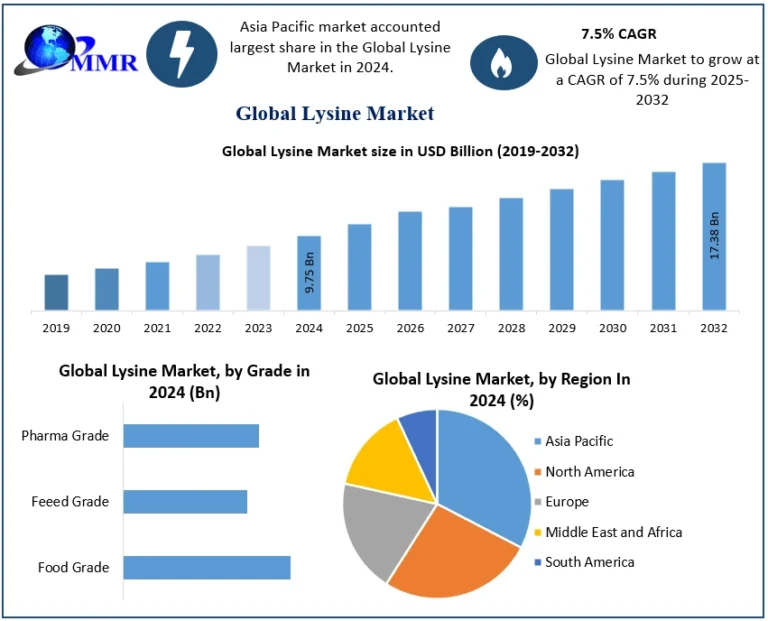
- The Lysine Market was valued at USD 9.75 billion in 2024.
- The market is projected to reach USD 17.38 billion by 2032.
- Revenue is expected to grow at a 7.5% CAGR from 2025 to 2032.
- Asia Pacific remained the leading regional market in 2024.
- China accounted for approximately 31% of global lysine consumption.
- Swine feed represented the largest livestock segment.
- Animal feed accounted for 92.5% of total application volume.
- Food and dietary supplements are gaining market share.
- Fermentation technology remains the primary production method.
- Rising global meat consumption continues to support long-term demand.
Why This Matters Now
Global livestock producers are under pressure to improve feed efficiency while reducing production costs and environmental impact. Lysine has become one of the most important feed amino acids because it enhances animal growth, improves protein utilization, and lowers nitrogen emissions. At the same time, growing interest in nutritional supplements and clinical nutrition is expanding lysine’s role beyond animal feed, creating new commercial opportunities across food and healthcare industries
Market Overview
Lysine Market Size is an essential amino acid that cannot be synthesized naturally by humans or animals and must be obtained through diet or supplementation. Commercially, lysine is primarily produced through microbial fermentation of sugar and is widely used in animal feed, dietary supplements, pharmaceuticals, and food fortification.
The market is primarily driven by expanding global meat production, increasing livestock populations, and growing demand for efficient feed formulations. Feed manufacturers increasingly use lysine to replace higher-cost protein ingredients such as soybean meal while maintaining animal growth performance and meat quality.
Supply dynamics remain influenced by raw material availability, fermentation capacity, and agricultural commodity prices. Feedstock shortages and government interventions may create temporary pricing pressures, encouraging manufacturers to invest in production optimization and capacity expansion.
Growing awareness of nutritional health, aging populations, and increasing sports nutrition consumption are also supporting demand for food-grade and pharmaceutical-grade lysine products.
Key Trends Driving Growth
Animal Feed Optimization
Livestock producers continue adopting amino acid-balanced feed formulations to improve feed conversion efficiency and reduce feeding costs.
Business impact: Feed manufacturers benefit from higher demand for precision nutrition ingredients that improve productivity.
Sustainable Livestock Production
Lysine reduces nitrogen excretion by improving protein utilization in animal diets, supporting more sustainable farming practices.
Business impact: Environmental regulations encourage wider adoption of amino acid supplementation across commercial livestock production.
Expansion of Food and Nutrition Applications
Health-conscious consumers increasingly seek amino acid supplements for muscle recovery, protein synthesis, and overall wellness.
Business impact: Food-grade lysine creates new revenue opportunities beyond traditional feed markets.
Advances in Fermentation Technology
Manufacturers continue investing in microbial fermentation technologies to improve production efficiency and reduce manufacturing costs.
Business impact: Higher production efficiency strengthens competitiveness while improving supply stability.
Feed Ingredient Cost Management
Volatile prices for soybean meal and other protein ingredients continue encouraging livestock producers to optimize amino acid supplementation.
Business impact: Lysine remains an economically attractive solution for reducing feed formulation costs.
Explore detailed analysis, insights, and growth opportunities
Segment Insights
Dominant Segment: Animal Feed
Animal feed remained the largest application, accounting for approximately 92.5% of total market volume.
Lysine improves feed conversion, accelerates weight gain, enhances meat quality, and reduces dependence on expensive protein ingredients. Increasing global consumption of pork, poultry, and other meat products continues supporting demand from commercial feed manufacturers.
Business impact: Feed-grade lysine producers benefit from recurring demand tied directly to global livestock production.
Fastest-Growing Segment: Swine Feed
The swine segment accounted for approximately 57.9% of livestock consumption and is expected to remain the fastest-growing livestock category.
Growing pork consumption, particularly across China and other Asian economies, continues increasing demand for lysine-enriched feed formulations that improve growth performance and feed efficiency.
Business impact: Rising pork production strengthens long-term demand for lysine while supporting expansion of commercial feed manufacturing.
Additional Key Sub-Segments
Poultry
Increasing global poultry consumption supports higher lysine usage for improved flock performance, meat quality, and feed efficiency.
Food & Dietary Supplements
Growing health awareness, sports nutrition demand, and aging populations continue driving expansion of food-grade lysine products.
Pharmaceuticals
Pharmaceutical-grade lysine remains an important ingredient in nutritional formulations supporting collagen production and calcium absorption.
Lysine Hydrochloride
Lysine hydrochloride continues representing the most widely used commercial form due to high purity, stability, and broad application across feed industries.
Regional Growth Story
Asia Pacific
Asia Pacific dominated the global Lysine Market in 2024.
China remained the world’s largest consumer, accounting for approximately 31% of global demand. Strong livestock production, expanding meat consumption, and large-scale feed manufacturing continue supporting regional leadership.
Growing investments in fermentation capacity and feed production strengthen Asia Pacific’s competitive advantage.
North America
North America maintains strong demand due to advanced commercial livestock operations and widespread adoption of amino acid-balanced feed formulations.
Feed efficiency and sustainable livestock production remain major industry priorities.
Europe
Europe represents a mature market where environmental regulations encourage precision nutrition and reduced nitrogen emissions through optimized amino acid supplementation.
Demand remains supported by commercial poultry and swine production.
Latin America
Brazil continues serving as one of the world’s largest feed producers, supporting increasing lysine consumption across poultry and cattle production.
Although short-term feed production fluctuations may influence demand, long-term export growth continues strengthening regional opportunities.
Competitive Landscape
The Lysine Market remains highly competitive, with major global manufacturers competing through production scale, fermentation technology, integrated supply chains, and cost-efficient manufacturing.
Archer Daniels Midland (ADM) and Evonik Industries leverage global feed ingredient portfolios and extensive distribution networks to maintain strong market positions.
Leading Asian manufacturers including Meihua Group, COFCO Biochemical, Changchun Dacheng, Global Bio-Chem Tech, Cheil Jedang Corp., Juneng Golden Corn Co., Sunrise Nutrachem Group, and Eppen continue expanding production capacity to meet growing international demand.
Companies such as KYOWA HAKKO BIO CO., LTD., Penta Manufacturing Company, Bajaj Healthcare Ltd., Chenfu Group, Easthope, and BANGYE Inc. focus on specialty amino acid production and regional market expansion.
Competition is increasingly centered on fermentation efficiency, production economics, product quality, and supply reliability rather than pricing alone.
Recent Developments
- Manufacturers increased investment in microbial fermentation technologies to improve lysine production efficiency.
- Producers expanded manufacturing capacity to address growing demand from global animal feed industries.
- Industry participants increased research and development to optimize production costs and strengthen supply security.
- Companies expanded food-grade and pharmaceutical-grade lysine portfolios to diversify beyond traditional feed applications.
Future Outlook
Manufacturers that combine large-scale fermentation capacity, cost-efficient production, and diversified food and feed applications will be best positioned to capture long-term growth as global demand for sustainable animal nutrition and high-value amino acid ingredients continues to expand.
Analyst Perspective – Siddhi Dole
The Lysine Market is entering a phase where efficiency, sustainability, and food security are becoming the primary growth drivers rather than livestock expansion alone. As producers face increasing pressure to improve feed conversion ratios while reducing production costs and environmental impact, lysine is evolving from a conventional feed additive into a strategic nutritional ingredient for modern livestock production. Its ability to enhance protein utilization and reduce nitrogen excretion aligns with global efforts to improve the sustainability of meat production.
About Maximize Market Research
Maximize Market Research Pvt. Ltd. (MMR) is a global market research and consulting company that provides reliable, data-focused, and practical business insights. The firm serves a wide range of industries, including healthcare, pharmaceuticals, technology, automotive, electronics, chemicals, personal care, and consumer goods. Through market forecasts, competitive analysis, strategic consulting, and industry impact assessments, MMR helps organizations understand changing market conditions, identify growth opportunities, and make informed business decisions for long-term success.
Contact Us :
2nd Floor, Navale IT Park Phase 3
Pune Banglore Highway, Narhe
Pune, Maharashtra 411041, India
+91 9607365656
sales@maximizemarketresearch.com
