Fill Finish Manufacturing Market: Advancing Biopharmaceutical Production Through Precision and Automation
The Fill Finish Manufacturing Market has become a vital component of the global pharmaceutical and biotechnology industry. Fill finish manufacturing refers to the final stage of drug production, where sterile pharmaceutical products are filled into vials, syringes, cartridges, or ampoules and then sealed for distribution. This critical process ensures product sterility, dosage accuracy, and regulatory compliance, making it essential for the safe delivery of injectable drugs, vaccines, biologics, and other sterile therapeutics.
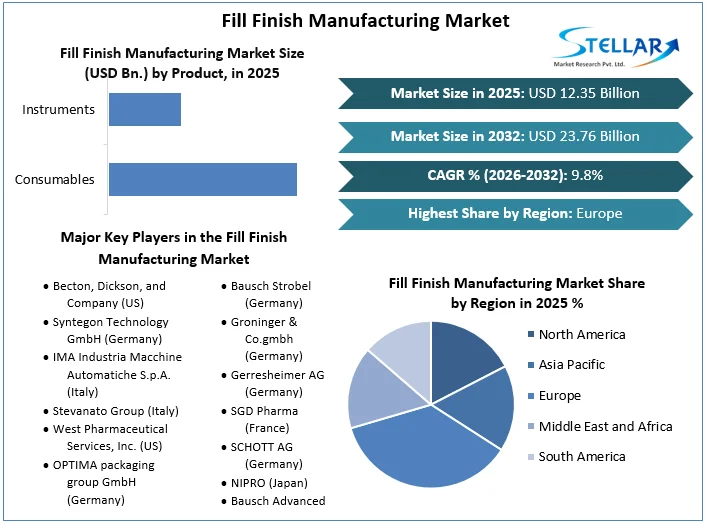
Fill Finish Manufacturing Market was valued at USD 12.35 billion in 2025. Global Fill Finish Manufacturing Market size is estimated to grow at a CAGR of 9.8 % over the forecast period.
The growing prevalence of chronic diseases, increasing demand for biologics and biosimilars, and rapid advancements in vaccine development are driving significant investments in fill finish manufacturing capabilities worldwide. Pharmaceutical companies are expanding production facilities, adopting automated aseptic technologies, and partnering with contract development and manufacturing organizations (CDMOs) to meet rising global demand. As precision, speed, and quality become increasingly important in drug manufacturing, the fill finish manufacturing market is expected to witness sustained growth in the coming years.
Download Free PDF Brochure: https://www.stellarmr.com/report/req_sample/Fill-Finish-Manufacturing-Market/937
Rising Demand for Biologics and Injectable Therapies
One of the primary factors fueling the fill finish manufacturing market is the growing demand for biologics and injectable medicines. Biopharmaceutical products, including monoclonal antibodies, cell and gene therapies, and recombinant proteins, require highly controlled sterile manufacturing processes to maintain product integrity and patient safety.
The increasing incidence of cancer, autoimmune disorders, diabetes, and infectious diseases has accelerated the development of injectable therapies that require sophisticated fill finish solutions. Additionally, the aging global population and greater access to advanced healthcare treatments continue to expand the demand for sterile pharmaceutical products.
Biopharmaceutical companies are investing heavily in manufacturing infrastructure to support expanding product pipelines while ensuring compliance with stringent quality standards.
Automation Transforming Fill Finish Operations
Automation has become a defining trend in modern fill finish manufacturing. Traditional manual processes are gradually being replaced by advanced automated systems that improve efficiency, reduce contamination risks, and enhance production consistency.
Robotic filling systems, automated inspection equipment, real-time monitoring technologies, and digital manufacturing platforms enable pharmaceutical companies to achieve greater operational precision while minimizing human intervention. These technologies improve productivity, reduce manufacturing errors, and support compliance with Good Manufacturing Practice (GMP) regulations.
The integration of artificial intelligence, machine learning, and predictive maintenance solutions is further enhancing manufacturing performance by optimizing equipment utilization and minimizing production downtime.
Expansion of Contract Manufacturing Services
The rapid growth of the pharmaceutical outsourcing industry has created substantial opportunities for contract development and manufacturing organizations (CDMOs). Many pharmaceutical companies prefer outsourcing fill finish operations to specialized service providers with advanced sterile manufacturing expertise and regulatory capabilities.
CDMOs offer flexible production capacity, faster commercialization timelines, and access to cutting-edge manufacturing technologies without requiring significant capital investment from pharmaceutical companies. This outsourcing trend has become particularly important for small and mid-sized biotechnology firms developing innovative therapies.
The increasing number of strategic collaborations between pharmaceutical manufacturers and CDMOs is expected to remain a major driver of market expansion.
Growing Importance of Aseptic Processing
Sterility remains one of the most critical requirements in fill finish manufacturing. Injectable pharmaceutical products must be manufactured under highly controlled aseptic conditions to prevent microbial contamination and ensure patient safety.
Advanced aseptic filling technologies, isolator systems, restricted access barrier systems (RABS), and automated environmental monitoring solutions have significantly improved manufacturing reliability. These technologies reduce operator intervention while maintaining sterile production environments throughout the manufacturing process.
As regulatory authorities continue strengthening quality requirements, pharmaceutical manufacturers are investing in next-generation aseptic processing equipment to meet evolving compliance standards.
Technological Innovations Supporting Market Growth
Continuous technological innovation is reshaping the fill finish manufacturing landscape. Single-use technologies have gained widespread adoption due to their flexibility, reduced cleaning requirements, and lower risk of cross-contamination. Disposable tubing, bags, connectors, and filling components simplify production while reducing operational costs.
Advanced visual inspection systems using artificial intelligence can automatically detect container defects, particulate contamination, and sealing irregularities with greater accuracy than traditional manual inspection methods. Digital manufacturing platforms also enable real-time process monitoring, electronic batch records, and predictive quality management.
These innovations help pharmaceutical companies improve production efficiency while maintaining the highest standards of product quality.
Regional Market Insights
North America remains a leading market for fill finish manufacturing due to its strong pharmaceutical industry, advanced biotechnology research, and extensive investments in manufacturing infrastructure. The region benefits from established regulatory frameworks, significant research funding, and the presence of major pharmaceutical companies.
Europe continues to demonstrate steady growth, supported by expanding biologics production, favorable regulatory initiatives, and increasing demand for biosimilars. Countries such as Germany, Switzerland, and Ireland have become important hubs for pharmaceutical manufacturing and contract production services.
The Asia-Pacific region is emerging as one of the fastest-growing markets due to increasing pharmaceutical investments, expanding healthcare infrastructure, skilled manufacturing workforces, and supportive government initiatives. Countries including China, India, South Korea, and Singapore are attracting substantial investments in sterile manufacturing facilities and CDMO operations.
Latin America and the Middle East are also gradually strengthening their pharmaceutical manufacturing capabilities to improve regional healthcare security and reduce dependence on imported medicines.
Challenges Facing the Market
Despite strong growth prospects, the fill finish manufacturing market faces several operational and regulatory challenges. High capital investment requirements for sterile production facilities, specialized equipment, and quality control systems can limit market entry for smaller manufacturers.
Regulatory compliance remains another significant challenge. Pharmaceutical companies must adhere to strict GMP guidelines, validation procedures, and international regulatory standards throughout the manufacturing process. Failure to meet these requirements can result in costly production delays or product recalls.
Additionally, supply chain disruptions affecting pharmaceutical-grade glass vials, rubber stoppers, filters, and other critical components may impact production schedules and increase manufacturing costs.
Competitive Landscape
- Becton, Dickson, and Company (US)
- Syntegon Technology GmbH (Germany)
- IMA Industria Macchine Automatiche S.p.A. (Italy)
- Stevanato Group (Italy)
- West Pharmaceutical Services, Inc. (US)
- OPTIMA packaging group GmbH (Germany)
- Bausch Strobel (Germany)
- Groninger & Co.gmbh (Germany)
- Gerresheimer AG (Germany)
Download Free PDF Brochure: https://www.stellarmr.com/report/req_sample/Fill-Finish-Manufacturing-Market/937
Future Outlook
The future of the fill finish manufacturing market is expected to be shaped by continued growth in biologics, personalized medicine, cell and gene therapies, and vaccine production. Increasing automation, artificial intelligence, digital manufacturing technologies, and single-use systems will continue transforming sterile pharmaceutical manufacturing.
As pharmaceutical companies seek greater flexibility, efficiency, and regulatory compliance, demand for advanced fill finish solutions is likely to accelerate. The expanding role of CDMOs, combined with ongoing investments in manufacturing infrastructure and process innovation, will create new opportunities across global markets.
Conclusion
The fill finish manufacturing market plays a critical role in ensuring the safe, efficient, and reliable production of sterile pharmaceutical products. Rising demand for injectable therapies, rapid advancements in biologics, increased pharmaceutical outsourcing, and continuous technological innovation are driving sustained market growth. While regulatory complexities, high capital investments, and supply chain challenges remain, ongoing investments in automation, aseptic processing, and digital manufacturing are strengthening industry capabilities. As healthcare systems continue to evolve and demand for advanced therapies rises, fill finish manufacturing will remain an indispensable pillar of the global pharmaceutical supply chain.
