Key Highlights
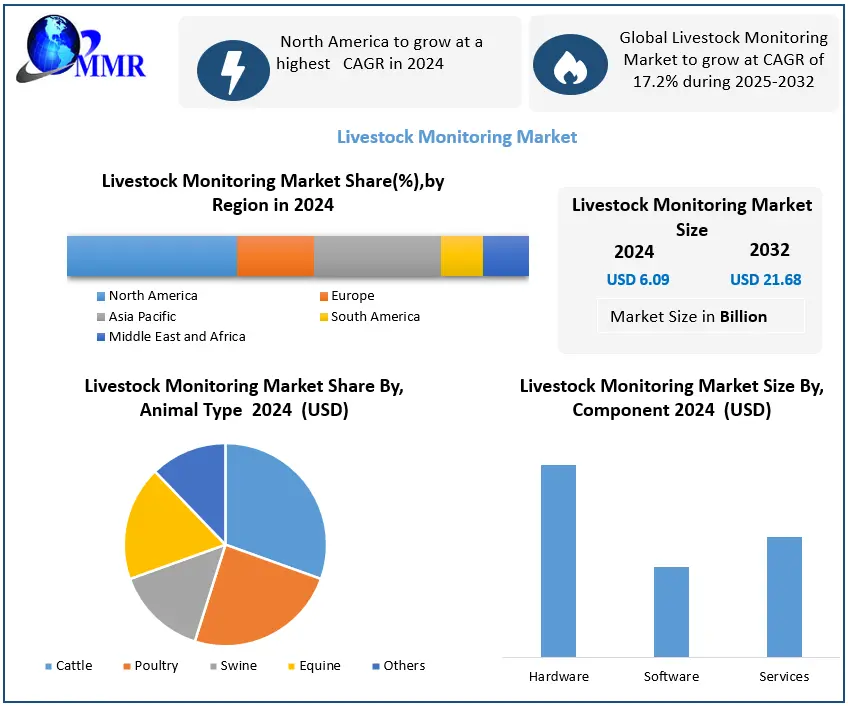
- The Livestock Monitoring Market was valued at USD 6.09 Bn in 2024 and is expected to reach nearly USD 21.68 Bn by 2032, creating a strong electronics opportunity across sensors, RFID, GPS and farm automation systems.
- The market is forecast to grow at a 17.2% CAGR from 2025 to 2032, making livestock monitoring a high-growth smart agriculture technology market.
- Cattle dominated by animal type in 2024 and is expected to hold the largest share during the forecast period, making dairy and beef operations the core demand base.
- Hardware dominated by component in 2024, supported by RFID tags, GPS devices, smart collars and automated milking systems.
- North America is expected to hold the highest share, led by advanced livestock farming operations, cattle and poultry monitoring demand, and precision farming adoption.
Why This Matters Now
Livestock farming is becoming a sensor network. Animal health, feed efficiency, reproductive cycles and location data are moving from manual records into AI, RFID, GPS and cloud platforms.
That shift makes livestock monitoring a semiconductor-linked agriculture market. The value pool is no longer only farm equipment; it now includes wearable sensors, smart collars, cameras, monitors, RFID tags, GPS systems, satellite devices and analytics platforms that convert farm activity into operating data.
Market Overview
Livestock monitoring is the systematic observation, tracking and management of animals raised for agriculture, including cattle, poultry, swine and other livestock. The technology stack includes sensors, GPS, RFID and data analytics to collect real-time information on animal health, behavior, location and welfare.
The Livestock Monitoring Market is segmented by animal type, component, offering technology, application and end use. Applications include milk harvesting management, heat detection monitoring, feeding management, heat stress management, health monitoring management, and sorting and weighing management.
For electronics and semiconductor suppliers, the disclosed demand drivers are IoT sensors, RFID tags, GPS devices, wearable sensors, cameras, monitors, satellite devices, cloud systems and AI analytics. The public page does not disclose foundry investments, advanced packaging, chiplet architecture, HBM, chip manufacturing capacity expansion, display technology developments, memory or logic chip trends.
Key Trends Driving Growth
AI and IoT are the first growth engine. Allflex and Quantified AG use IoT-based sensors to track animal health and behavior in real time, while Connecterra uses AI-powered analytics to provide actionable insights for farm management.
Precision livestock farming is the second structural shift. HerdX is cited for using data analytics and monitoring tools to improve efficiency and reduce costs, while the broader market is moving toward data-driven decision-making in farm operations.
Health and welfare pressure is raising adoption. SCR Dairy and Vital Herd provide wearable devices with sensors to monitor vital parameters, helping farms prevent diseases and improve herd health.
Remote management is becoming a buying requirement. Afimilk offers cloud-based solutions for remote monitoring, giving farm operators access to livestock data without being physically present at every asset location.
Sustainability is also entering the market. Monitoring systems track environmental factors and support eco-friendly practices, while Moocall is cited for breeding solutions aligned with sustainable farming demand.
The main restraint is adoption cost. Smaller farms face high upfront expenses for IoT sensors, RFID tags, GPS systems, cameras, monitors and satellite devices, while rural internet limitations, data privacy concerns, skills gaps, interoperability issues and resistance to change slow deployment.
Request a Free Sample Report for Comprehensive Market Insights
Segment Insights
- Dominant Segment Cattle: Cattle dominated by animal type in 2024 and is expected to hold the largest share during the forecast period. Monitoring applications focus on health tracking and reproductive management, with wearable sensors and RFID tags supporting early disease detection and breeding efficiency.
- Dominant Component Hardware: Hardware dominated in 2024 because RFID tags, GPS devices, smart collars and automated milking systems are primary tools for real-time animal tracking, health monitoring and feeding management.
- Fastest-Growing Segment: The public MMR page does not identify a fastest-growing animal type, component, offering technology, application or end-use segment with a usable CAGR. No fastest-growing segment is inferred.
- Technology Scope RFID, GPS and Sensors: The market covers RFID, GPS, sensors and other technologies. These technologies form the electronics layer behind animal identification, location tracking, health alerts and productivity analytics.
- End-Use Scope Dairy, Meat, Small and Large Farms: Dairy farms, meat production farms, small farms or household farms, and large commercial farms are included, but end-use shares are not disclosed.
Regional Growth Story
North America dominated in 2022 and is expected to continue its dominance during the forecast period. The United States supports growth through advanced technology infrastructure and large livestock operations, with demand concentrated in cattle and poultry monitoring.
Canada is also a significant producer, using monitoring technologies in dairy and swine farming to optimize feed management and environmental monitoring. North America also exports monitoring technologies and systems to emerging economies, giving regional suppliers a strategic international growth channel.
Asia Pacific and Africa are identified as developing-region expansion opportunities. The public page states that growing awareness and investment in these regions are increasing demand for advanced monitoring solutions, but it does not disclose country-level revenues for China, Japan, South Korea, India or Taiwan.
Europe matters because regulatory standards support adoption. EU rules on animal identification and traceability are cited as drivers that support compliance and food safety, making livestock monitoring part of regulated supply-chain transparency.
Competitive Landscape
Key players include Afimilk, Connecterra, Cainthus, SmartShepherd, Quantified AG, GEA Farm Technologies, DeLaval, BouMatic, Merck Animal Health, Dairymaster, Lely International, Fullwood Packo, Nedap, GEA Group, Sensaphone and Fancom. The competitive base spans dairy automation, RFID, AI analytics, wearable sensors and precision farming systems.
DeLaval’s advanced milking robots use sensors to monitor milk quality and cow health. That signals competition around automation depth, not only monitoring dashboards.
Allflex’s RFID-based livestock identification and health monitoring systems show the importance of traceability infrastructure. Afimilk’s data-driven dairy herd management and Trimble’s GPS-enabled livestock tracking show that market leadership requires hardware, analytics and farm workflow integration.
Cainthus uses computer vision and AI for livestock behavior monitoring, while Connecterra uses AI analytics for productivity and resource optimization. No named fab investment, acquisition, semiconductor packaging breakthrough, chip capacity expansion or HBM development is disclosed on the public page.
Recent Developments
- DeLaval Milking Robots: DeLaval introduced advanced milking robots equipped with sensors for monitoring milk quality and cow health, signaling tighter integration between automation and herd intelligence.
- Allflex RFID Systems: Allflex Livestock Intelligence provides RFID-based solutions for livestock identification and health monitoring, strengthening traceability and individual animal management.
- Afimilk and Trimble Systems: Afimilk’s data-driven dairy herd management and Trimble’s GPS-enabled livestock tracking systems show rising demand for location-aware and analytics-led farm operations.
- AI and Robotics: Cainthus applies computer vision and AI to livestock behavior monitoring, while Lely’s robotic milking systems show how automation can raise livestock-management efficiency.
Strategic Implications
For semiconductor suppliers, livestock monitoring creates demand for low-power sensors, RFID chips, GPS modules, wireless connectivity, cameras, edge devices and data-processing systems. The page does not quantify chip content, so the opportunity should be read as system-level electronics demand rather than a disclosed wafer-demand forecast.
For farm operators, the business case is productivity and risk control. Health alerts, feeding insights, heat detection, location tracking and reproductive monitoring can reduce disease losses and improve herd management.
For investors, the market offers exposure to AI farming, IoT hardware, cloud analytics, animal welfare compliance and food traceability. The constraint is scalability: smaller farms in emerging economies may delay adoption because of upfront costs, infrastructure gaps and limited technical capability.
Future Outlook
The Livestock Monitoring Market is forecast to grow from USD 6.09 Bn in 2024 to nearly USD 21.68 Bn by 2032 at a 17.2% CAGR. Growth will come from cattle monitoring, hardware adoption, RFID, GPS, sensors, AI analytics, cloud platforms, robotic systems, disease prevention and traceability compliance.
The next phase will test whether suppliers can reduce device cost and make farm data usable across fragmented operations. Future technology leaders will control the AI-enabled sensor layer behind precision livestock farming; laggards will remain hardware vendors in a market increasingly defined by data, automation and animal-level intelligence.
Analyst Perspective
“Livestock monitoring is becoming a high-growth electronics and AI market as farms move from manual observation to sensor-driven animal intelligence,” said Rucha Deshpande, Analyst at Maximize Market Research. “The strongest suppliers will combine RFID, GPS, wearable sensors, cloud analytics, AI insights and farm-ready automation into scalable livestock-management platforms.”
About Maximize Market Research
Maximize Market Research Pvt. Ltd. (MMR) is a global market research and consulting company that provides reliable, data-focused, and practical business insights. The firm serves a wide range of industries, including healthcare, pharmaceuticals, technology, automotive, electronics, chemicals, personal care, and consumer goods. Through market forecasts, competitive analysis, strategic consulting, and industry impact assessments, MMR helps organizations understand changing market conditions, identify growth opportunities, and make informed business decisions for long-term success.
Contact Us
2nd Floor, Navale IT Park Phase 3
Pune Banglore Highway, Narhe
Pune, Maharashtra 411041, India
+91 9607365656
sales@maximizemarketresearch.com
