Key Highlights
- Semiconductor interface design is moving from visual response to physical sensation as smartphones, VR systems, cars and surgical robots demand touch feedback. Haptic technology turns electronic interaction into tactile experience, creating demand for actuators, sensors, driver ICs and software algorithms.
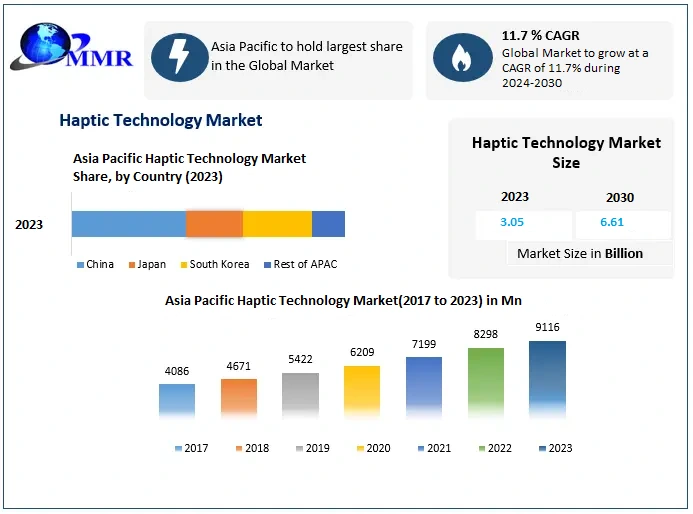
- The Haptic Technology Market was valued at USD 3.05 Bn in 2023 and is expected to reach USD 6.61 Bn by 2030, giving electronics suppliers a defined growth market tied to immersive digital interaction.
- The market is forecast to grow at an 11.7% CAGR from 2024 to 2030, making haptic feedback a strategic layer across consumer electronics, automotive, gaming, healthcare and education.
- Vibration feedback dominated in 2023 because it is widely used in smartphones, gaming controllers and wearables, and is more cost-effective than force or tactile feedback.
- Asia Pacific dominated in 2023 and is expected to hold the largest share, supported by consumer electronics, gaming, automotive, healthcare technology and 5G rollout.
Why This Matters Now
Haptics is becoming the missing interface layer for next-generation computing. Screens, voice and cameras are not enough for immersive VR, safer automotive controls, remote robotics and medical simulation.
That creates a strategic opening for electronics and semiconductor suppliers. MMR identifies innovations in actuators, sensors and software algorithms as likely to produce more sophisticated and realistic tactile feedback during the forecast period, shifting value from basic vibration motors to integrated haptic systems.
Market Overview
Haptic technology simulates the sensation of touching a physical object, such as pressing a touchscreen button or feeling the texture of a virtual surface. It is used in smartphone screens, gaming controllers, virtual reality, augmented reality, medical training simulations and remote machine-control systems.
The Haptic Technology Market is segmented by component into hardware and software; by feedback type into tactile, force and vibration feedback; by application into consumer electronics, automotive, gaming and entertainment, medical and healthcare, and education and research; and by technology into resistive haptics, capacitive haptics, piezoelectric haptics and linear resonant actuators.
The public page contains a labeling inconsistency: the top panel lists USD 3.05 Bn as forecast market size, while the overview and scope table state USD 3.05 Bn in 2023 and USD 6.61 Bn by 2030. This article uses the overview and scope table figures because they match the supplied market-size statement.
Key Trends Driving Growth
Enhanced user experience is the core driver. Haptics adds a tactile dimension to digital interaction, allowing users to feel virtual objects, textures and forces, which improves engagement in gaming, smartphones, VR and AR.
Automotive interfaces are becoming a major adoption lane. Haptic feedback is integrated into infotainment systems, touchscreens and steering wheels, helping drivers and passengers interact with in-car controls while reducing distraction.
Healthcare is turning haptics into a safety technology. Medical training simulations and surgical robotics use tactile and force feedback to let professionals practice procedures and control minimally invasive systems with higher precision.
Remote operations are widening the industrial use case. Haptic technology is employed in remote-control systems for machines and robots, allowing operators to feel and control remote environments with greater precision.
The main constraints are cost, power use, miniaturization and standards. MMR states that sophisticated haptic systems are expensive, power-intensive in portable devices, difficult to miniaturize and affected by lack of universal standards, which can create platform fragmentation.
Request a Free Sample Report for Comprehensive Market Insights
Segment Insights
- Dominant Segment Vibration Feedback: Vibration feedback dominated in 2023 and is expected to hold the largest share. Its lead comes from wide use in smartphones, gaming controllers and wearables, plus lower implementation cost compared with more complex force or tactile systems.
- Dominant Application Consumer Electronics: Consumer electronics dominated in 2023 and is expected to hold the largest share. Smartphones, gaming consoles, controllers, peripherals and home appliances use haptic feedback to make interfaces more intuitive and engaging.
- Fastest-Growing Segment: The public MMR page does not identify a fastest-growing component, feedback type, application or technology segment with a usable CAGR comparison. Software is stated to grow at 3.8% CAGR, but the page does not label it as fastest-growing.
- Component Signal Software: Haptic software regulates haptic exposure in real time and generates command signals that driver ICs use to operate devices. That makes software critical to high-quality interactions, diagnostics, regulatory compliance and safety-sensitive applications.
- Technology Scope Piezoelectric and LRAs: The market includes resistive haptics, capacitive haptics, piezoelectric haptics and LRAs, but the public page does not disclose their individual shares or growth rates.
Regional Growth Story
Asia Pacific dominated in 2023 and is expected to hold the largest share during the forecast period. The region benefits from rapid technological advancement, a large consumer electronics industry and rising adoption of immersive experiences in gaming, automotive and other sectors.
The region is also building industrial and healthcare demand. Manufacturing operations are adopting haptic feedback for remote machinery and robotics, while healthcare systems use haptics in medical training simulations and surgical robotics.
5G rollout strengthens the regional case. MMR states that 5G networks in several Asia Pacific countries support faster and more reliable connectivity, which can enable real-time haptic feedback and remote haptic experiences.
The report covers China, South Korea, Japan, India, Australia, Indonesia, Malaysia, Vietnam, Taiwan, Bangladesh and Pakistan in Asia Pacific; the United States, Canada and Mexico in North America; and Germany, the UK, France, Italy, Spain, Sweden and Austria in Europe. Country-level revenue, semiconductor incentives, export dynamics, foundry investment and chip capacity data are not disclosed.
Competitive Landscape
Key players include Immersion Corporation, Tanvas, HaptX, Texas Instruments, Boréas Technologies, Ultraleap, Novasentis, 3D Systems, Precision Microdrives, Force Dimension, Digital Catapult, Nidec, Alps Alpine, ON Semiconductor, Microchip Technology and Johnson Electric. This base spans IP, actuators, semiconductor components, software and immersive-interface systems.
Companies are collaborating with device manufacturers, gaming companies and automotive manufacturers to integrate haptic solutions into broader products. That signals a platform-driven market where component suppliers must win design-ins inside smartphones, controllers, cars, VR systems and medical devices.
Immersion, Ultraleap and HaptX are cited for innovation in touch and force feedback. Their activity signals a market moving beyond simple vibration into higher-fidelity tactile systems that can command stronger pricing in professional, gaming and training applications.
MMR cites Maxim Integrated’s acquisition by Analog Devices as an example of M&A reshaping the competitive landscape by expanding power-management exposure, including haptic technology. The public page does not disclose foundry investments, advanced-packaging breakthroughs, chiplet roadmaps, HBM activity or chip-capacity expansions.
Recent Developments
- M&A Activity: Maxim Integrated was acquired by Analog Devices, expanding Analog Devices’ portfolio in power management, including exposure to haptic technology.
- Partnership Model: Haptic technology companies are collaborating with device, gaming and automotive manufacturers to integrate touch feedback into end products.
- Startup Activity: The market continues to attract startups and emerging companies with new haptic solutions, increasing competition and technical experimentation.
- Innovation Pipeline: Advances in haptic actuators, sensors, feedback mechanisms and software algorithms are improving precision, realism and adoption across applications.
Strategic Implications
For semiconductor suppliers, haptics creates demand for driver ICs, sensors, power-management devices, actuator-control electronics and embedded software support. The public page does not quantify semiconductor content, so the opportunity should be read as interface-system demand rather than a disclosed wafer-capacity forecast.
For OEMs, haptics is becoming a differentiation layer. Consumer devices, car interiors, surgical robots and VR systems can use tactile feedback to improve usability, safety and realism.
For investors, the market offers exposure to immersive computing, automotive interfaces, healthcare simulation, gaming and industrial robotics. The key risks are cost, battery drain, lack of standards, limited haptic-enhanced content and supply-chain disruption affecting haptic components.
Future Outlook
The Haptic Technology Market is forecast to grow from USD 3.05 Bn in 2023 to USD 6.61 Bn by 2030 at an 11.7% CAGR. Growth will come from consumer electronics, VR and AR, gaming controllers, automotive touchscreens, steering wheels, medical simulation, surgical robotics, education, research and remote machine control.
The next phase will test whether suppliers can deliver realism without excessive cost, power consumption or device-space penalties. Future technology leaders will control the tactile interface stack behind immersive computing and safe machine control; laggards will remain trapped selling basic vibration components into a market moving toward high-fidelity touch.
Analyst Perspective
“Haptic technology is becoming a core electronics interface market as smartphones, gaming systems, VR platforms, vehicles and surgical robotics demand more realistic digital touch,” said Rucha Deshpande, Analyst at Maximize Market Research. “The strongest suppliers will combine actuator innovation, sensor precision, driver IC integration, software control and low-power design.”
About Maximize Market Research
Maximize Market Research Pvt. Ltd. (MMR) is a global market research and consulting company that provides reliable, data-focused, and practical business insights. The firm serves a wide range of industries, including healthcare, pharmaceuticals, technology, automotive, electronics, chemicals, personal care, and consumer goods. Through market forecasts, competitive analysis, strategic consulting, and industry impact assessments, MMR helps organizations understand changing market conditions, identify growth opportunities, and make informed business decisions for long-term success.
Contact Us
2nd Floor, Navale IT Park Phase 3
Pune Banglore Highway, Narhe
Pune, Maharashtra 411041, India
+91 9607365656
sales@maximizemarketresearch.com
