Proteases Market: Enzyme Innovation Accelerates Growth Across Food, Pharma, and Biotechnology Industries
The global Proteases Market is experiencing significant expansion as industries increasingly adopt enzyme-based solutions to improve processing efficiency, sustainability, and product performance. Proteases, also known as proteolytic enzymes, play a crucial role in breaking down proteins into peptides and amino acids, enabling their use across diverse industries including food and beverages, pharmaceuticals, healthcare, detergents, animal nutrition, biotechnology, and industrial processing.
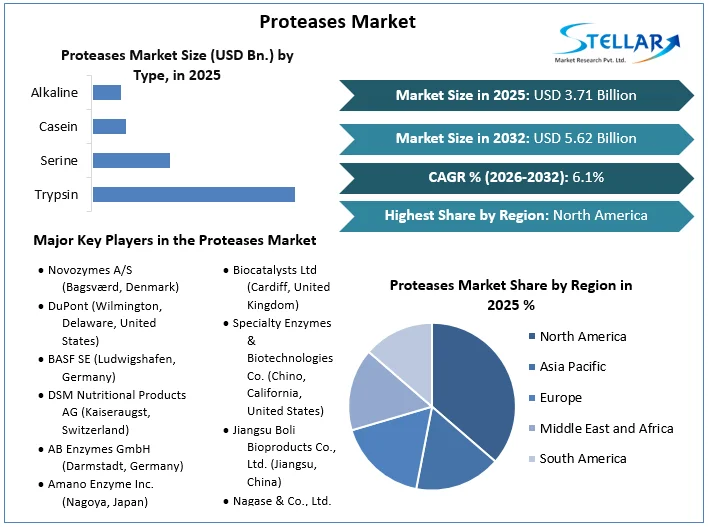
According to Stellar Market Research, the global Proteases Market was valued at USD 3.71 billion in 2025 and is projected to reach USD 5.62 billion by 2032, growing at a CAGR of 6.1% during 2026–2032. The market growth is being driven by increasing demand for sustainable enzyme-based solutions, expanding biotechnology applications, rising processed food consumption, and growing adoption of microbial proteases across industrial sectors.
Download Free PDF Brochure: https://www.stellarmr.com/report/req_sample/Proteases-Market/1952
Growing Industrial Adoption of Enzyme-Based Solutions
Proteases have become essential biological catalysts due to their ability to accelerate protein breakdown processes while reducing energy consumption and improving production efficiency. Industries are increasingly replacing conventional chemical processes with enzyme-based alternatives because of their environmental benefits, operational efficiency, and improved product quality.
In the food and beverage industry, proteases are widely used for meat tenderization, dairy processing, protein modification, brewing, and the production of nutritional ingredients. In pharmaceutical and biotechnology applications, these enzymes support drug development, protein analysis, therapeutic production, and diagnostic processes.
The increasing focus on sustainable manufacturing is encouraging companies across multiple industries to invest in enzyme technologies, creating long-term growth opportunities for the proteases market.
Microbial Proteases Drive Market Transformation
Among different sources of proteases, microbial proteases are gaining strong attention due to their scalability, cost-effectiveness, and adaptability to industrial applications. Microbial enzymes produced through fermentation processes offer consistent quality, high productivity, and improved stability compared with animal- and plant-derived alternatives.
Bacteria, fungi, and yeast-based proteases are increasingly preferred in food processing, detergent manufacturing, pharmaceuticals, and wastewater treatment applications. Their ability to function under different temperature and pH conditions makes them suitable for diverse industrial environments.
Advancements in genetic engineering and enzyme optimization are further improving microbial protease performance. Manufacturers are developing customized enzymes with enhanced activity, stability, and application-specific characteristics to meet evolving industry requirements.
Food and Beverage Industry Remains a Key Growth Engine
The food and beverage sector represents one of the largest application areas for proteases. Growing consumer demand for processed foods, protein-rich products, and functional nutrition is increasing the use of enzymes in food manufacturing.
Proteases are used in:
Dairy processing for cheese production and protein modification
Meat processing for tenderization
Bakery applications for improving dough quality
Beverage production for clarification and processing efficiency
Nutritional products for generating bioactive peptides
The rising popularity of high-protein diets and sports nutrition products is also creating new opportunities for protease manufacturers. Enzyme-based protein hydrolysis helps produce easily digestible protein ingredients used in supplements and functional foods.
Pharmaceutical and Biotechnology Applications Expand Opportunities
The pharmaceutical and biotechnology industries are becoming important contributors to protease market growth. Proteases are used in drug discovery, biopharmaceutical manufacturing, molecular research, and therapeutic applications.
Increasing investments in biotechnology research, personalized medicine, and advanced healthcare solutions are supporting demand for specialized enzymes. Proteases are also used in diagnostic applications and laboratory research due to their ability to modify and analyze protein structures.
The expansion of biologics production and biotechnology innovation is expected to create additional demand for high-quality protease solutions with improved precision and reliability.
Sustainability Trends Supporting Market Development
Sustainability has become a major factor influencing enzyme adoption across industries. Proteases offer environmentally friendly alternatives by reducing reliance on harsh chemicals, lowering energy consumption, and improving resource efficiency.
In detergent manufacturing, proteases help create efficient cleaning products that work effectively at lower temperatures, supporting energy conservation. In industrial waste management, enzymes contribute to biological processing methods that reduce environmental impact.
The growing emphasis on green chemistry and sustainable production practices is encouraging companies to invest in microbial and plant-based protease technologies.
Technological Advancements Enhancing Protease Performance
Innovation in enzyme engineering is transforming the proteases market. Companies are using advanced biotechnology techniques to develop enzymes with improved stability, activity, and application-specific performance.
Key technological trends include:
Genetic engineering of microbial strains
Precision fermentation technologies
Protein engineering and optimization
Advanced enzyme formulation techniques
Digital tools for enzyme discovery
These innovations enable manufacturers to develop specialized proteases designed for specific industrial requirements, improving efficiency and reducing production costs.
Market Segmentation Overview
The Proteases Market is segmented based on source, type, and end-user applications.
By Source
The market includes:
Plant-based proteases
Animal-based proteases
Microbial proteases
Microbial proteases are expected to dominate due to their scalability, cost advantages, and wide industrial applicability.
By Type
The market includes:
Trypsin
Serine proteases
Casein proteases
Alkaline proteases
Others
Serine proteases held a significant position due to their broad application across food processing, pharmaceuticals, and detergent industries.
By End User
Major application segments include:
Food and beverages
Pharmaceuticals and healthcare
Others
The food and beverage sector continues to represent a major demand center due to increasing adoption of enzyme-assisted processing.
Regional Market Insights
North America dominated the proteases market in 2025 due to strong biotechnology capabilities, advanced pharmaceutical research, and established food processing industries. The region benefits from significant investments in enzyme research and commercial-scale production technologies.
The United States remains a major contributor due to its strong pharmaceutical sector, biotechnology ecosystem, and increasing demand for sustainable industrial solutions.
Europe is another important market supported by advanced food manufacturing, environmental regulations, and increasing adoption of bio-based technologies. Countries such as Germany, France, and the United Kingdom are investing in sustainable enzyme applications.
Asia-Pacific is emerging as a high-growth region due to rapid industrialization, expanding food processing industries, rising healthcare investments, and increasing biotechnology capabilities. Countries including China, India, Japan, and South Korea are creating significant opportunities for enzyme manufacturers.
Challenges Affecting Market Growth
Despite strong growth prospects, the proteases market faces several challenges. High research and development costs associated with enzyme engineering and production optimization can impact profitability.
Regulatory requirements for food-grade and pharmaceutical-grade enzymes also create compliance challenges for manufacturers. Companies must meet strict safety and quality standards before introducing enzyme-based products into commercial markets.
Additionally, fluctuations in raw material availability and production costs may influence enzyme pricing and supply chain stability.
Competitive Landscape
The proteases market is highly competitive, with companies focusing on innovation, strategic partnerships, and portfolio expansion. Leading industry participants are investing in biotechnology research, sustainable enzyme production, and customized solutions for industrial customers.
Key players include Novozymes A/S , DSM, BASF SE, DuPont, and other specialized enzyme manufacturers. Companies are strengthening their positions through research collaborations, advanced fermentation technologies, and expansion into emerging markets.
Competitive strategies increasingly focus on developing environmentally friendly enzymes, improving production efficiency, and creating application-specific protease solutions.
Download Free PDF Brochure: https://www.stellarmr.com/report/req_sample/Proteases-Market/1952
Future Outlook
The future of the proteases market will be shaped by rising demand for sustainable processing technologies, biotechnology advancements, and expanding industrial applications. Growth in functional foods, pharmaceutical innovation, animal nutrition, and green manufacturing will continue creating new opportunities.
Microbial proteases, precision fermentation, and advanced enzyme engineering are expected to remain major trends influencing the industry. As companies seek cleaner, more efficient, and sustainable production methods, proteases will play an increasingly important role across global industries.
Conclusion
The Proteases Market is evolving rapidly as industries embrace enzyme-based solutions for improved efficiency, sustainability, and innovation. Growing demand from food processing, pharmaceuticals, biotechnology, and industrial applications is driving market expansion. While regulatory complexity and development costs remain challenges, advancements in microbial enzyme production and biotechnology are opening new growth opportunities. With increasing focus on sustainable manufacturing and high-performance biological solutions, proteases are expected to remain a critical component of future industrial transformation.
